You must log in or # to comment.
The only way that works is if all the oil execs are in ground zero.
I have a similar modest proposal to solving the wealth inequality hoarding problem of billionaires
Someone needs to work out the inheritance fallout. With our luck it will still fall within the same families, or the government.
I think y’all are missing the point here.
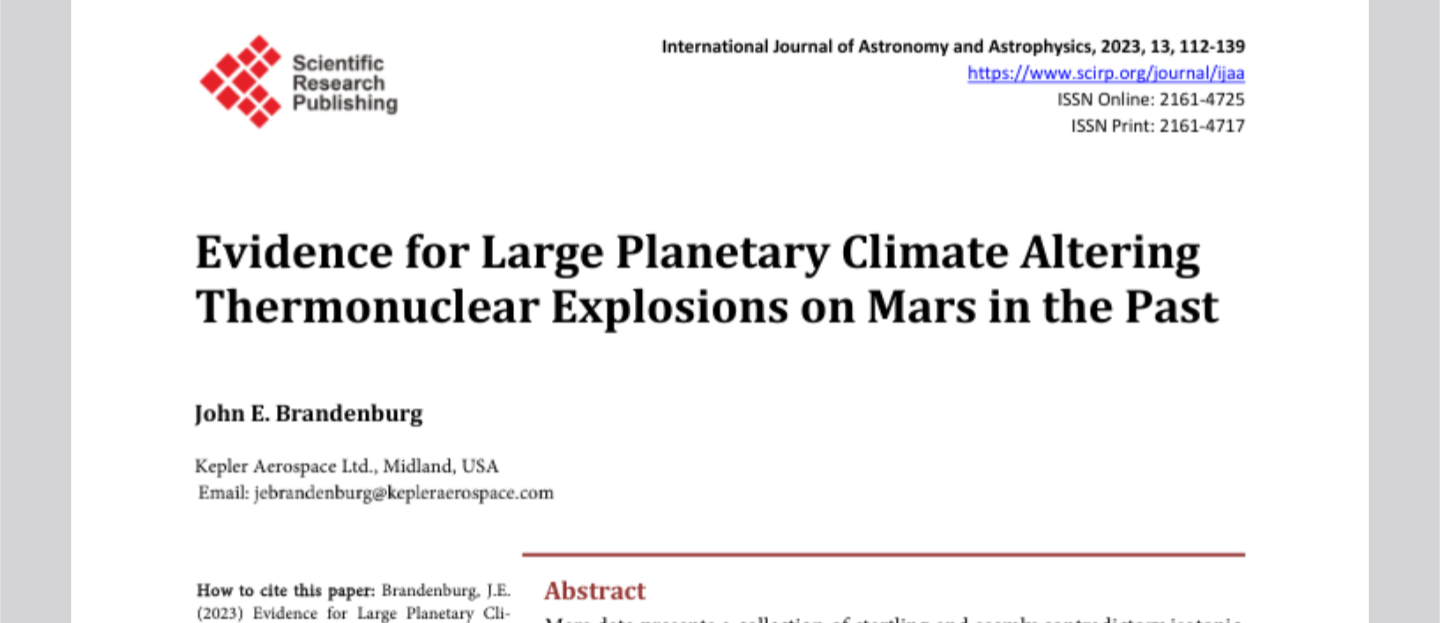
It’s really to justify the production and testing of an insanely large planet altering weapon that would create a really cool firework.
Actually, one of their feasibility assumptions is that the device is too large to be used militarily.
Ah. I suppose building an 81 gigaton nuclear weapon wouldn’t be small.
Let’s fire up the antimatter then!
I think they underestimate a military’s desire to use all of the things that go boom.
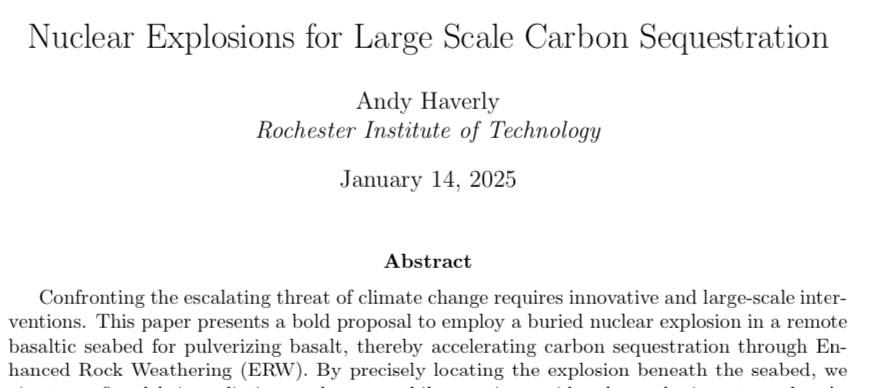
Seems half-baked. Well unbaked really. They make a shit ton of assumptions that I’m not sure are true.
For example, why do they assume 90% pulverization efficiency of the basalt? Or is that a number they just pulled out of their ass?
And does ERW work if the pulverized rock is in a big pile on the sea floor? Or would we have to dig the highly radioactive area up and spread it around the surface?
And does the radioactive water truly stay at the site of the explosion? Or will it be spread through the entire ocean via currents?
Cool concept but, like, maybe we should check the assumptions a little harder?
Some people would literally rather nuke the planet than take a train to work…
And does ERW work if the pulverized rock is in a big pile on the sea floor? Or would we have to dig the highly radioactive area up and spread it around the surface?
Yeah… Doesn’t the carbon sequestering happen from rain absorbing carbon in the atmosphere and then attaching to the rock to mineralize it? Something tells me 6-7 km of ocean might impede that process.
And does the radioactive water truly stay at the site of the explosion? Or will it be spread through the entire ocean via currents?
Dilution is the solution…ocean big?
Dilution was supposed to be the solution to the whole greenhouse gasses emissions, turns out atmosphere not … that big.
The ocean dissolves a large amount of CO2, which then, just like in the rain example, can react with minerals. It can react faster if there is more surface area of said minerals.
Do you know if Co2 that dissolves into water is less buoyant, or is it held in suspension? Or is this relying on the sediment being suspended in the ocean for a while before being deposited back on the ocean floor?
I am not sure if I understand you. Dissolved CO2 in water of like normal water. There is no crazy difference. If water can get to the rocks, so can the dissolved CO2.
There is no crazy difference. If water can get to the rocks, so can the dissolved CO2.
Oh, I was just pondering the efficiency. If Co2 is held in suspension and only the top layer of sediment is going to be exposed to the carbon in the water, and not to a degree of co2 more concentrated than normal.
Every bit that is in contact with water is also in contact with CO2.
I mean… if we’re being honest, the long-term effects of global thermonuclear war would be (very eventual) carbon sequestration in tens to hundreds of millions of years, and then we’ll renew our oil reserves! We of course won’t be around to use them, seeing as we’ll have been sequestered into the oil.
Can we get new oil actually? I thought we now have organisms that can break down every organic matter and thus it can not really accumulate anymore?
Oil actually comes from aquatic life (mostly plankton) that sinks to the sea floor and gets buried, squeezed and heated. Oil still forms today, but it’s a process of millions of years.
Coal is formed from plants, and that does indeed require something doesn’t eat it first. Swamps, for example, help a lot, letting the fallen trees sink down where most stuff can’t eat it. Peat can also form into coal. Coal forms even slower than oil though, and it’s much rarer, but it also doesn’t require an ocean, so it’s often more accessible for us land-living humans
Coal is much rarer than oil? I have to look that up, I always thought there is far more coal.
Nope, there is about 3x more coal than oil.
IIRC, all that coal comes from plant material from before there were microbes that can break down cellulose. Meaning that while it’s possible to regenerate oil over millions of years, coal cannot.
So yes, there may be more of it now, but when we burn it, it’s gone forever.
There’s an abiotic pathway that creates new oil geologically. It’s a very small amount.
The theory is popular in Russia, where it’s claimed to be the main way oil is produced. That’s complete bullshit. It turned out there is some, but not enough to matter.
If you squeeze a baby hard enough
Another cycle, another life. Same shithole planet.
Just spitballing here. These grand ideas good/bad practical/or not are the beginning of mankind learning how to geo engineer planets or moons. I’ll be long dead before I get proven right or wrong so it’s easy to spitball
Uh oh. What an apropos American way to go.
Gotta nuke somethin’.
Dare to dream.
The last time I checked, we don’t have a whole lot of climate solutions that feature the bomb. And I’d be doing myself a disservice… and every member of this species, if I didn’t nuke the HELL out of this!
I’m pulling for artificial diamonds. It’s the funniest solution: dumping truckloads of precious gemstones back down empty wells. Or burying them in the desert. Or I guess just handing them out for industrial uses, since even grinding them to dust isn’t the same problem as CO2. Have a free bucket of aquarium gravel, made out of worthless tacky gold.
Hey, if you can make diamond that easily, we can exchange a LOT of substances for it. Not just windows and glasses, but pretty much every ceramic object, insulators, but also just toilets (slap some paint on it and done).
Drop a plate, floor breaks.
I say we take off and nuke the entire site from orbit
It’s the only way to be sure
No more climate change if no more climate!
I feel like the podcast Behind The Bastards talked about this in the episode released today.
Did they talk about nuking the great lakes again?
No: this was about how the US Government considered underground nuking Alaska for the coal, killing cattle to check for cancer, and having people believe it was aliens. I was at work, so I may have missed a few points, but there was a discussion on power via turbine powered by nuclear weapon melted salt.
Re-naming all the Great Lakes to Lake America (with the easy to remember acronym “AAAAA!”) was one of the late night shows.
The point is that it’s a passive process, not an active one. No need for pumping.
Water is so much denser than air that you do get more exposure time per unit time.
I’ve got my fingers crossed for a Snowpiercer set up.
Well, I’m sure controlled slow-paced mining is more energy efficient and will emit less carbon to create…
But I’m not stopping that guy. Go on. I’ll just watch from a safe distance.
Going of the value in the paper and wikipedia it would take the energy used by all of humanity in two months.
You either spend a truckload of resources during decades to make a bomb that explodes releasing the same energy humanity spends in two months, or you spend a truckload of resources doing the end task at a slower pace for decades.
The later is guaranteed to require a smaller truckload.
Why is the second guaranteed to be smaller?
We know how nuclear bombs work. The majority of the energy comes from nuclear fusion, a highly exothermic process, that can (in the foreseeable future) only be used in bombs.
If we don’t need to drop the bomb, but rather assemble it in place, it can just use deuterium as a fusion fuel. Deuterium can be distilled from normal water for much less energy that it generates in fusion.Edit: mixed up fusion and fission in the first statement
The majority of the energy comes from nuclear fission
Yes, from an extremely inefficient fission reaction that can be improved by an order of magnitude by doing it slowly in a reactor.
Mixed up fission and fusion there, they sound so similar in English.
The comment talks about fusion.Most of the energy does not come from fusion.
It does in modern designs, the first time it happened was in 1952.
To quote Wikipedia:
The first thermonuclear weapon detonation, where the vast majority of the yield comes from fusion, was the 1952 Ivy Mike test of a liquid deuterium-fusing device.