Can’t believe nobody has linked the relevant xkcd yet
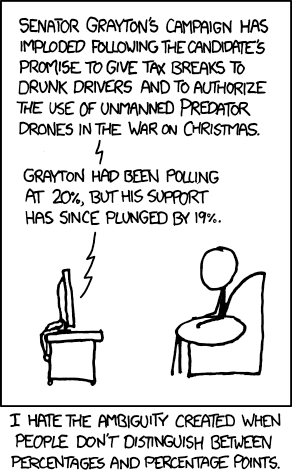
Which of course is why people referred to points when discussing stocks/markets. Got to love an unambiguous term.
🫡
In game design, it has to be stated whether it’s multiplicative or additive. Sometimes a logarithmic function is used as well, with increases in efficiency as 1 / ( 1 + bonus ). This allows you to always add more bonus, but there’s diminishing returns.
i wish it was more common to also indicate the precedence of a percentage increase, so that it’s easier to know if i’m dealing with (x + y ) * z or x + (y * z). although that’s admittedly a lot harder to communicate.
Just include a glossary of formulas for figuring out stats/chances/whatever in your game. With clearly labeled variables. Then throw a reference to that glossary in your tooltips/helpful popups.
Wouldn’t it be easier for everyone to instead not add such systems? After all, don’t many go for the simple logic of bigger number is better instead of doing the math?
Funny thing is this is a language issue, not a math issue.
Why not both?
I’ve always thought of math as a language and I talk to my kids about it that way too. Math is an other way to describe the world.
It’s very different from spoken languages and translating between the two needs to be learned and practiced.
Our math education doesn’t include enough word problems and it should be bi-directional. In addition to teaching students how to write equations based of sentences we should teach them how to describe what’s going on in an equation.
Yeah, it is kinda both in general. Though in this case, the math about this is well-defined: it’s possible to increase a percentage either with addition or multiplication and both of those can make sense, just the words we would use to describe them are the same so it ends up ambiguous when you try going from math to English or vice versa.
But the fact that switching between communication language and a formal language/system like math isn’t clear cut does throw a bit of a wrench in the “math doesn’t lie”. It’s pretty well-established that statistics can be made to imply many different things, even contradictory things, depending on how they are measured and communicated.
This can apply to science more generally, too, because the scientific process depends on hypotheses expressed in communication language, experiments that rely on interpretation of the hypothesis, and conclusions that add another layer of interpretation on the whole thing. Science doesn’t lie but humans can make mistakes when trying to do science. And it’s also pretty well established that science media can often claim things that even the scientists it’s trying to report on will disagree strongly with.
Though I will clarify that the “both” part is just on the translation. Formal systems like math are intended to be explicit about what they say. If you prove something in math, it’s as true as anything else is in that system, assuming you didn’t make a mistake in the proof.
Though even in a formal system, not everything that is true is provable, and it is still possible to express paradoxes (though I’d be surprised if it was possible to prove a paradox… And it would break the system if you could).
Yes. I really think that the translation part is one of the hardest.
As a brief aside, I want to note that this conversation is happening in one of the languages we’re discussing and that could influence any conclusion we come to. I’m also going to suggest that we ignore Gödel for now
There are many people who are good at math. There are even a lot of people who are reasonably good at grinding through the mechanics of math. That doesn’t solve any of the problems you described above.
Statistics are a great example of this. Early statistics classics are mostly about the mechanics; here’s how you calculate the mean, standard deviation, confidence intervals, etc. 2 types of students generally come out of that class; math students who will forget all of that because they’re going to learn the “real” versions (eg they go through a huge number of proofs that involve calculus and linear algebra), and students who will forget all of that because the whole thing sounds like gibberish.
We teach natural languages the same way but we go much farther. Students learn vocabulary and grammar rules but they’re also expected to learn how to use them correctly. We had students current events articles and ask them to analyze them. We ask students to practice many writing methods including fiction and expository writing.
When I talk to my own kids about statistics I never write any formulas. I ask questions like, “What do you think ‘mean’ means?”, “If I have a bunch of <example item> does ‘mean’ describe it well?”, “What happens if I add an <example item> with <huge outlier>? Do you still think it’s a good description?” “How would you describe it better?”
If I ever had to design an introductory statistics course it would contain very little “math”. Classes, homework, projects, and tests would consist of questions like; “Here’s some data and an interpretation, are they lying? Why or why not?” “Here’s a (simple) data scenario. Tell me what’s going on.” “Here’s some (simple) data. Produce a correct and faithful summary. Now produce a correct but misleading summary. Describe what you did and the effect.” “Here’s a conclusion. Provide sample data that most likely fits the conclusion.” “Change one word in the sentence, ‘Increase your chances by 80% means that there is now an 80% chance.’ to make it a true statement.”
It’s really pretty simple - if something increases by 80%, you add 80% of whatever it already is… one dollar becomes $1.80… one percent becomes 1.8 percent.
Most people don’t understand it because they’ve seen it done wrong so often, the wrong way seems right.
I’m quite willing to bet that 70% of the population has no clue that percentages, fractions, and decimals are the same thing.
That’s about 60% more than expected
You mean 38 percent points higher ?
Then odds show up to the party and upend everything we thought we understood.
I work in a place full of statisticians, and we’ve had to unfortunately have numerous conversations with some of them about the difference between “a decrease” and “a decrease in the rate.” Apparently “it’s increasing slower” isn’t clear enough for some.
Maybe I’m understanding wrong but a decrease in the rate would be the derivative of a decrease. Aka the slope of the line. So if you are decreasing at -x. Rate of decrease is -1.
Unless I follow your wording incorrectly. Obviously it isn’t always so nice of a function in real stats. Is that what they are missing?
I think it’s more y=5x and then y=3x, so you’re still increasing, but the rate of increase has decreased. Versus y=-x where the function is now decreasing.
This is exactly the issue that happens. They write things out narratively like a decrease happened, which would cause some panic in certain groups we work with, and then they would argue when we requested they fix it to represent a decrease in the rate of increase, or a slower/lower increase than prior, or however they wanna say it. But it certainly didn’t decrease.
So the derivative of the derivative, lol. It goes all the way down in math, physics though, that guys a jerk. (Sorry for the bad joke)
I’ve always wondered how to disambiguate multiplication and addition of percentages. I guess that’s what percentage points are for?
Exactly. Unfortunately, they aren’t used widely and consistently enough. Even in the press. So you frequently have to second guess what you’re reading.
Wrong: I had a 1% chance, and I doubled my chances. Now my chances are 101%.
Right: I had a 1% chance, and I doubled my chances. Now my chances are 2%.
Wrighongt: I had a 1% chance, and I doubled my chances. Now my chances are 3%, because I’m a lucky person.
Sleep deprived fraction lover: I had a 1% chance, and I doubled my chances. Now due to 1/100 * 1/100 I chances are 0.0001%.
well it’s ambiguous. Its also a sloppy way of expressing an increase by 80 percentage points.
Dark Souls cleared this up for me real quick.
Difference between increase of x% (old percentage + old percentage * x%)% and increase of x percentage points (old percentage and x)%
That’s why when presenting numbers at work, we always distinguish a movement of X % (percent) from a movement of X ppts (percentage points)
So you’re telling me there’s a chance?
I know all this. I play DPS!
Why lying with maths is so easy, the average person, even in developed countries is practically innumerate (massive hyperbole, but the fact lying with numbers is easy, still stands)
In the same vein, if the volume on your phone is on 1, and you increase it to 2, it has increased by 100%
Kinda. Logarithms are weird
i think