
You must log in or # to comment.
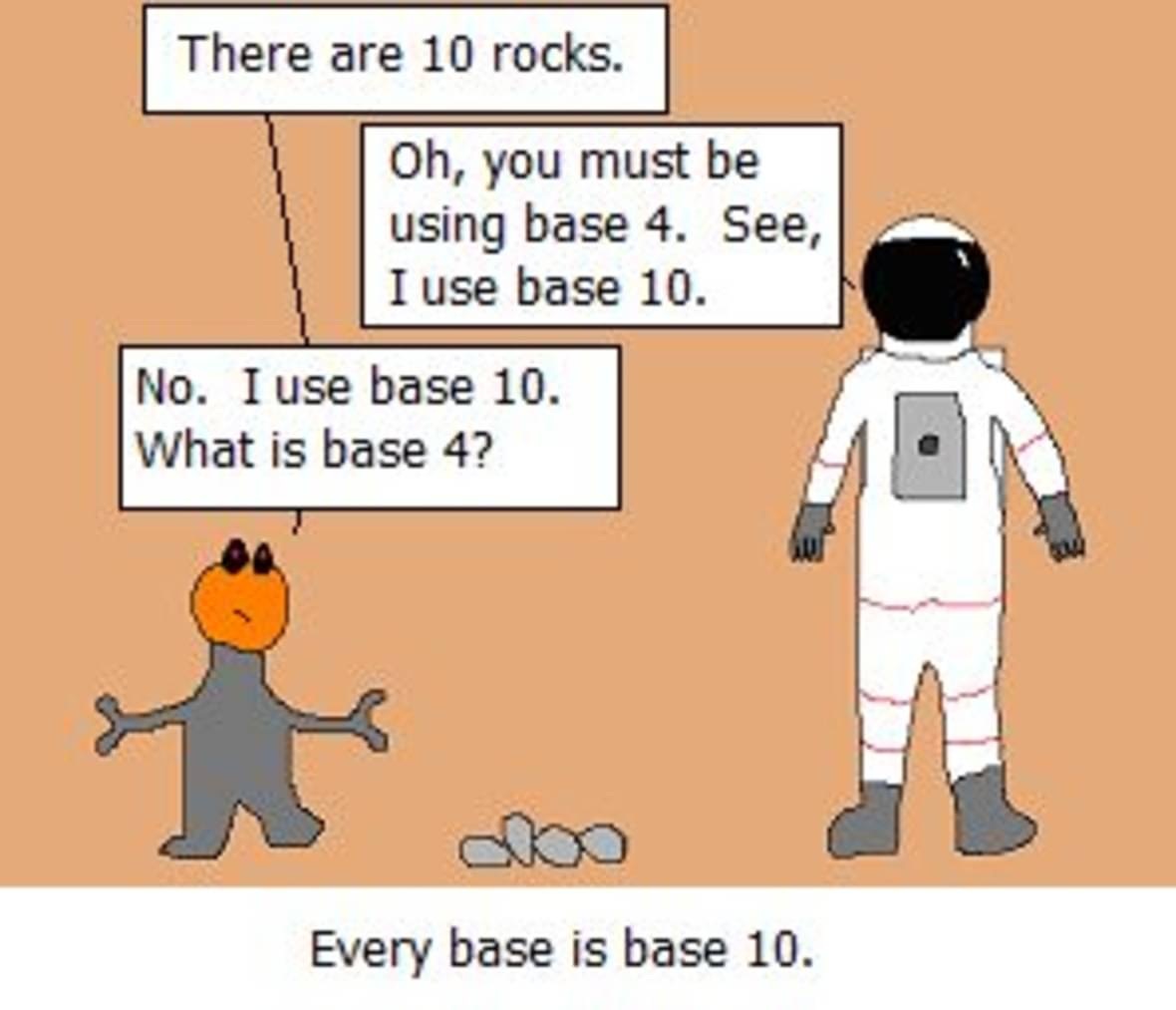
I like the detail that there alien has 4(10) fingers as opposed to the 10(22) that the human has.
Now I get the joke.
Thanks!
Can we all use base 12?
It will be a shower of shit for like 50 years but then it will be marginally better for pretty much everyone.
42* years. Centuries are now 84 years. We are living in the 19th century! I rate this idea 12/12.
5/7 movie
shut the f*k up rob
I rate it A/10, it’s a really efficient numbering system but I personally will have a really hard time adjusting
50 years? I bet we couldn’t even agree on how to write “11” & “12” on such short notice. (See: date format, encoding, etc)
Well we write 12 like this: 10
It’s easy
oops I mean “10” & “11”
we could just go with the hexidecimal way and go with A,B,C for 10,11 and 12
No, 12 in base 12 is 10, not C. But yes, 10 can be A and 11 can be B
Dude’s out here trying to get us to use base 13.
Why not?
Why not use a large prime as the base?
Honnest answer, 1/2 in DEC is 0.5 easy. 1/2 in base 13 is .6666666666… Easy but ugly. You want a base that has comon fractions easily represented by decimals. People like dozenal since many fractions are easily represented. 1/2 = 0.6, 1/3 = 0.4, 1/4 = 0.3
I’m personally a fan of hexidecimal partly because I’m a programmer and partially because it can be halved several times
it’s almost like you’d have to use a different notation system to express a different base…
Is 1/2 in base 13 not 0.65?
Ahh yes, let’s introduce floating point rounding errors for one half. Sounds fun.
Lets use base Pi and put an end to that infinite digit bullshit.
Why use a fixed base? Or why not use an irrational number like e, the most efficient base
I still think some largish prime, like 37 hits the perfect spot of being usable enough for people to use, but still useless enough to stop almost everybody from learning any advanced math.
But yeah, making integers non-representable is a serious trade-off that deserves consideration.
ah right, thanks
Over my dead body.
The current standard seems to be an upside down 2 and 3
An upsidedown 3 is just a 3…?
Rotated, not flipped.
Some people argue that it would be harder to count on your fingers but we could just surgically give everyone more?
There are 12 sections on your fingers (excluding your thumb) you then use your thumb to count to 12 on one hand.
Two hands can allow you to count to 24. Which is way higher than 10. Base 12 is better!
Binary’s the way. 1023 with 10 fingers
I like the idea of some numbers being popular hand gestures.
4 - Fuck you; 17 - Shaka (hang loose); 18 - Metal horns; 19 - “I love you”; 132 - Double fuck you
With 2 hands you can count to 144.
Bold of you to assume I’d ever remember this counting technique. Hell I’m shocked I remember counting my fingers for base 10…
To be fair, you should be comparing 2 hands in base 12 to 2 hands in base 10, I. E. 20:24. Still a real difference, but not the 10:24 difference you pointed out.
When was the last time you’ve actually needed to count something on your fingers?
Billions of years ago, our collective great-great-great-[several million more]-grandparent evolved a fin with a five bone structure. That idiot didn’t know anything about common denominators, and now we’re stuck with this numeric system that can’t divide things into thirds without causing issues.
Vertebrates appeared less than a billion years ago.
50 years? We can’t even switch to metric.
Every civilised country on earth uses metric.
Only the really shitty ones use imperial. Imperial is just stupid (unless you count in base 12 ironically)
Or better yet, base 6?
nah we should use binary, anything else is cringe.
That’s Acadian, right? It was originally based on the number of easy to count bones in your fingers (12-24)
so, 60 years in base 10
There are 10 types of people: Those who understand binary and those who don’t.
And those who didn’t expect the joke to be in base 3
Based.
I like that the alien has 4 fingers. Fitting!
There are only 10 ways of doing things: the right way and the wrong way. (Programming joke)
There are actually 00000000000000000000000000000010 ways of doing things (in most languages)
Huh, that’s a good point. A better universal naming system would be something like “Base x+1”, with x being one integer lower than 10. So humans would use Base 9+1, and the alien would use Base 3+1.
*This has been on my mind all day and the more I think about it, the more obvious it becomes how fundamentally terrible the name “Base-10” is. How did this never occur to the people who coined the term? Even the system I suggested is flawed as it’s still trying to incorporate the same bad logic.
A better system would be something like Base 9, stopping shy of the respective 10 in each system, or if it needs to be clarified, Base 9+0, as 0 is the extra digit in the first place, not 10.
we’d only be able to represent bases for numbers with one digit though because what does base 15+1 mean? the 15 could be in any base higher than 5. the clearest way would probably be to just represent it with lines or something “base ||||||||||”
It’s only 15 to us because we use base 10 (or 9+1). Like how we have 4 through 9, but that aliens in the picture only count up to 3.
In the case of a mismatch, the culture using the higher base would just translate down (Base 21+1 in the given scenario).
Single units would probably be the simplest method, but also wildly impractical as the base gets higher. You really want to count each digit just to figure out someone uses Base 100?
that’s fair, translating down is a good idea
Base 16 is typically represented with letters being used as the extra numerals, so it would end up being F+1. Problem solved.
Base 16
Do you mean Base G?
All your base are belong to us
What the fuck is G?
It would be the digit representing a value of 16 (i.e. the amount of lines here: |||| |||| |||| ||||), if you’re talking about it from the perspective of a number system with base 17 (|||| |||| |||| |||| |) or higher.
what about numbers larger than 16?
There are still 20 more letters that can be used as stand-ins. Things will get interesting if you try to go past Base 36, though.
this is exactly what i was trying to get at
Make up a new symbol?
Or use ancient scripts like Phoenician or Glagolitic.
wait until you find out about hexadecimal systems. It turns out we already have words for referring to numbers lol.
i know about hexadecimal, but what if you need to refer to a base larger than 16? i’m not saying it isn’t possible to create symbols for every number, i’m saying if you have to describe your base with more than one digit, you encounter a problem of not knowing what base that multi-digit number is in.
well no, i know, i’m just saying that’s it’s not really that big of a problem, unless you’re using octal, and you skill issue.
You should design base systems to be independent of each other, and hex does a really good job at this, because often times it’s prepended with 0x to imply hex.
What about Roman numerals?
I think that would confuse things more than it would help. It’s base 5, unless it’s base 10, unless it’s base 50, etc. And then there’s the rules designating numbers 1 below certain other numbers, or 2 below, depending on the system being used. That’s a whole web of complications when communication is already murky.
One glyph to one integer communicates the number system being used more clearly.
I use base 8+1. What is 9?

Wow I never thought about that.
But it is always like this:
let there be any base "b"
That can represent a number by the sum of their positional digits:

number = sum(d_i * b ^ i)
   where i is the position index and d_i is the digit at this position. (note: index starts with 0, from the least digit farthest to the right)
So the (decimal) number 4 in base 4 is then
1×4¹ + 0×4^0 = 10And (decimal) number 8 in base 8 is
1×8¹ + 0×8^0 = 10And 10 in base 10:
1×10¹ + 0×10^0 = 10deleted by creator
Which is why to write hexadecimal, we added letters to it, because there isn’t a digit for “12”.
Octal is base 8. Decimal is base A. Hexadecimal is base G. Any questions?
What is this “8” you refer to? Here in the land of people without thumbs, 10 comes after 7.
If you have a problem with that you must also have a problem with the other two
All your base belong to us
Not to be that guy - just to make sure you nail it perfectly next time - it’s “all your base are belong to us”
What you say?
He said “all your base are belong to us” or something about zigs, it went by too fast
They set us up the bomb.
I get this comic which is about translation errors.
Comments are wildly off …
…BASE!
Clearly the human uses base 22.
That’s very clever. Maths checks out.
Only when written, which is the whole point of notation. “Ten” is still a fixed amount, and so is four.
“ten” is a fixed amount in base 10. A base 4 user may have an entirely different naming system for numbers above 3, so “ten” (which is written as 22 in base 4) could be twenty two, twoty two, dbgluqboq, or Janet. But similarly to how we don’t have a single syllable, dedicated number name for decimal 22 (as in, it’s composed of the number names ‘twenty’ and ‘two’), they may not have a single syllable, dedicated number name for decimal 10 (which is ‘22’ in base 4).
No, ten is a fixed amount in English. It has roots in base ten, but we also have eleven and twelve from other bases. (also dozen, gross, score.) In English there is no ambiguity when it comes to what number the word ten represents.
I never argued that. I wasn’t even talking about the word ‘ten’ in English but the usefulness of the word ‘ten’ in base 4.
EDIT: I see where you’re coming from: base 10 English also has a unique name for something that is not 0-9 or a power of 10 - however, the only reason to this is that they are from base 12. Obviously base 12 has unique words for numbers below the base. But not numbers above it (apart from maybe powers of 12). Which further proves the point.
My point is the difference between number system and language. We’re seamlessly converting back and forth while writing this, but there’s a specific amount in our heads that we’re trying to communicate, either by word or by number. The number is ambiguous only if you don’t know the base, while the word is ambiguous only if you don’t know the language. The meme is - presumably - in English, and they’re talking (in speech bubble form), so the misunderstanding doesn’t really happen. it’s only when a secondary ‘language’ is introduced - the numbers - that it is possible.
Ten in particular, which we usually write as a two digit number because of historical and biological context, still uniquely describes a certain amount without any relation to it being written as the first two digit number. In any language, you wouldn’t translate to one two three ten just because they usually write in base four, you’d translate to whatever their word for the number is that you’re trying to translate.
even when written out non base ten systems, are still possible to be non base ten.
It’s only base ten when you convert from one base system to another. We are merely referencing between two base systems when we say that 4 bits is “16” because there are 16 possible options there. 16 is just our conceptualized version and conversion of that base system, in ours. You can read binary as if it’s just powers of 2, it’s incredibly trivial.
octal and hex are the best example of this, because octal skips numbers while counting. Hex introduces letters. Neither of which fly even remotely sanely through base ten. Unless you’re converting.
deleted by creator
Base 20. 1,2,3,4,10,11,12,13,14,20
deleted by creator
That’s base 5.
No it’s base 10
just as theres no single numeral for 10 in base 10, theres no numeral for 4 in base 4.
1 2 3 10 11 12 13 20 21 22
You forgot to count 0. The alien should write 4 as 10, not 4.
This one took me a bit.