
You must log in or # to comment.
It’s a numbers game.
- X submits paper to Journal 1, and peers A,B,C reject it.
- X submits paper with minor changes to Journal 2, and only peers D and E reject it.
- X submits paper with minor changes to Journal 3, and only peer G rejects it
- X submits paper with minor changes to Journal 4, and no one rejects it.
Journal 4 increments prestige, Scientist X increments prestige, but nothing true or good is actually gained.
Science.
Did peer F get murdered for indicating they were going to reject the paper? 🔍🧐
peer F accepted the paper
deleted by creator
The ones that fail peer review go from “unexpected result” to “the fuck were you actually doing?!?”
there are a couple journals where peer review means the former. one that i can think of is Organic Sytheses orgsyn.org
Never,
It’s peer review not peer verified.
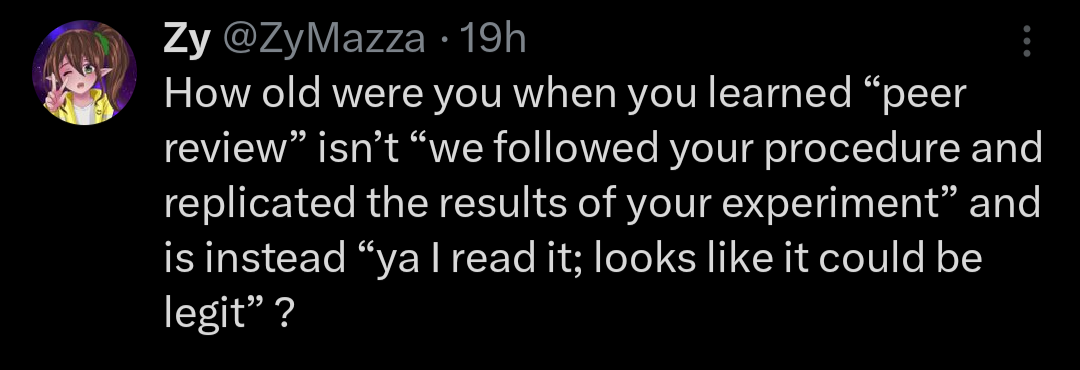
English is my second language so I don’t get this post, it always meant someone else read it.
I recently read an interesting article proposing to get rid of the current peer review system: https://www.experimental-history.com/p/the-rise-and-fall-of-peer-review
The argument was roughly this: for the unfathomable (unpaid) hours spent on peer review, it’s not very effective. Too much bad research still gets published and too much good research gets rejected. Science would also not be a weak-link problem but a strong-link problem, i.e., scientific progress would not depend on the quality of our worst research but of that of our best research (which would push through anyway in time). Pretty interesting read, even though I find it difficult to imagine how we would transition to such a system.
In my field of research, there seems to be a recent push for artifact evaluation. It’s a separate process which is also optional but you get to brag about the fact that you get badges if your experiment results were replicated.
There’s also some push back against this since it’s additional work, but I think it’s a step in the right direction.
Wait deadass?!?!? If so then 20 lol
Best part is the reviewers don’t get paid for their work, the publishers pocket all of the money they get from selling journals
While charging researchers to publish the paper and the reader for accessing it. If they can get away with it. It’s a fucking scam, thus arxiv and others exist.
I’ve personally had much less respect for global academia ever since I learned how publishing journals can demand so much from researchers and their audience, while providing so little.
What did you think the “review” part of it meant other than reviewing it?
They thought the review process was more arduous than looking at some newly discovered scientific fact that no one had ever known before and saying “yeah that seems self-evident.”
If you feel like that’s reductive, now you know why I felt like responding
I’m just happy they learned what peer review means. I doubt even a third of Americans know what it means or its impact on their lives
So it’s like a crowd strike code review
Scientists can get really petty in peer review. They won’t be able to catch if the data was manipulated or faked, but they’ll be able to catch everything else. Things such as inconclusive or unconvincing data, wrongful assumptions, missing data that would complement and further prove the conclusion, or even trivial things such as a sentence being unclear.
It generally works as long as you can trust that the author isn’t dishonest
deleted by creator
I do trust scientists about peer review more than code reviews. This is how I imagine the crowd strike reviewer.
Damn I guess I was today years old. I remember in high school chemistry class we were taught about peer review and had to do it for each other, except the way we did was actually testing and replicating results, so that cemented the misconception.
In my field, peer review was “obviously hasn’t read enough Foucault”.
Was lucky to contribute to a paper for the first time recently and was certainly suprised to see what peer reviews looked like lmao
Is it better or worse than code reviews in programming? Typically, if it’s 5 lines, we scrutinize everything. If it’s 500 lines, it’s a quick scan with a “looks good” comment.
I’d say its similar. Though from the limited dataset of peer reviews I have, I’d say that peer reviews are more informative / detailed while code reviews usually have way less typos lol.
LGTM!
Science is essentially just throwing shit at the wall and seeing what sticks.
The more shit you throw, the higher chance there is that something sticks. You just need to make sure the shit is properly documented, and that’s what the peer review is for?
I doubt this will stick on the wall.
Throws it to the wall and it sticks.
Holy shit!