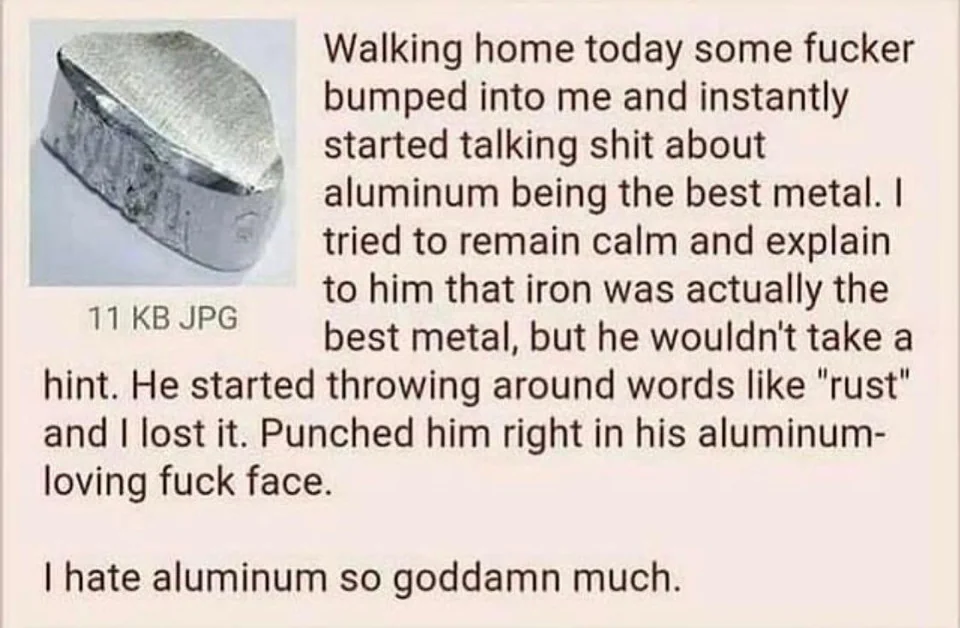
A-lu-min-i-um
People always argue that -num isn’t a legitimate way for the name of an element to end, but I never see you guys talking about Platinium.
All words are made up and language isn’t real
Because platinum is also a concept. Nobody has gotten an aluminum record, or an aluminum medal. Some metals have ascended beyond mere utility into superficiality. Aluminium isn’t there yet.
Pronounced aluminyum
Halloumi, yummy.
Team aluminum all the way. A higher up where I work is obsessed with stainless steel, he gets these monstrous heavy duty tables made out of SS that hold objects 1/3 of their weight. Makes lab rearranging a nightmare lol.
Aluminum is where it’s at, and where it is, is everywhere.
Your cans? Aluminum. Your car? Mostly aluminum. Old wiring, you better believe that’s aluminum. Your fucking phone screen is aluminum, sand paper is aluminum, half the birth stones are all aluminum let’s fucking goooo baybee
Most cars are still steel. Source I work on cars in New England. So much rust, even on the ones with aluminum bodies, at least wherever it can touch a dissimilar metal and becomes a battery.
And crucially the important parts that keep it from exploding (cylinder liners) and save you in a crash (crumple and bumper cores) are almost all steel. Because it deforms better with simpler engineering.
See also iron brakes in most cars hardened steel bearings everywhere.
I was referring to the engine block and pistons being aluminum. I assume chassis and many of the critical spinning bits are still steel or iron.
It’s also mostly a shit post. I’m a machinist and I am surrounded by aluminum in funny forms.
Yeah I’m mostly just shitting on it for fun too. But the pistons don’t work very long without steel rings, wrist pins and big end bolts.
The problem is we have to bring copper, brass and other fancy metals in them though, because the all spin on oil cushion bearings. Unless we’re talking Babbitt bushings from the early 1900s.
It’s alumina. Which is aluminium oxide.
If you really want to stop the stainless steel obsession, you could start cleaning the benches with bleach and not rinsing again afterwards. The corrosion will set in quickly.
Aluminum will stain, but it won’t start rusting.
I’ll just get a spray bottle of mercury and fuck your aluminium assface right up.
We seem to be at an impasse, my stainless steel ass face. How about a compromise: we return to asbestos!
Two punches for calling it Aluminium
Us Americans are too excited about making stuff with our Uh-loo-min-um that we just skip pronouncing some of the vowels
Guy that named it called it Aluminum
Weirdo types that decided they were in charge of naming things decided to name it Aluminium so it “matched” the likes of other metals like titanium, iridium, etc
Guy that named it called it Aluminum, Alumium, and Aluminium. Aluminium stuck, even in the US.
Then some weirdo types decided they were in charge of naming things in the US decided it needs to be Aluminum. It took them about 50-90 years to succeed.
And thanks for that. Aluminum is a stupid ass name.
As opposed to “Platinium”
Tantalium
Weirdo types that decided they were in charge of naming things
You can say “British” here
No, the guy who discovered it called it Alumium, after Alum. Both Aluminum and Aluminium were later constructions by journals on opposite sides of the pond.
Guy that named it called it Aluminum
Let me guess: you pronounce GIF as Jif just because the creator is a peanut butter obsessed weirdo who couldn’t pronounce “graphics”?
couldn’t pronounce “graphics”
That’s not how acronym pronunciation works though. We don’t pronounce them based on the words they stand for, otherwise we would pronounce NASA, SCUBA, LASER, etc. differently. Both pronunciations have valid arguments so why can’t we just accept both and stop being weird about it.
Because I arbitrarily decided it’s gif 13 years ago and anyone who says it the other way is wrong 😡😡😡
'MINUM!
IKR I’m so glad I can pronounce Aluminum the right way.
Always been more of an iridium man myself
Are you dense?
Not as bad as those osmium-heads, plus we’ve got sparkle and color!
I’ll take osmium-heads over degenerates any day.
I prefer all my farm tools and weapons to be made out of iridium personally, but that’s just me
Mistborn moment
Aluminum is F grade allomantic material.
unless you need to block the allomancy
Non drinkable metals are just lame. You cannot even make a good cocktail without Mercury or Gallium.
I can’t think of many things you encounter every day that just use straight iron. Only alloys that use iron
Meanwhile, you’ll use very pure aluminum all the time
deleted by creator
Uh, I hate to break it to you, but literally all the iron in the human body is either part of a protein or bound to other molecules. It’s not an alloy per se, but it isn’t exactly pure iron
Pure aluminium is only used when you need to have very little reactivity.
General construction steel has >98% weight iron. Around the same as most aluminium alloys.
Really now? I thought most steel had way more carbon & chromium/nickel/manganese than that. I guess I underestimate how little is needed to make iron no longer mushy.
Sounds like aluminum is a loner and iron plays well with others. I’d bet there is still more iron encountered every day than aluminum even if the aluminum is pure and the iron is alloyed.
Pure virgin aluminium vs chad alloyed iron
I was super confused when I read “loaner”, I thought you meant loaning as in like borrowing. But then I realized you meant “loner”. Lol
Oops, my bad lol
Perhaps so, but one might argue that human tech relies more on iron than any other metal - because of its magnetic properties. We need iron to generate and manipulate electricity.
sounds like a good argument for iron.
Team Stainless Steel all the way. Strong and tougher than that weak aluminum shit.
deleted by creator
You… aluminum-loving sonofabitch.
Ever heard of hardened steel you aluminum loving mf?
deleted by creator
Fatigue resistance
Heat resistance
I prefer some alu in my steel pan. Heats faster.
Soft ass non-magnetic piece of shit aluminum
I still can’t believe there’s people pronouncing it aluminium instead of aluminium
The same people who presumably fill balloons with helum, want to cut down on sodum in their diet, prevent Iran from refining uranum, power their phones with lithum batteries, and enjoy singing David Guetta’s house classic Titanum
Can confirm Rust is superior!
At least we can all agree that diamond is the hardest metal.
Dragonforce is the hardest metal known to man, it is the metal you use to break diamond
Pretty sure neutron star matter is the hardest metal buddy
I’ve often heard that Diamond Is Unbreakable
I thought carbon fibre was the hardest metal
All the Simpsons fans out there know how great Zinc is.
Together they are thermite!
As a former cyclist, steel is real. I’ve seen aluminum bikes fail (as in, break at the top and down tube)during a ride. Screw your aluminum!
deleted by creator
Aluminium doesn’t get stronger on the welds like steel does, it gets weaker. So if you screw them up, you end up with a two part bike
Weaker or more brittle?
Weaker, by like 50%. Welding aluminium isn’t worth it most of the time, just use steel if you need that. Otherwise bolt it together.
While I agree, I do have to clarify that there is a fatigue limit, it’s mainly that the limit for steel increases so fast that few people are willing to put in the testing for billions of cycles to model ultra-high cycle fatigue
Where is that limit supposed to be? The line does not flatten, unlike that of steel. Which is a flat line from 1 million to 1 billion cycles. During the same number of cycles, aluminium drops from 25 to 14 ski, a loss of 44 %. The article specifically mentions:
Some metals such as ferrous alloys and titanium alloys have a distinct limit, whereas others such as aluminium and copper do not and will eventually fail even from small stress amplitudes.
Head’s up, referring to it as a “limit” like your article did is incorrect. In engineering you have what’s called an S-N diagram, which plots out the average time to failure based on average cyclic stress. Basically, a lower avaerage stress results in a higher average life. Also, this plot uses a logarithmic scale for both axis, because then all of the plots are straight lines.
For steel, the S-N diagram has what’s called the “knee”, which is where you have two distinct lines in the S-N curve: one horizontal and one at an angle, with the two intersecting at 1 million cycles. Referring to the knee as a limit (like in the article) is wrong because it’s not a limit; it’s the threshold where if you design a part to last beyond that (aka less cyclic stress than would get 1 million cycles) then it practically lasts forever.
In reality, the part won’t actually last forever, since the S-N curve beyond 1 million cycles isn’t perfectly horizontal. It’s just that reducing your cyclic stress quickly increases your predicted life into billions or even trillions of cycles. This is known as ultra-high cycle fatigue, and it’s generally impractical to do all the testing required to model because each sample would take months to test on the low end. Plus, there’s little demand for such models in the industry, though there are a handful of PhD students and post-docs working on it
Does that change anything regarding the discussion? If the limit is quickly so high that it is beyond reasonable time spans? In the comparison at hand, aluminium has no fatigue limit, steel does. They still use aluminium for aircraft etc. due to the superior weight savings.
Does that change anything regarding the discussion?
Yes, because the term “fatigue limit” makes lay people think the exact opposite of what is intended.