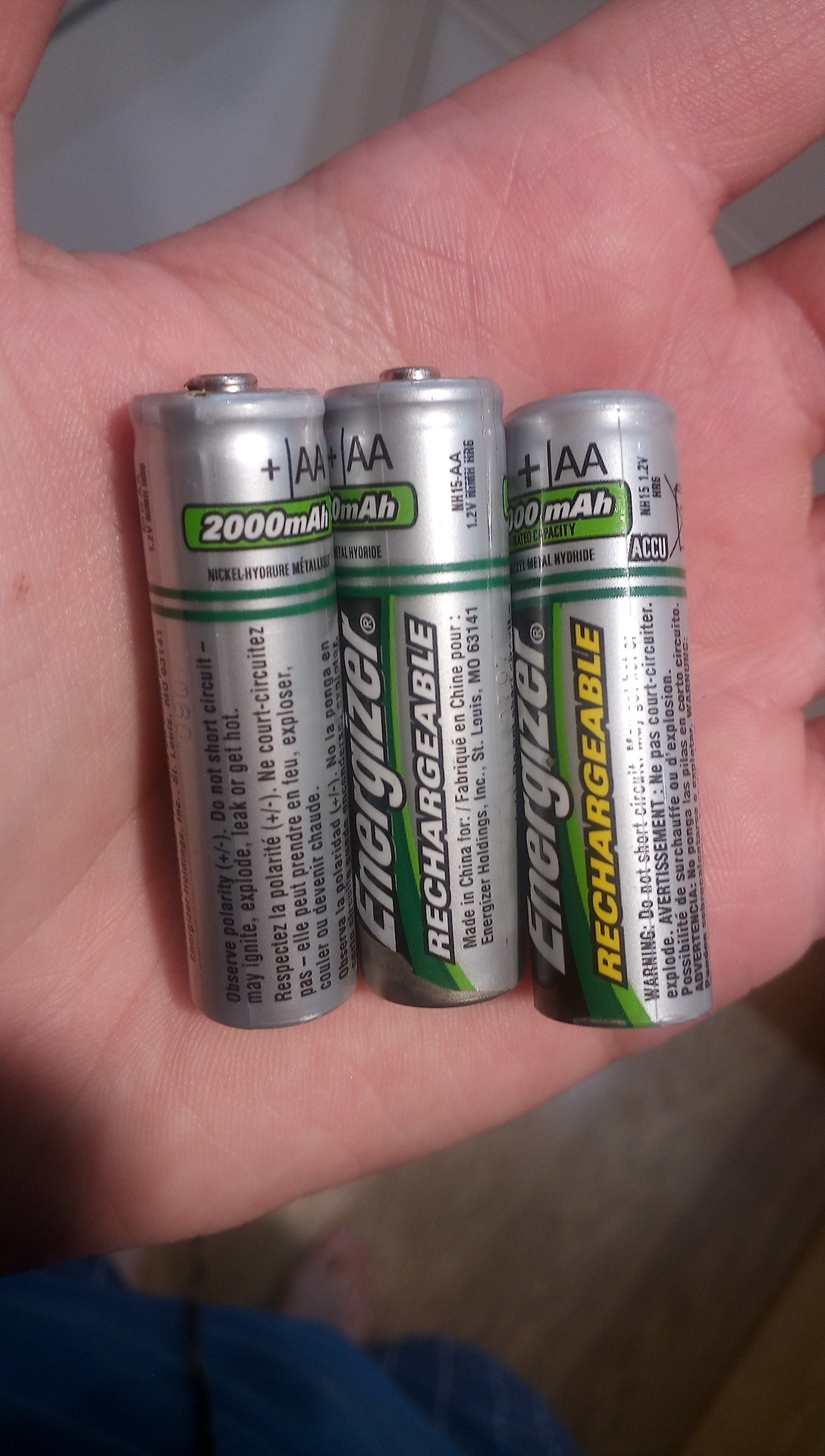
I know these are currently out of fashion but I’m still thankful they exist.
Let’s remind ourselves of devices that use(d) these standardized batteries:
- Toys
- Digital cameras
- Torches
- Gadgets like fans
- Wireless keyboards
- TV remotes
Thanks to having a standardized system of batteries,
- You can use the same battery across several devices. This is a no brainer but it’s very practical.
- Batteries can charge quicker thanks to being put in a dedicated charger and not being limited by USB cables. (But yes I concede that USB has been updated for faster charging over the years)
- Devices don’t have down time when their battery is charging. To charge, the battery is removed from the device and can immediately be replaced with a fresh one.
- You’ll never have to trash a device due to an expired battery. Just buy a replacement. And building on this…
- Any improvements in future battery technology can be retro-fitted into your existing devices. And there is a high incentive for future improvement, because…
- An accessible (due to easy replacement) and large (due to many devices) battery market is very attractive to competition.
If you look at the pros I listed, they all happen to be things that would be very useful for electric cars. So I think it would aid the adoption of electric cars if their batteries were standardized too.
Tipp for people wanting to get into rechargeable AA and AAAs: get IKEA Ladda batteries and their charger. They are cheap and japanese made. Some people argue that they are just relabeled Panasonic eneloops!
Edit: Oh also if you used rechargeable batteries in the past and you remember them sucking that’s probably true. But the battery chemistry is better now and it’s possible that your batteries degraded quickly because of “dumb” chargers. Modern chargers like the gray 4 battery Ikea charger detect how and for how long to charge and thus will not ruin the batteries.
LADDA are my go-to as well. I recommended going with the wall charges and not the USB-A charger, since the latter juices them up very slowly (compared to the wall outlet or the storage+charge box).
Its unlikely Panasonic eneloops. Project Farm does a great test for all the batteries and the IKEA showed no characteristics to the Panasonics. https://youtu.be/0A1GvQ40j0Q
The two cells tested in that video are different. The Ladda 2450 mAh is equivalent to the black wrapped Eneloop Pro, but the video only tests the standard white Eneloops which have less capacity but a better cycle life rating. This is honestly one of the most disappointing videos I’ve seen from Project Farm, he didn’t test most of what makes a cell better/worse.
Whether or not they are identical cells, from what I’ve read there is only one factory in Japan that makes NiMH cells, so the Eneloops and the Ladda come from the same factory and are therefore likely to be very similar.
Ahhh, I didn’t know that about the Eneloops Pro. Thanks.
Thanks for the info! It’s incredible how much the quality of batteries and chargers vary. It’s good to know a cheap easy place to get them
Those batteries in your photo are NiMH batteries… which discharge on their own at a fairly rapid rate even if you’re not using them at all. They’re also pretty big and heavy for the amount of power they provide (which, due to the self-discharge issue, is effectively a lot lower than the official number on the battery).
I strongly recommend investing in devices that use 18650 batteries. They’re about the same size/weight as a AA, and they last much longer (both in terms of from full to flat and also the number of years (decades?) of use you’ll get from the battery.
A lot of “proprietary” batteries are in fact a bunch of 18650 cells wired together.
It’s worth investing in good ones - the quality varies significantly from brand to the next. With a good 18650 cell, you won’t be replacing it when the battery expires, you’ll be transferring it to a new gadget when the gadget is broken or so old that you decided to buy a new/better model.
While all this is true, unfortunately not many devices support swappable 18650s, either they have swappable AA/AAA or have built-in 18650s that would require disassembly to replace. However, if you CAN find a device with swappable 18650s (the only ones I’ve found so far are flashlights) they’re absolutely great!
Wait, do they not make AA-sized 18650 batteries?
18650 isn’t a specific type of battery, but a size. 18mm diameter, 65mm length, and 0 typically represents it being cylindrical in shape. 18+65+0
But 18650 size is manufactured at much higher scales than other sizes, and therefore it’s the cheapest, and therefore it continues to dominate.
The main barrier is when you need multiple batteries.
If you install a dozen 18650’s in a device (or thousands in a car), they will work great as long as they’re all at the same charge level and can maintain the same voltage throughout the discharge cycle. If they can’t do that, then the battery could catch fire. Yikes. So any device with multiple 18650 cells will hard wire them together so the user is forced to use and charge and discard the entire set of cells as a single battery.
AA/AAA NiMH batteries won’t catch fire if they’re uneven, but being uneven will damage the batteries. You don’t need to keep them together to be safe, but you do need to keep them together if you want the batteries to last longer than six months. Keeping them together can be a logistical nightmare and it’s the main reason I’ve stopped using them… it’s just too much work to keep all the batteries together (especially if the device is shared in a household or workplace). If you get it wrong, then they don’t last much longer than disposables.
Disposable batteries have the same issue - but since they’re disposable you’re probably pulling four brand new batteries from a packet.
An 19650 cell holds about the same amount of energy as five AA batteries. So there are a lot of devices that can run well off a single battery, and those tend to be the ones that are user replaceable.
Low self discharge NiMH batteries have been available for a long time now. They hold a charge for several years.
Oh I see, I’ll look into them. Yeah these are at least 10yrs old so I wouldn’t be surprised if the technology was quite bad for today’s standards
Oh I see, I’ll look into them. Yeah these are at least 10yrs old so I wouldn’t be surprised if the technology was quite bad for today’s standards
I had some Molicel (I want to say, P26s) 18650s in regular rotation that lasted only three years. I went through Mooch’s battery reviews ahead of selecting them, purchsed them at Liionwholesale, and they started heating up in my Nitecore one by one after maybe 1,200 full discharge (e-cig) cycles. Meanwhile, I have vape-shop NCRs from 2016 still humming along (though rarely used).
At this point, I’m not really sure what to make of battery reviews. And the economics work fine for three years of consistent use. I just wish that was how they were sold, not like some absurd number you’ll never hit.
The 18650 should have become the ubiquitous replacement in most applications, but nooo, the manufacturers had to go all proprietary and enforce even more planned obsolescence
18650s can be pretty explosive if not properly handled though compared to traditional Lithium based rechargeables though, no?
I wish power tool companies would get off the proprietary batteries and adopt the CAS standard https://www.cordless-alliance-system.com/
I have a bunch of Eneloop batteries and they’re great.
The single battery cells in electric cars are pretty much already standardized in size, just the assemblies and cooling systems are not.
deleted by creator
That’s true for kinda sorta everything? Battery manufacturers don’t want to have to deal with creating a bunch of custom battery runs, so they end up standardizing and higher level manufacturers buy from there. This is especially true in situations where space isn’t at an absolute premium (like it is in a phone). Open up the battery pack for your cordless drill and you’ll find very standard batteries inside there, probably hooked up in series to get to the desired voltage.
My Garmin Montana GPS uses 3 AA batteries and it’s really handy if you’re in an area without mains electricity since carrying a an extra set (or even buying alcalines in a pinch) will get you going again!
I love these things. I’ve used the same 8 for almost 10 years for my Xbox controllers and VR hand controllers. I can’t imagine how many regular batteries I would have gone through.
Ikr?
I remember shopping for a Bluetooth speaker and while I settled on a JBL one, I did consider the IKEA model that takes AAA’s but it wasn’t available to try nor buy - it would’ve been nice to be able to consider one that was externally powered but ah well.
Yeah, the first USB power bank we had at home also used 4 replaceable AAs. I wish this was still common
I use rechargeable interchangeable batteries wherever I can, but I recently ran into some issues with an ultra-cheap BDC “massage” pillow. The OCP in the batteries was getting triggered and the motor would stop and start spinning for 10 seconds at a time. Tried to add small value resistors and capacitors to it but nothing worked and I had to get a pack of alkaline. Only now do I remember I have a bunch of spare 18650s and USB battery charging boards that I could’ve retrofitted!
Next time add a capacitor instead of a resistor for this
In series or parallel? How would it help?
In parallel. The capacitor smooths out the power and keeps it from spiking and shutting down over and over.
A resistor (in series) would help too but might restrict power too much to work well.
No harm in adding a capacitor.
On almost all my projects the weird behavior has been solved by throwing a cap in it
It’s also really fun to scream AA
Li-Ion solved this problem.
The downside is the volt is not 1.5volts. Its closer to 1.2volts. This is fine if you’re using 2 batteries for things like the TV remote. But when you’re using things that require more than 4 batteries, then you might get into some weirdness. I have a remote for my DSLR that sends infrared to the softbox. Every 10 shots, it would miss the shot. It turned out to be the batteries. It needed all 6Volts vs 4.8Volts.
Alkaline batteries lose voltage as they drain, so 1.5V is at full charge but it drops down to about 1.2V very quickly and then stays at 1.0V - 1.2V for most of the alkaline battery’s operating life.
NiMH batteries tend to consistently stay at their nominal voltage (1.2V) through their entire charge.
So in other words, if you have devices that really expect exactly 1.5V per battery, they would only work with alkalines at the very top of their charge. Nowadays most non-garbage circuits should be designed to work just fine with anything above 1V per battery.