

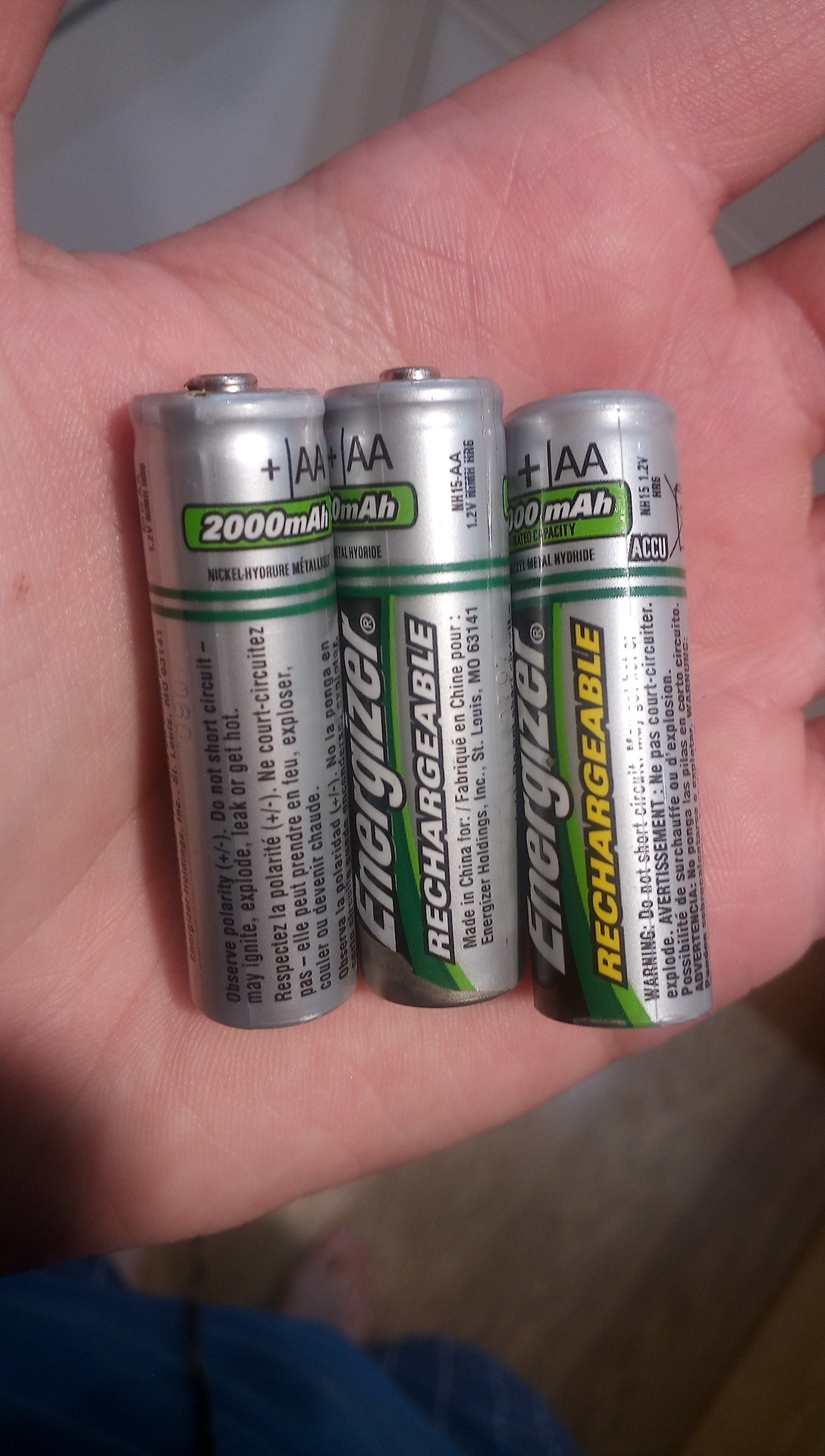
I know these are currently out of fashion but I’m still thankful they exist.
Let’s remind ourselves of devices that use(d) these standardized batteries:
- Toys
- Digital cameras
- Torches
- Gadgets like fans
- Wireless keyboards
- TV remotes
Thanks to having a standardized system of batteries,
- You can use the same battery across several devices. This is a no brainer but it’s very practical.
- Batteries can charge quicker thanks to being put in a dedicated charger and not being limited by USB cables. (But yes I concede that USB has been updated for faster charging over the years)
- Devices don’t have down time when their battery is charging. To charge, the battery is removed from the device and can immediately be replaced with a fresh one.
- You’ll never have to trash a device due to an expired battery. Just buy a replacement. And building on this…
- Any improvements in future battery technology can be retro-fitted into your existing devices. And there is a high incentive for future improvement, because…
- An accessible (due to easy replacement) and large (due to many devices) battery market is very attractive to competition.
If you look at the pros I listed, they all happen to be things that would be very useful for electric cars. So I think it would aid the adoption of electric cars if their batteries were standardized too.
Those batteries in your photo are NiMH batteries… which discharge on their own at a fairly rapid rate even if you’re not using them at all. They’re also pretty big and heavy for the amount of power they provide (which, due to the self-discharge issue, is effectively a lot lower than the official number on the battery).
I strongly recommend investing in devices that use 18650 batteries. They’re about the same size/weight as a AA, and they last much longer (both in terms of from full to flat and also the number of years (decades?) of use you’ll get from the battery.
A lot of “proprietary” batteries are in fact a bunch of 18650 cells wired together.
It’s worth investing in good ones - the quality varies significantly from brand to the next. With a good 18650 cell, you won’t be replacing it when the battery expires, you’ll be transferring it to a new gadget when the gadget is broken or so old that you decided to buy a new/better model.
While all this is true, unfortunately not many devices support swappable 18650s, either they have swappable AA/AAA or have built-in 18650s that would require disassembly to replace. However, if you CAN find a device with swappable 18650s (the only ones I’ve found so far are flashlights) they’re absolutely great!
Wait, do they not make AA-sized 18650 batteries?
18650 isn’t a specific type of battery, but a size. 18mm diameter, 65mm length, and 0 typically represents it being cylindrical in shape. 18+65+0
Heres a quick read
But 18650 size is manufactured at much higher scales than other sizes, and therefore it’s the cheapest, and therefore it continues to dominate.
The main barrier is when you need multiple batteries.
If you install a dozen 18650’s in a device (or thousands in a car), they will work great as long as they’re all at the same charge level and can maintain the same voltage throughout the discharge cycle. If they can’t do that, then the battery could catch fire. Yikes. So any device with multiple 18650 cells will hard wire them together so the user is forced to use and charge and discard the entire set of cells as a single battery.
AA/AAA NiMH batteries won’t catch fire if they’re uneven, but being uneven will damage the batteries. You don’t need to keep them together to be safe, but you do need to keep them together if you want the batteries to last longer than six months. Keeping them together can be a logistical nightmare and it’s the main reason I’ve stopped using them… it’s just too much work to keep all the batteries together (especially if the device is shared in a household or workplace). If you get it wrong, then they don’t last much longer than disposables.
Disposable batteries have the same issue - but since they’re disposable you’re probably pulling four brand new batteries from a packet.
An 19650 cell holds about the same amount of energy as five AA batteries. So there are a lot of devices that can run well off a single battery, and those tend to be the ones that are user replaceable.
Low self discharge NiMH batteries have been available for a long time now. They hold a charge for several years.
Oh I see, I’ll look into them. Yeah these are at least 10yrs old so I wouldn’t be surprised if the technology was quite bad for today’s standards
I had some Molicel (I want to say, P26s) 18650s in regular rotation that lasted only three years. I went through Mooch’s battery reviews ahead of selecting them, purchsed them at Liionwholesale, and they started heating up in my Nitecore one by one after maybe 1,200 full discharge (e-cig) cycles. Meanwhile, I have vape-shop NCRs from 2016 still humming along (though rarely used).
At this point, I’m not really sure what to make of battery reviews. And the economics work fine for three years of consistent use. I just wish that was how they were sold, not like some absurd number you’ll never hit.
Oh I see, I’ll look into them. Yeah these are at least 10yrs old so I wouldn’t be surprised if the technology was quite bad for today’s standards