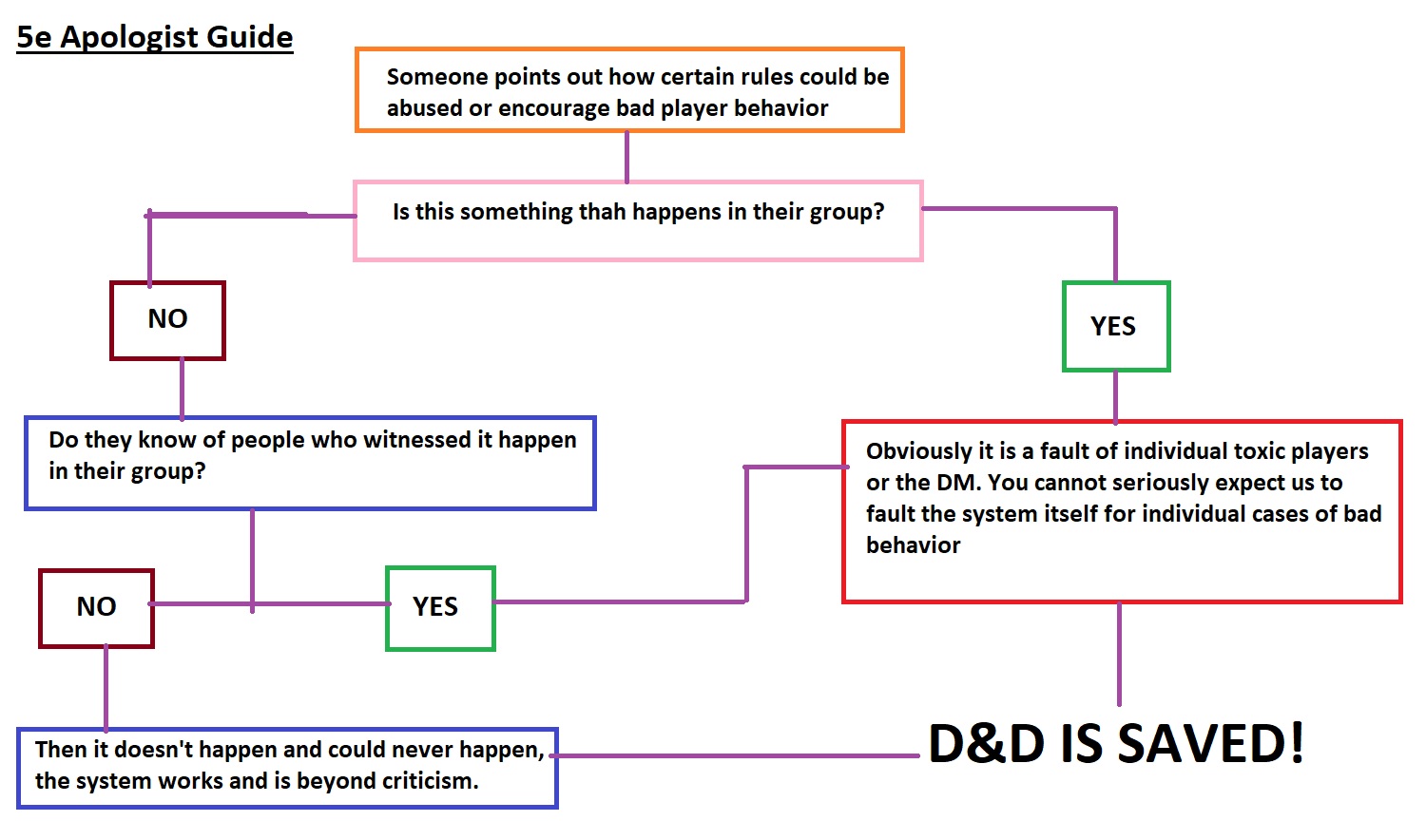
I really hate whenever I try to explain how some bad rules can be abused and immediatelly get someone say shit like “If this happens in your group, change it” as if that would solve the problem. And whenever it is not soemthing you witnessed personally, then it means it never happens and could never happen.
Are the 5e apologists in the room with us?
No, but seriously, most people I know (rightfully) criticize 5e for a lot of things, from sloppy writing in general, to shitty adventure books, to nonsensical rulings and poor balance. I’ve never met someone willing to defend 5e so passionately.
I’ve always claimed that base 5e is basically unplayable past tier 2 because of how wild power scaling becomes, and how sloppy certain rules are (God forbid that your wizard doesn’t attempt to Shapeshift the Fighter’s Echo before you even reach tier 3). And frankly, base 5e is too boring to play for long, anyway. Homebrew is where it’s at.
Check the other comments. They are absolutely in the room with us.
Oddly enough, they don’t defend it by saying it’s good. They defend it by tearing down everything else, or brushing the flaws under the carpet with “well, you can just ignore the bad stuff, so they don’t count.”
This has a lot of “stop enjoying that!” energy.
There’s no set of rules that a clever person can’t exploit or circumvent in some way, and min/maxers have been a plague on the RPG community since long before 5e. Frankly, if this sort of thing is a regular issue for you then the problem is the people you’re playing with. A good DM can roll with players like this and balance them.
Also the toxicity that is implied to exist by this post is pretty rare really. Even back when I was using Reddit, toxicity generally sank to the bottom of comment sections, and even more so here. When I got into D&D close to the beginning of 5e, some online voices on YouTube for example carried this toxicity but nowadays, most voices are far newer and friendly.
In general, most people are more interested in what happens at their table instead of all tables, and the rules are just guidelines to aid that.
I wouldn’t say it implies a toxic fanbase at all. It clearly states that’s the MO of an apologist. It further states that someone chimes in with that MO. Not a horde, not a group, an individual.
And I agree wholeheartedly. They are a minority. A very annoying, very vocal, minority.
The amount of cope is staggering sometimes and makes me disengage from discussing the hobby altogether.
Even your comment has some cope mechanism embedded:
The rules are just guidelines
As if nobody knew that. The guidelines are shit at some points, that’s the whole discussion.
There’s a thing in D&D forum spaces called the Oberoni Fallacy. The fallacy goes that, if someone says there’s a problem with a D&D rule, they’re wrong because they can just Rule 0 it away. It’s a fallacy because they have just proposed a solution to what apparently isn’t a problem.
People constantly saying “the rules are just guidelines” to any D&D problem is the same sort of idea. Yeah, I know you can ignore them, but I paid for the damn book, so I want what’s IN the book to actually matter.
You are the red box in the image.
Right, OK, yes, so what? the red box is where reasonable people arrive mentally.
Not really. You’re placing blame on players using a system as written and a DM for being unable to handle an exploit in the rules. At no point do you open the rules themselves up for criticism. In fact, you deflect all criticism away from the rules, as if the impossibility of a perfect system excuses every bad decision ever made.
Just like how there is no ruleset that cannot be exploited, there is no ruleset that cannot be improved. It’s only by acknowledging the flaws that something can improve, but you seem hellbent on dismissing flaws entirely. That’s unhealthy.
DnD isn’t just a set of rules, though. It is inherently a social activity, and that means there has to be a certain level of expectation for social norms. If your group has toxic people in it, they will be toxic while playing tic-tac-toe.
The solution is to employ social pressure or ostracism for those people. We can certainly modify rules that have proven abusive in the past, but enforcing rules of conduct must always be the first line of defense.
If D&D isn’t a set of rules, why do they charge so much for their rulebook?
It’s also worth noting that nobody has said an actual exploit. Nobody has DONE anything toxic. Someone just noticed a POTENTIAL exploit and suggested fixing it before any problems occur. Yet ostracizing people is a more acceptable position than a rules patch?
If the rules aren’t something to be changed, why do they charge so much for the rules revision they just put out?
At its core DnD is a wargame where we spend most of the game time fighting against monsters and bad guys. Having robust combat systems is the big draw of the game and fighting monsters in interesting ways without being too unfair either way. People want rules that are robust enough to make interesting combat but don’t completely break down under a bit of the box thinking, like the peasant rail gun, or the moon box lich, or the create water in someone’s lungs to cause drowning, or the coffeelock to get infinite spell slots.
All of these mechanical oversights are frustrating to play with because we have to stop the game and debate over whether this cheesy game breaking bullshit should be allowed at the table and it takes time away from the reason we’re all here, to get together play a game, and let everyone have fun, DM included. And sitting around debating whether the moon counts as a container for a lich’s soul reliquary or lining up 500 peasants and each of them readying and handing off an object at a bazillion mph for an hour and a half breaks the rules is not fun.
You want a system for magic that encourages being busted even at high levels? Play some Mage the Ascension, you can do some absurdly wacky shit even at fairly low power levels.
Yet ostracizing people is a more acceptable position than a rules patch?
Yes. If you can’t get someone to knock off bad behavior, the rules do not matter.
If the rules aren’t something to be changed, why do they charge so much for the rules revision they just put out?
There are good reasons to change rules. People breaking social norms is not one of them.
Once again, nobody has done anything. There is no bad behaviour anyone needs to stop. You don’t even know what the exploit is, or how the group feel about using it. You are inventing a hypothetical person to punish for a hypothetical misdeed while the actually flawed rules (by WotC’s admission, as proven by the erattas and rules revision) are right in front of you.
oh hey it’s that box from the chart. d&d is saved!
I get annoyed when people say things like “big deal, just do xyz yourself, why are you complaining?” . Because making a clear and comprehensive game is WOTC’s job they are being paid for with our money!
If the system has a flaw, it’s their job to fix it, if they don’t they’re doing a bad job.
That being said, 5.5e has been pretty cleaned up in this aspect. I’m honestly shocked at how they both added new fun systems and codified a lot of vague mechanics.
There are valid concerns and invalid concerns because a huge assumption is that the DM won’t use the rules about being able to address edge cases. A large and complex system will always end up with some weird combination that can be abused, but as long as there are a reasonable number and they don’t come up often then the system is fine.
5e does have some basic problems like exhaustion undercutting barbarian rages, but the vast majority of online examples of things being broken involve a massive misreading of the rules by ignoring context, vague rules (a separate problem from being broken), or people thinking an outcome is broken when it is just the system working as intended. Like being able to use Shield Master to knock down/shove opponents with a bonus action before making attacks since the bonus action rules say it can be in any order. Knock them off a cliff and no opponents? Ok, since you must attack on the same turn your action is lost because it could only being used to attack. That doesn’t make it broken, and it is addressed as an edge case by the DM.
Again, some things are broken, but most of the things people call broken are just edge cases that can easily be handled by the DM being overblown in a game that has too much focus on fiddly combat while being written with the story first.
By Exhaustion undercutting Rage, do you specifically the 2014 Berserker barbarian? That’s the only one I know of that gets exhaustion from Rage, and it’s up to them whether they want to activate that feature( Frenzy) or not.
Yes, it undercuts Frenzy which isn’t good enough to deserve exhaustion. It was story based design that worked against itself.
Good thing they removed it in in the 2024 rules then
https://www.dndbeyond.com/sources/dnd/free-rules/character-classes#Barbarian
Woohoo, 10 years later!
Every edition of every ttrpg has had rules that can be exploited and abused, and the solution has always been for groups to alter rules as necessary. It’s impossible to make an airtight ruleset. You are just a 5e hater.
It’s impossible to make it perfect, but it’s trivial to make it better. For example, get rid of Silvery Barbs.
And we’d really hope with a large corporation behind it, they could do more than get rid of the obvious. They could do the playtesting necessary to properly balance martials vs casters.
That’s just one spell in an optional sourcebook that’s just an MTG cash-in, though. I’ve never been in a campaign that allowed players to use content from non-core books with abandon.
Obviously it is a fault of individual toxic players or the DM. You cannot seriously expect us to fault the system itself for individual cases of bad behavior.
It’s a sourcebook they charged money for. They couldn’t have bothered to do basic playtesting to earn that money?
And there’s plenty more where that came from. Between a Shadow and a Tarrasque, one can safely be beaten by a low-level party, and the other is a threat to the whole world. The CRs reflect that, except they’re backwards.
In fairness, caught early, Shadows wouldn’t need a level 20 party to stop them. But they’re still above CR. And with the Tarrasque, all they had to do was leave in the anti-cheese measures they already had. And steal all the immunities from Pathfinder.
Speaking of CR, that was a bad way of doing things. Sure it’s convenient if you have a party of four players fighting a monster, but if you have to figure out how to recalculate it based on different party sizes, you may as well just use level to begin with and then figure out what level would challenge your players. Then it would work just as well on enemies with class levels. And it would mean Polymorph could be at least somewhat close to being balanced. As it is, a single spell can turn one party member into a monster capable of challenging for characters of that level, and then when defeated, they still just turn back.
Oh yeah, not to defend it because it is OP as hell, but there’s a lot more at the core of 5E that needs fixing, it just seems odd to single out a spell from a sourcebook most tables don’t use anyways, given that it’s setting-specific and was never compiled into later core books like Tasha’s.
To me it just read more like MTG power creep making its way into an MTG setting. I don’t know if that indicates that it was developed by a separate team entirely but the entire thing was definitely just a cash grab to leverage their other properties.
Considering I’ve been running 5e since the Plague Year, I wouldn’t call myself a hater. I did notice, however, this very pattern whenever I voice concerns about anything with the rules - first people assume whatever flaw or exploit I point out, has been used in my group and then their solution is always to leave the group or kick someone out of it, and if it didn’t happen in my group, then it means it doesn’t ever happen. It’s a catch-22 debating with these people.
As some who argues about the rules a lot, most people know close to nothing about the actual, written rules.
If you do want to debate with someone about the rules, feel free to message me, I enjoy it much more than I should.
My hypothesis is that a lot of people are emotionally invested in DND, and if you say bad things about it then it feels like you’re saying bad things about them. Saying it didn’t happen or it was the players fault let’s them still feel good about DND.
We’re all susceptible to this.
For some reason DND fans seem less likely to just go “yeah it’s kind of garbage but I like it”
I agree and I’d take it one step further: it’s undesirable to play games with elaborate exploit / abuse guards. Those systems suck! They’re boring, same-y, and labyrinthine. I literally don’t care about pvp, or balance, or “winning”. It’s not that kind of game play
The nirvana fallacy is to substitute a good solution (fix a broken rule or exploit) with a perfect solution that is obviously impossible (create an airtight ruleset), then use that to justify doing nothing.
I’m just not bothering with a company that’s repeating the exact same mistakes as their predecessors, so it’s basically anything but 5e for me nowadays.
This is silly. EVERY system can be exploited, and every group should expect eachother to act in good faith. The difference between systems is what parts are done for you and what parts you do yourself, and every group is going to want a different assortment of those pieces. You’re just mad that some groups get what they want out of DnD. You are the problem person in this image.
Serious question - what rules in 5e encourage bad player behaviour?