Help me understand this better.
From what I have read online, since arm just licenses their ISA and each vendor’s CPU design can differ vastly from one another unlike x86 which is standard and only between amd and Intel. So the Linux support is hit or miss for arm CPUs and is dependent on vendor.
How is RISC-V better at this?. Now since it is open source, there may not be even some standard ISA like arm-v8. Isn’t it even fragmented and harder to support all different type CPUs?
each vendor’s CPU design can differ vastly from one another unlike x86 which is standard and only between amd and Intel.
The ISA guarantees that a program compiled for it can run on any of these vendor designs. For example native binaries for Android run on any SoC from any vendor with the ARM ISA compiled for. The situation is exactly the same as with x86, Intel and AMD. Their core designs are very different yet binaries compiled for x86 run on either Intel or AMD, and on any of their models, even across different architectures. E.g. a binary compiled for x86_64 would run on AMD Zen 2, as well as Intel Skylake, as well as AMD Bulldozer.
How is RISC-V better at this?
It’s better in that it’s free to use. Anyone making a chip implementing RISC-V doesn’t have to pay ARM or Intel for a license. Not that Intel sells them anyway.
The fragmentation issue might become a new problem. With that said we definitely want to move away from the only usable cores using ARM or x86, neither of which we can design and manufacture without the blessing of two corpos, one of which is a proven monopoly abuser.
RISC-V is better for Linux due to driver support. Vendors making hardware are more likely to use RISK-V for their controllers due to the costs. Modern computers are putting more functions under control of kernels that run on proprietary compute. (There exists a chart showing how little the Linux kernel directly controls.) As more of those devices run RISC-V, they will become more discoverable.
Also, those that can design or program tge devices will have more transferrable skills. Leading to the best designs spreading, and all designs improving.Places in a computer with compute (non-exhaustive, not all candidates for RISC-V):
BMC
Soundcard (or subsystem on mainboard)
Video card (GPU and the controller for the GPU)
Storage drives
Networking
Drive interface controlling card
Mainboard (not BMC)
Keyboard
Mouse
Monitor
UPS
PrinterWill it be perfect? Nope.
A lot of the vendors will lock things up as well.There exists a chart showing how little the Linux kernel directly controls
I’d be greatly interested in seeing this chart
USENIX ATC '21/OSDI '21 Joint Keynote Address-It’s Time for Operating Systems to Rediscover Hardware
Timothy Roscoe, ETH Zurich
At 19:22
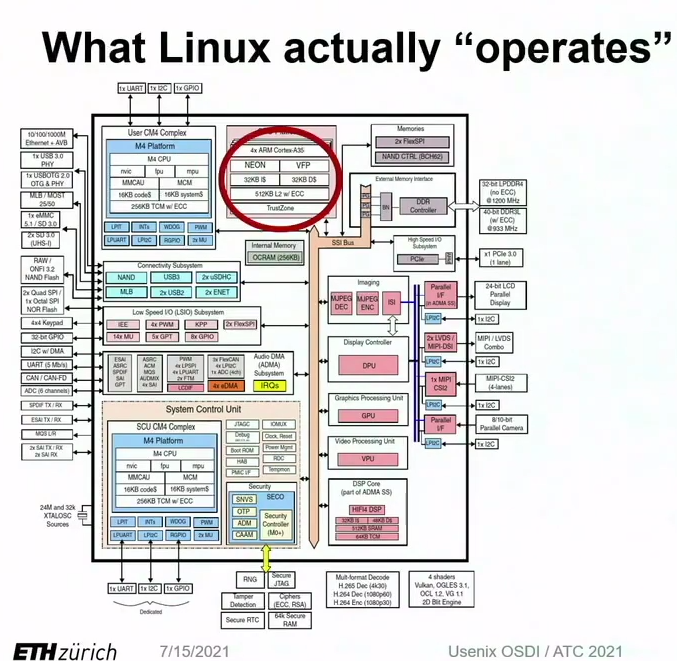
examples he gives are what you’d expect:
- Linux doesnt control the bootloader
- Linux doesn’t control power management
Many systems on the chip that Linux doesn’t have control over, and could be compromised by a cross SoC attack
Thank you for pulling the image out.
This talk surprised me at the time. I was starting the eye opening experience of design hardware. Linux more orchestrates the hardware than controlling it.
For me it opened my eyes to the idea that all you really need is some CPU time and a little RAM space to have a full-fledged performative system. Sure, there will be a large attack vector for remote spying, but if you just want to code and play games then it’s pretty amazing how little you need :-)
Same here
To avoid convo in multiple places, it is in reply to message you replied to.
Thanks!
There’s also the fact that Arm doesn’t really work with arbitrary PC style hardware. Unless this got fixed (and there have been some pushes) you have to pretty much hard code the device configuration so you can’t just (for example) pull a failed graphics card and swap a new one and expect the computer to boot. This isn’t a problem for phone (or to an extent: laptop) makers because they’re happy to hard code that info. For a desktop, though, there’s a different expectation.
RiscV does support this, i believe, so in that sense it fits the PC model better.
I don’t follow. Isn’t the OS’s job to discover hardware? How is the CPU instruction architecture come into play here?
See the start of this post talking about device tree models vs boot time hardware discovery.
There’s no reason an arm chip/device couldn’t support hardware discovery, but by and large they don’t for a variety of reasons that can mostly be boiled down to “they don’t want to”. There’s nothing about RISC-V that makes it intrinsically more suited to “PC style” hardware detection but the fact that it’s open hardware (instead of Apple and Qualcomm’s extremely locked down proprietary nonsense) means it’ll probably happen a lot sooner.
Thank you, that was very elucidating.
Shortest answer is that RISC-V is Open Source and ARM is proprietary but what does that mean?
First, it means “freedom” for chip makers. They can do what they want, not what they are licensed to do. There are a lot of implications to this so I will not get into all of them but it is a big deal. There is even a standard way of adding ISA extensions. It makes RISC-V an interesting choice for custom chip makers trying to position themselves as a platform ( think high-end, specialty products ).
If you are a country or an economy that is being hit with trade restrictions from the Western world ( eg. China ), then the “freedom” of RISC-V also provides you away around potentially being denied access to ARM.
For chip makers, the second big benefit is that RISC-V is “free” as in beer—no licenses. For chips in laptops or servers, the ISA license is a small part of the expense per unit. But for really high-volume, low-cost use cases, it matters.
In the ARM universe, middle of the market chip makers license their designs off of ARM ( not just the ISA ). This is why you can buy “Cortex” CPUs from multiple suppliers. Nobody else can really occupy this space other than ARM. In the RISC-V universe, you can compete with ARM not just selling chips but by licensing cores to others. So, you get players like StarV and MilkV that again want to be platforms.
So, RISC-V is positioned well across the spectrum—somewhat uniquely so. This makes it an excellent bet for building software and / or expertise.
It is only the ISA that is Open Source though. Unlike some of the other answers here imply, any given RISC-V chip is not required to be any more open than ARM. The chip design itself can be completely proprietary. The drivers can be proprietary. There is no requirement for Linux support, etc. That said, the “culture” of RISC-V is shaping up to be more open than ARM.
Perhaps because they want to be platforms, or perhaps because RISC-V is the underdog, RISC-V companies are putting more work into the software for example. RISC-V chip makers seem more likely to provide a working Linux disto for example and to be working on getting hardware support into the mainline kernel. There is a lot of support in the RISC-V world for standards for things like firmware and booting.
With the exception of RaspberryPi, the ARM world is a lot more fractured than RISC-V. You see this in the non-Pi SBC world for example. That said, if we do consider just RaspberryPi, things are more unified there than in RISC-V.
Overall, RISC-V may be maturing more quickly than ARM did but it is still less mature overall. This is most evident in performance. Nobody is going to be challenging Apple Silicon or Qualcomm X Elite with their RISC-V chips just yet. Not even the Pi is really at risk.
Eventually, we will also just get completely Open Souce designs that anybody can implement. These could be University research. They could be state funded. They could be corporately donated designs ( older generations maybe ). Once that starts to happen, all the magical things that happened for Open Source software will happen for RISC V as well.
Open Source puts a real wind at RISC-V’s back though. And no other platform makes as much sense from the very big to the very small.
Thank you for the great write-up. Man, I sometimes regret not having studies computer science. I am really invested in open source and net neutrality etc., but I can’t contribute shit so I’m restricted to a mere consumer.
I’m just happy that my garuda linux just keeps working most of the time becaus I couldn’t code anything if my devices would fail.
I can’t contribute shit so I’m restricted to a mere consumer
That’s not true! Contributing documentation improvements is critically important for the growth and health of the open-source community but is very overlooked.
I got graduate and masters in the hardware area but learned all of those things about arm and riscV by myself. I only got to see mips and hypothetical ISA in my courses. Heck riscV and rpi didn’t even exist.
All you need is interest and time.
Yes. Less blobs than ARM. I’m not even sure if some RISC-V have any blobs – someone correct me if I’m wrong.
Also getting cockblocked by proprietaryisms is bullshit. HDMI is a Circle Jerk of capitalism controlling competition and the market for self preservation.
i’ve had the same thought lately. the common arm design approach around the bootloader seems to turn old Android phones and tablets into e-waste sooner than necessary, in theory they could all run Linux and be useful for another ten years. but it’s hard enough to port mainline Linux to Android devices, and almost impossible to get all the included hardware working properly
I don’t think there has been huge issues with incompatible ISAs on ARM. If you’d use NEON extensions, for example, you might have a C-implementation that does the same if the extensions are not available. Most people don’t handwrite such code, but those that do usually go the extra mile. ARM SoCs usually have closed source drivers that cause headaches. As well as no standardized way of booting.
I haven’t delved super-deep into RISC-V just yet, but as I understand these systems will do UEFI, solving the bootloader headache. And yes, there are optional extensions and you can even make your own. But the architecture takes height for implementing an those extensions in software. If you don’t have the gates for your fancy vector instruction, you can provide instructions to replicate the same. It’ll be slower on your hardware, but it’ll be compatible if done right.
Actually, I think RISC-V is even worse than ARM. With ARM, at least you have a quite reliable instruction set on the CPU. With RISC-V, most vendors have their own extensions of the instruction set, which opens a big can of worms: Either you compile all your stuff for your own CPU, or you have a set of executables for each and every vendors flavor of RISC-V commands, or you exclusively use the RISC-V core commands. The first would be only for hardcore geeks, the second would be a nightmare to maintain, and the third would be not really efficient. Either way, it sucks.
bc arm is not free
deleted by creator