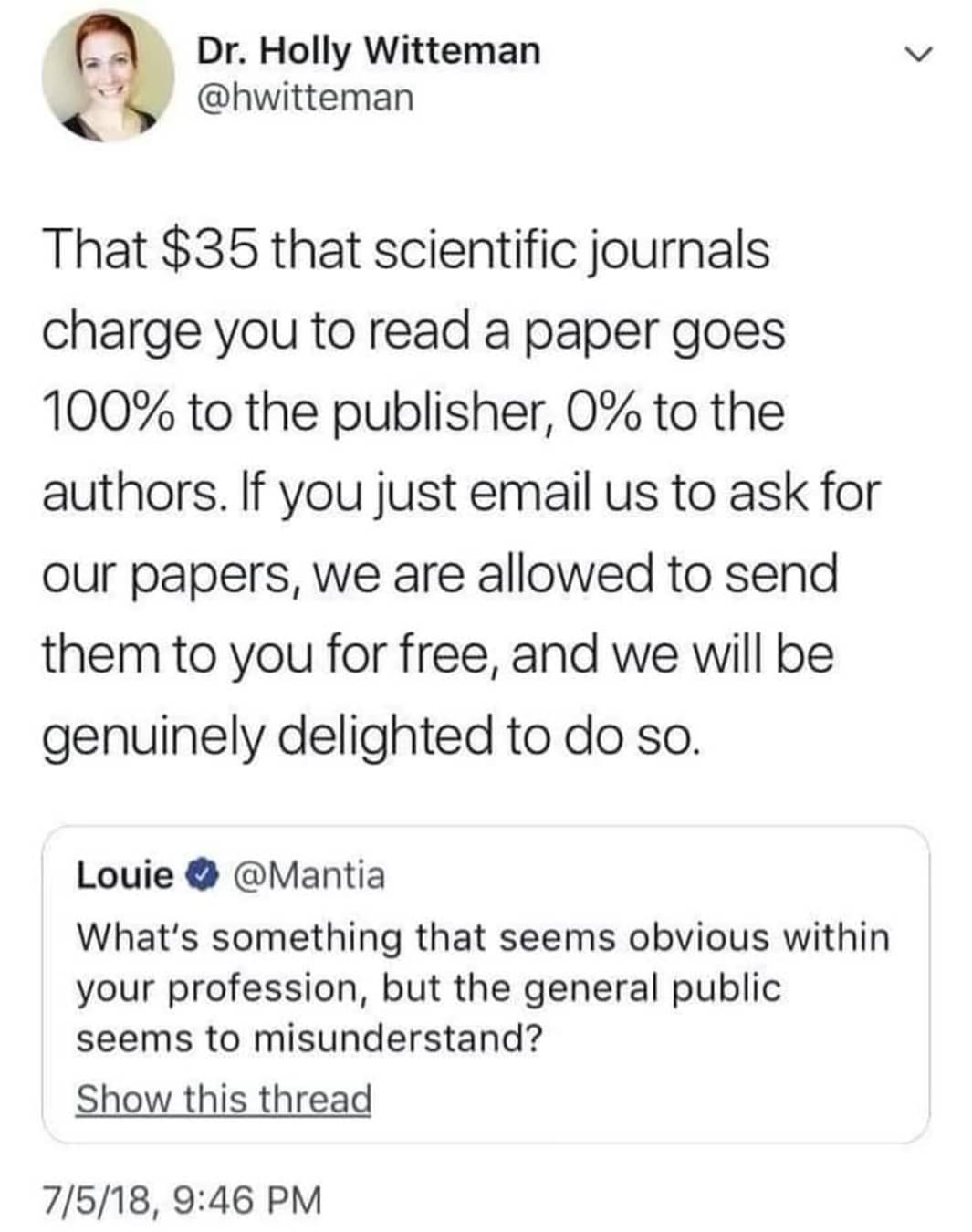
Imagine living in a world where it has to be explicitly said that you are allowed to send someone a free copy of something you wrote.
The research was paid for by someone. It is not unheard of for a company to offer a grant under the condition that they get the results, say, six months before the rest of the world.
This the the case for publically funded research as well. Scientific journals have paper submitted for free, papers reviewed for free, then they charge the $35/article fee to anyone who reads it, or more generally, they charge universities/etcs in the 5 to 6 figures sum/year for unlimited access.
Scientific journals are a billion dollar industry who do literally nothing for that money. They limit scientific progress to make money, and thats it.
If they review papers for “free” is that not worth something?
I definitely don’t think it should be for profit but it seems like there is value and costs to what they do. That money has to come from somewhere.
EDIT: I am unfamiliar with the process so I took OP’s words at face value. Several others indicate this is inaccurate. So, seems like all they do it host/publish the papers. Which does cost money, but that just seems like something that should be funded by other means rather than users paying. Kinda weird to hide science behind an arbitrary paywall.
I could be wrong, but my understanding is the reviews are done by other academics for free, if at all… That’s why getting published is kind of reputation based and circular because the cheapest review is just to look up whether they’ve been published before.
I have been the referee for two articles at an academic journal. It said in their agreement that for three or more papers per year you’d be compensated this and that much. But I guess I misunderstood because they emailed me and asked to pay me for just the two reviews. Anyhow, it basically no money. The time you put in to do a proper review is a lot more than what you are compensated for. Your uni still pays your salary, so this is just a bonus, but still, very little. This journal is hosted by a public entity, private ones may be very different.
I am unfamiliar with the process so I took OP’s words at face value.
You misunderstood. The journals get the papers submitted for free (i.e. they don’t pay the authors) and reviewed for free (i.e. they don’t pay the reviewers).
deleted by creator
AFAIK, peer reviewers are typically other academics in the field (peers) that are asked to voluntarily review a given article. The publisher doesn’t pay peer reviewers.
I had the option for some compensation for my reviews. Very little, but still.
The journals dont review anything. Other scientists do the reviews for free. Scientific prominence is a key to promotion for scientists, so they publish and review to keep and advance their jobs. Journals were built to abuse this fact.
Scientists publish papers for free, other scientists reviews papers for free, journals charge billions/yr to publish this free work, now mostly in digital formats, a medium that is effectivly free when serving text files.
Scientific journals are a racket, bar none. There are attempts to open source the publishing of these journals, but often if you publish in an open source one, the for profit journals will not accept the piece.
Given that even peer review is a shit show, I’d say there’s no value in these publishers reviewing anything.
Angry Elsevier noises intensify in the background…
“We work hard every day to stamp ‘peer-reviewed’ on ChatGPT botslop and collect money. It’s a valuable service.”
People shouldn’t have to email you. Put your papers on arxiv.org or your own web site.
A number of journals actually have clauses around how you can’t publish it anywhere else if they accept it.
So you can’t ‘publish’ it in those places, but you can send it privately to people who ask.
People can ask me for it by sending a “GET” request to my web server using the HTTP protocol.
And then those can “leak” it :)
It seems like that could just about go in one’s email signature:
“If this message has an attached published paper, please do me the service of making this publicly available via arxiv /scihub or other agency as I’m typically bound from doing this by the publishers conditions”
Boycott the journals! Both the readers and the researchers!
Usually that’s just for their version. Arxiv the version before it was accepted.
deleted by creator
Stop making excuses and send me that film you made. I know you want to do it.
deleted by creator
now I’m wondering if you think your filmmaking skills are bad or if your film involves you using firearms on garbage cans.
deleted by creator
There are other parties involved that restrict what I can and can’t do
I’m going to guess it’s got something to do with the high cost of creating the actual film reel that gives creditors the power to dictate access to the film as per a contract.
You see how that may be different yet?
It is different, but tbf academics are also reliant on external funding sources to conduct research. It’s not absurd to think that the grant writers or university administration might have some stipulations about the free distribution of research they paid for.
Have we forgotten what happened to Aaron Swartz? With the state of the world today, I naturally expect everything to be monetized, regardless of whether it makes any rational or ethical sense.
To be fair though, the people who fund the research are not the people who lose out if the publisher isn’t paid their £30. They are very often governmental or inter-governmental research agencies and programmes. Realistically it is rare for anyone except from the publisher to care about free distribution. The publishers are however pretty vicious (e.g. Swartz’s case).
No idea why you chose to phrase this in a condescending way. I have no doubt that they will have been able to come up with any number of differences after having it pointed out that it wasn’t the case for scientific papers.
Can anyone point to the law on this? I am in science and still was under this impression. Why is film different? I do share papers but I always thought I was doing so in the shadows. When I want to republish an image I’ve created that I’ve used in another paper I need to ask the publisher for permission to do so (this is pretty explicit) and then cite that source in the new publication. Ive assumed the publisher now owns my words as well and that I cant just share that with anyone. If that’s not true what sets it apart from your film? Can I share it as much as I’d like? Can I just put all my pdfs on my instutional public facing website? Does funding source matter at all?
Usually, for academic journals, you can retain most of your copyrights and grant a license to the journal. You have to pay attention to the options they give you when going through the publishing process, though. Because it does depend.
Some funding sources require that you retain certain copyrights in order to comply with things like public access mandates.
Scientist here. I encourage everyone to use a shadow library like Scihub to break the stranglehold that Elsevier and Wiley have on the free availability of knowledge. These are financialized corporations that add nothing to society and leach off of scientists’ hard work.
Why scientists HAVE to publish on those platforms rather than some other reasonable alternative?
I would guess university agreements with publishers
Aka academic corruption.
Oh, that sucks tho
Why scientists HAVE to pay to publish on those platforms rather than some other reasonable alternative?
I work as a non-academic at a research university.
Let me tell you, academics love discussing and sharing every phase of their papers, especially the findings and subsequent theories or discoveries. I get to participate in research activities quite frequently and some of it is so fascinating. They love someone showing interest and love sharing on their knowledge and findings. There’s a couple I’ll be waiting months more to hear conclusions on, but it’s that “so cool if true” stuff. I can’t imagine the anticipation of those involved, but even if they hit a wall, they explain they’re still just as excited to know they’ve closed the door on something and may open the door to something else.
It seems like such rewarding work.
There’s also a stigma around journals the older and more experienced academics get. I won’t get into it, but yeah, all good things are open to exploitation and often the younger ones are held under wings to guide them on the right path for quicker career growth. That’s just how it eventually works with humans for any thing that’s meant to be of best intentions.
But most people are good people and their passion is untameable, so all you need is just ask them to share knowledge—they absolutely will. The vast majority are certainly not in it for the money, not unless it can get them more financing for more research lol.
Scihub ftw! 🏴☠️
You could drop the pirate flag because this isnt even piracy
Yes, this is how I made it through grad school lol. Wish I knew as an undergrad, but that’s fine.
Until now I could get by with Scihub and Arxiv for college and personal hyperfixation research, but I’d actually love to ask an author directly some time if I ever run into a paper where that’s necessary.
Ive had mixed results with this, but one author was really excited (as was i) and we had a good back and forth for a bit after i had a chance to read/digest the paper.
What I don’t understand, and maybe somebody can explain. If this is the case, why wouldn’t there be torrents of every paper whose authors would be genuinely delighted to share?
Not being skeptical here. I’m really curious.
And maybe there are, and they’re just not well advertised for understandable reasons?
Sci-Hub was the most similar exploitation of such “situation”
Too many small files, papers need different indexing.
Shadow libraries (like scihub, Anna’s archive etc.) are the way to go - as long as scientists don’t or can’t publish Open Access which is what needs to happen.
By the way, in almost 100% of cases (the rest being just OA where the published version could be sent by anyone to anyone or something legally really dubious), the authors have a right to send their paper, even if it is published in a paywalled journal. Basically, the only thing the journal has a right to for subscription-based (aka those that cost $35) articles is content plus page layout. If the authors have the exact same text but formatted differently, they are free to distribute it wherever and however they want.
Preprint servers or lab/personal websites are best first choices for that.
edit: a small disclaimer on the exact same text meaning exact same text the authors provided; if the editor in the journal has corrected some typos and inserted a/the here or there (a common thing for non-natives to miss), then this becomes more of a grey area, because technically at this point it’s not a 100% authors’ text).