I’m sure there’s nothing wrong with the program at all =)
Modern webapp deployment approach is typically to have an automated continuous build and deployment pipeline triggered from source control, which deploys into a staging environment for testing, and then promotes the same precise tested artifacts to production. Probably all in the cloud too.
Compared to that, manually FTPing the files up to the server seems ridiculously antiquated, to the extent that newbies in the biz can’t even believe we ever did it that way. But it’s genuinely what we were all doing not so long ago.
It’s that automated workflow ? With human checkpoints ?
Like, a programmer will ‘hit save’ and drop his work in version control, which automatically lands in a development environment, is promoted to test, and lands in the queue of a tester, and so on ?
But it’s genuinely what we were all doing not so long ago
Jokes on you, my first job was editing files directly in production. It was for a webapp written in Classic ASP. To add a new feature, you made a copy of the current version of the page (eg index2_new.asp became index2_new_v2.asp) and developed your feature there by hitting the live page with your web browser.
When you were ready to deploy, you modified all the other pages to link to your new page
Of course, it’s going to be difficult to find a modern application where each individually deployed component isn’t at least 7MB of compiled source (and 50-200MB of container), compared to this single 7MB war that contained everything.


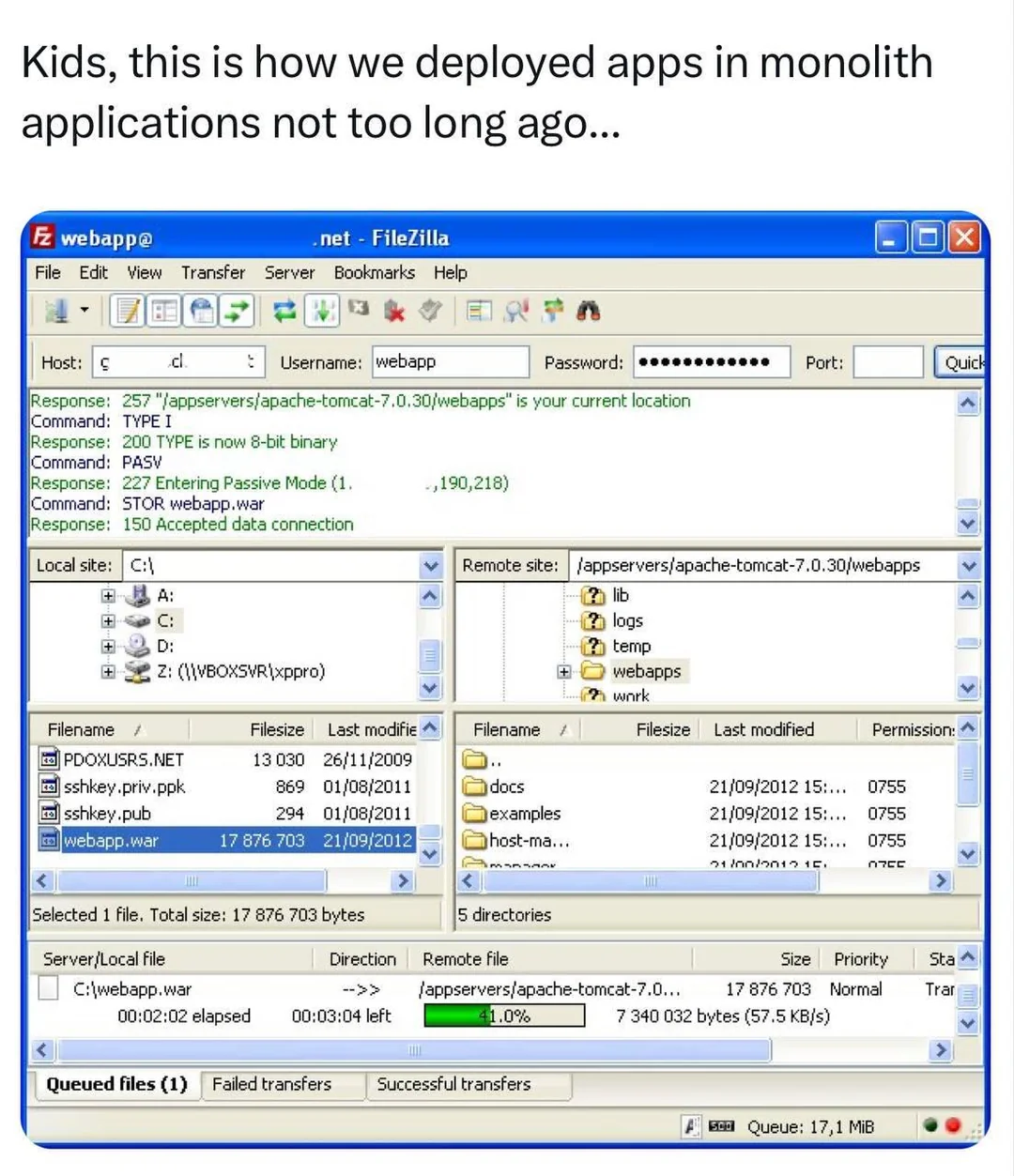
This application looks fine to me.
Clearly labeled sections.
Local on one side, remote on the other
Transfer window on bottom.
No space for anything besides function, is the joke going over my head?
I’m sure there’s nothing wrong with the program at all =)
Modern webapp deployment approach is typically to have an automated continuous build and deployment pipeline triggered from source control, which deploys into a staging environment for testing, and then promotes the same precise tested artifacts to production. Probably all in the cloud too.
Compared to that, manually FTPing the files up to the server seems ridiculously antiquated, to the extent that newbies in the biz can’t even believe we ever did it that way. But it’s genuinely what we were all doing not so long ago.
It’s that automated workflow ? With human checkpoints ?
Like, a programmer will ‘hit save’ and drop his work in version control, which automatically lands in a development environment, is promoted to test, and lands in the queue of a tester, and so on ?
Yes, exactly that.
Jokes on you, my first job was editing files directly in production. It was for a webapp written in Classic ASP. To add a new feature, you made a copy of the current version of the page (eg
index2_new.aspbecameindex2_new_v2.asp) and developed your feature there by hitting the live page with your web browser.When you were ready to deploy, you modified all the other pages to link to your new page
Good times!
The large .war (Web ARchive) being uploaded monolithicly is the archaic deployment of a web app. Modern tools can be much better.
Of course, it’s going to be difficult to find a modern application where each individually deployed component isn’t at least 7MB of compiled source (and 50-200MB of container), compared to this single 7MB
warthat contained everything.