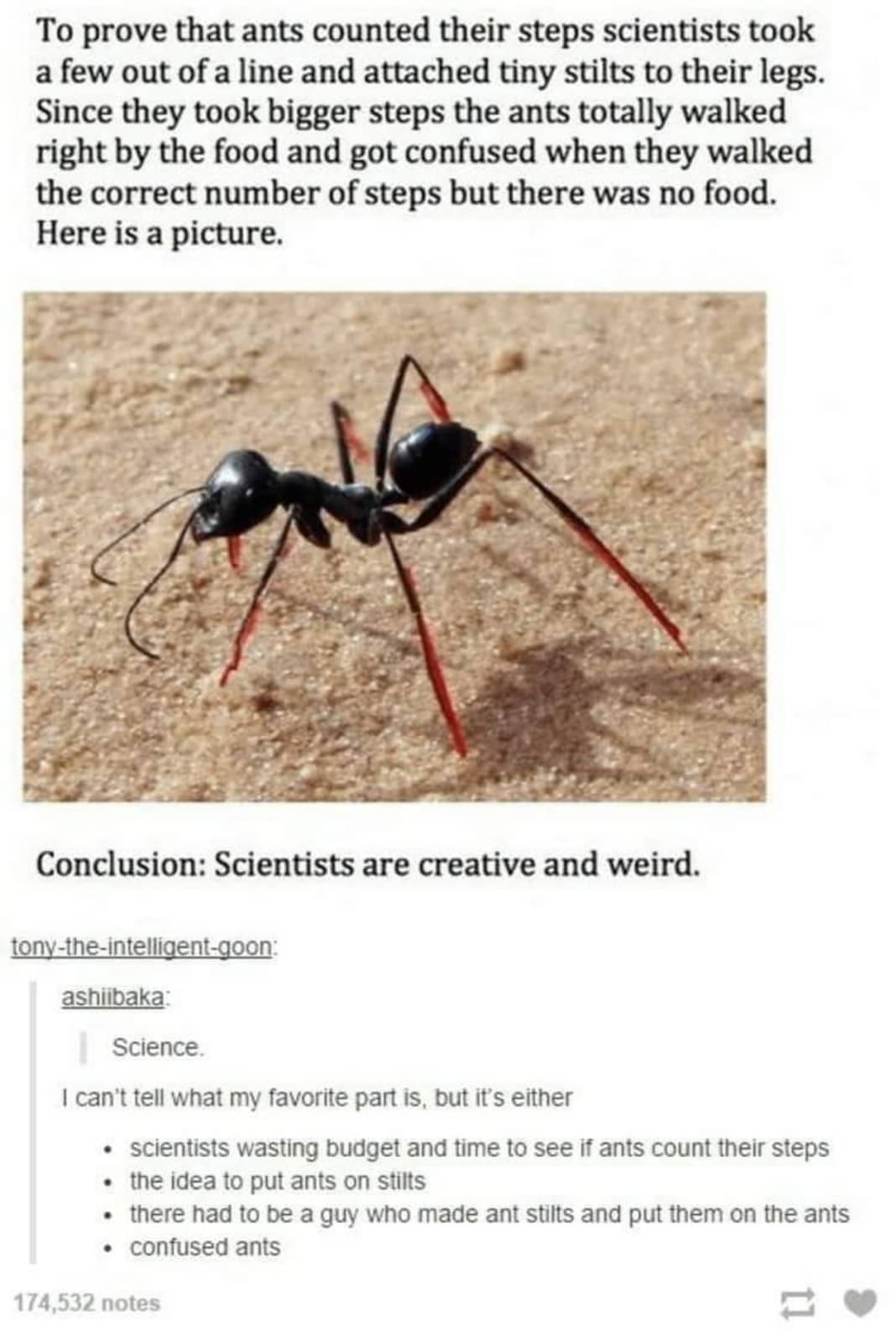
Research for the sake of research is how we make discoveries we never thought possible.
The best discoveries are the ones that start with somebody going, “Huh, that’s weird…”
This one’s not even that far out there. Understanding how ants think has direct applications! Ants must take many thousands of steps in a day; being able to count them precisely requires certain cognitive facilities we wouldn’t otherwise know existed. Next step: figure out how those things work with such simple cognition. Then apply that to self-organizing robots and use them to cure cancer or something.
Get stilted losers
-Science
Science is basically journalism about the natural world. If ants have exposed themselves to a laughable scandal, it’s only a matter of time before we’ve nailed their asses to a wall
How do you determine an ant is confused ?
If you woke up with stilts on one day wouldn’t you be confused? Seems self-evident that ants would be too. Like, “I don’t remember going to bed with stilts on, wtf man, what was I on last night?”
But they kinda say the ants only gets confused once they reach too far and there is no food
You ask it
Anyone else wondering how they even thought “Do ants count their steps?” To begin with ?
Let alone “Do ants count ?”
Nah, the way ants can find their way around has been a favorite question of mine, and I know there’s been a ton of people over lifetimes that have had curiosity about how exactly they navigate the world.
This answer, that they do count steps, makes more questions though. How do they count? Is it some kind of chemical reaction? Is it memory, are they counting in a way that we would recognize at all? Like, they could be fancy versions of those click counters bouncers use to keep track of how many people are up in the club, just some kind of chemical or mechanical tracker. It could be other methods that I can’t think of because I know jack spit about ant biology at that level.
Reaching the specific question from “how do ants navigate” to “are they counting steps” isn’t a big gap. I’m kinda surprised it took much time to get there tbh. Not sure when this experiment was done, but it’s way easier than detecting pheromone trails or whatever else has been done.

What is this? Stilts for ants?
I read ant bootie and thought of something ENTIRELY different
deleted by creator
The second half of this experiment is far less wholesome:
To verify their findings, these scientists reran the experiment by cutting off ants’ legs at the knees. Those ants consistently undershot their targets, showing definitively that ants do actually count their steps.
So yay, verified results via torture!
Unfortunately most if not all of animal science involves torturing animals :'(
I wonder if they happen to use base 10?
I’d guess base 6 with their 6 legs.
Every base is base 10.
Scientists should teach AI to be more like ants, maybe then it can finally do better math.
They could just teach the ants to be an AI like in a certain Tchaikovsky novel.
I wonder if they’re smart to count, or stupid to walk past the food.
Yes
Wasting budget and time? Grad students get paid?
I hope someone glues stilts to their legs then. What. It’s for science. Because we can’t figure out a better way to study how scientists get stilts glued to their legs.