I’ll just come out and say it: 50W. I know, I know an order of magnitude above what’s actually needed to host websites, media center and image gallery.
But it is a computer I had on-hand and which would be turned on a quarter of the day anyway. And these 50W also warm my home, although this is less efficient than the heat pump, of course.
What’s your usage? What do you host?
You must log in or # to comment.
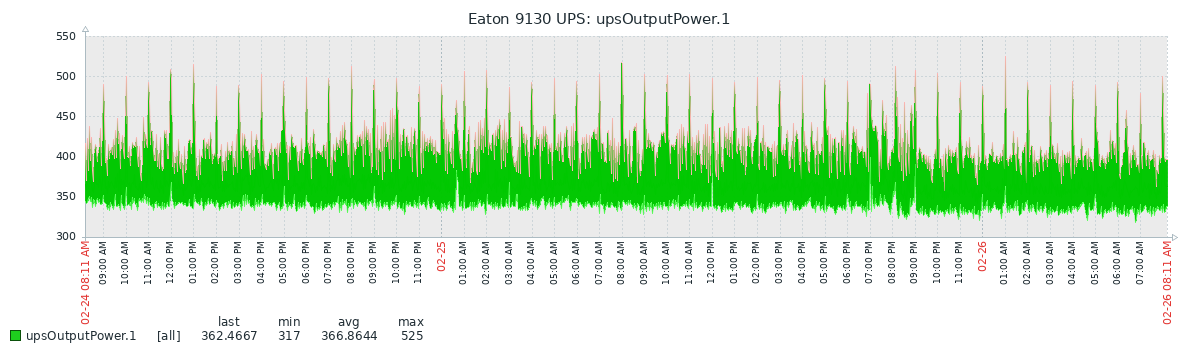
370W average.
3 x Lenovo x3650 M5 (Proxmox Nodes)
- 1 x Xeon E5-2697A v4
- 128GB DDR4 ECC
- 2 x 960GB sATA SSD
- 3 x 900GB SAS3 10K RPM HDD
- 1 x nVidia Quadro M2000
TP Link TL-SG3428X switch
Raspberry Pi 3B+ (physical Pi-hole server)
Generic Mini PC Intel N3150 (OpenVPN client)
Dell Optiplex (OPNSense firewall)
- Intel i5 4590
- 8GB
Is that 370watt across all of them or per fat server? I ask because three m5 sound like a lot of power drain!.
And thanks for sharing!
That’s for everything listed above. This is measured straight from my UPS which everything is connected to.
~600W. 2 machines: Dell 730 8 disks running multiple Minecraft servers. Supermicro 16 disks in raid 10 running multiple VM for various functions. All on a 6kva ups (overkill I know)
Luckily I have a large solar array.
Ok, so most of you also use normal PC processors for your setups. So my power usage is not that high in comparison.
But still, a RaspberryPI would use much less and would still be performant enough.
5W vs 50W is an annual difference of 400 kWh. Or 150 kG CO2e, if that’s your metric. Either way, it’s not a huge cost for most people capable of running a 24/7 home lab.
If you start thinking about the costs - either cash or ghg - of creating an RPi or other dedicated low power server; the energy to run HDDs, at 5-10W each, or other accessories, well, the picture gets pretty complicated. Power is one aspect, and it’s really easy to measure objectively, but that also makes it easy to fetishize.
50 watts is maybe halfof one of my 10 gig switches…
Damn son, what’re you runnung?
dell powerconnect 8164’s and arista 7050tx’s . House is wired with copper so 10 gig copper is what I have to use and that’s power hungry.
Damn, your switches are using that much? I have a MikroTik CRS518 and it’s using like 40 Watts on idle (transceivers not included)
yah, my house is wired with copper and 10 gig copper uses a lot of power. It doesn’t really help that the new slightly less power hungry 48 port 10 gig switches are thousands of dollars. I’m using 100 to 150ish watts per 10 gig switch to be able to buy the switch for under 500 bucks instead of using 60-100 watts and paying 2-5k per switch…
About 500W. 1 self build server 1 Dell R510 and one dell R710. This also includes a bit of network gear like a 48 port switch.
Probably about a kilowatt.
My current setup uses ~180W, which is a lot, but WAY better than my previous one, which was ~600W. Power is cheap where I live, so I’m not too worried about it.
180W homelab:
- N6005 fanless mini PC running pfsense
- mikrotik CRS310-8G+2S+IN switch
- TP-Link AP225 access point
- Server running proxmox w/ AMD 5900X, RTX 3080, 128GB ECC RAM, LSI-9208i w/2x10TB drives, and dual SFP+ NIC
600W homelab:
- Aruba 24-port PoE gigabit switch w/ 4xSFP+ ports
- Dell R720xd fully kitted out w/ 12x 6TB drives, 2x 512GB SSD, 2x 32GB SD cards, 100-something GB RAM, 2x whatever the best CPU was for that unit
- Dell R710 w/ 6x 6TB drives, 1x 256GB SSD, 100-something GB RAM, 2x whatever the best CPU was for that unit.
- TP-Link AP225 access point
~53 W
-
Server:
- AMD Ryzen 5 5600G
- 4x16 GB DDR4 3200 Mhz
- 256 GB NVMe as boot-disk
- 2x256 GB Samsung SSDs for VMs
- 2x2 TB WD Red Plus HDDs
-
Mini PC: Beelink S12 N95
- 16 GB DDR4
- 256 GB NVMe
-
8 port unmanaged TP Link switch
I would like to expand my storage, however I don’t have any available SATA ports and I believe adding an HBA would increase the idle draw about 8 W. I might just upgrade the SSDs and split the storage between the HDDs and SSDs.
-
~25W which consists of:
- Mini PC
- Lenovo Thinkcentre M700 Tiny
- i5-6500T
- 8GB DDR4
- 500GB SSD
- External USB 3.5" enclosure
- 2 x 2 TB HDD
- Network switch
- 4 Ports Gigabit
I’ve been thinking about upgrading because the CPU isn’t that fast, the RAM ain’t that much and I want to add a few more HDD’s. I’ve seen a pretty interesting Lenovo P520 with 64GB RAM a CPU that’s 3x times as fast and room for 6 HDD’s for €350, but the power consumption I can see online (80W) isn’t that appealing with European electricity prices.
- Mini PC
I use an Intel SBC with 10W TDP CPU in it. With a HDD and after PSU inefficiency, it draws about 10-20W depending on the load.
That’s impressive.
What do you use the system for? And services like PiHole or media server?
That’s impressive.
Yeah, you really don’t need a lot of CPU power for selfhosting.
It’s a J4105, forgot to mention that.
What do you use the system for? And services like PiHole or media server?
Oh, sorry, forgot to add that bit.
It’s mainly a NAS housing my git-annex repos that I access via SSH.
I also host a few HTTP services on it:
The services I use most here are Paperless and Piped.
Mealie will be added to that list as soon as the upstream PR lands which might be later this evening.
My Immich module is almost ready to go but the Immich app has a major bug preventing me from using it properly, so that’s on hold for now.
I do want to set up Jellyfin in the not too distant future. The machine should handle that just fine with its iGPU as Intel’s Quicksync is quite good and I probably won’t even need transcoding for most cases either.
I probably won’t be able to get around setting up Nextcloud for much longer. I haven’t looked into it much but I already know it’s a beast. What I primarily want from it is calendar and contact synchronisation but I’d also like to have the ability to share files or documents with mere mortals such as my SO or family.
The NixOS module hopefully abstracts away most of the complexity here but still…Makes sense that basic file hosting shouldn’t use much power.
Sharing stuff with friends and family is in my plan, eventually, not sure what approach to take yet, but I’d like to avoid an app for them, if I can (people are resistant to apps, I kind of get it).
I’ve looked at Nextcloud/Owncloud a few times, and it always seems like a lot more than I need, though I also want to move my calendar, contacts, etc, to my own hosting. Not sure what the right answer is, lol.
My setup already goes quite a bit beyond basic file hosting.
There is no self hosted service I could imagine to need that I’d expect not to be able to host due to CPU constraints. I think I’ll run into RAM constraints first; it’s already at 3GiB after boot.
0.12kWh / h normally (120W). I’m also running 6 HDDs in raid10 so the spin down time is not optimal.
That’s energy, not power. If that’s the energy consumption per hour, then that’s 120W, which is high but not outrageous with a full size computer with 6 disks.
Correct. I assumed a normalized kWh rating would be better than any instantaneous measurement I had on hand.
Don’t have anything spectacular performance wise but my late 2012 i7 Mac Mini Server is reporting ~14w (with my services running and downloads happening) and I saw bursts up to 30w. Not too bad for 12yo Mac running Homebridge, 2 Navidrome instances, Jellyfin, nginx, Transmission, and SMB (looking into Nextcloud to replace that).
120w continuous. Working on bringing it down, because that’s $1/day.
I’d rather spend that money on new hardware every year.
No idea!
Going from publicly-available info though:
Rpi4B - 6.4W max (more like 5 in real world usage)
Cpu case fan - 1.4W
2x SSD - ~6W each
13.8 to ~18 depending on what the SSDs are pulling i guess. I use it as an *arr seedbox and plex server (up to 1080p h264 works flawlessly!) as well as nextcloud
35W
DIY PC with 2 SSD and 1 HDD (it used to be 22W with 3 SSDs and no HDD)
Hosting arr stack, nextcloud, immich and many more (~40 services in total)