For those of you who use Raspberry Pi’s in your home environment, I’m curious as to what you use them for. What applications are you running on them? Do you have your Pi’s setup in a cluster?
RPI4/400 is perfectly capable as a little home server. All it needs is a good SD card.
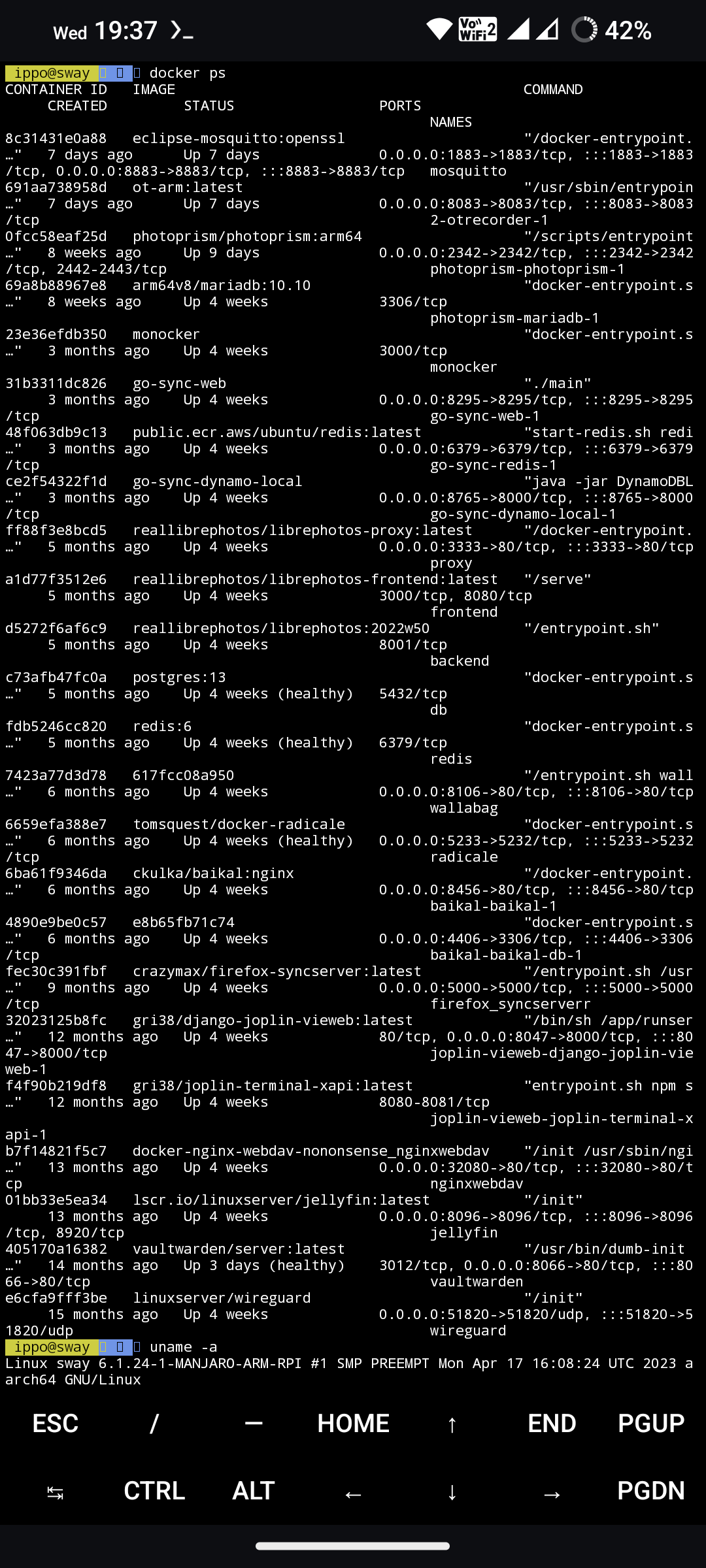
Owntracks,photoprism,monocker,brave go m-sync,libre photos,wallabag,radicals e,Baikal,Firefox sync,Joplin web,webdav server,jellyfin,vaultwarden,wireguard
Get an eMMC module ($10) for the Pi or buy something similar with one built-in. Much faster and more reliable.
Removed by mod
I have one pi (rpi 4b) that I still use. I have it in an Argon One V2 case for the daughter board that lets me boot from an M.2 SATA SSD. I got tired of the corrupted SD cards. It’s actually reliable now.
Anyway, I mainly only use it because in the event of a power outage, as soon as power is restored, it automatically turns on. If I’m not home, I can SSH back into my network and send a WoL packet to my actual server to turn it back on.
The pi also runs:
- Scrypted so I can view my ring cameras in the Apple Home app and so I get the “someone is at the door” notifications on my Apple TV
- Pi-Hole
- Pi-VPN
deleted by creator
I have a Pi4 running octoprint, pi-hole and some of my own containers.
The rest I run on a Hetzner VM.
Cluster of Pi4 8GBs. Bought pre-pandemic; love the little things.
Nomad, Consul, Gluster, w/ TrueNas-backed NFS for the big files.
They do all sorts of nifty things for us including Nightscout, LanguageTool OSS, monitoring for ubiquiti, Nextdrive, Grafana (which I use for home monitoring - temps/humidity with alerts), Prometheus & Mimir, Postgres, Codeserver.
Basically I use them to schedule dockerized services I want to run or am interested in playing with/learning.
Also I use Rapsberry Pi zero 2 w’s with Shairport-sync (https://github.com/mikebrady/shairport-sync ) as Airplay 2 streaming bridges for audio equipment that isn’t networked or doesn’t support AirPlay 2.
I’m not sure I’d buy a Pi4 today; but they’ve been great so far.
I use it as a media remote for my computer via infrared. IR sensor sends analog data to an arduino which converts it to digital and sends it to a raspberry pi which then invokes commands to control media on my computer by invoking rest apis on a “unified remote” server running on the computer.
Feeling impressed here…
If I want to have this, too: is there a kinda tutorial or quick-setup, or is it more like 6 weeks of tinkering? :-)
It actually turned out to be easier than I thought.
The infrared reader (arduino code) is based on
https://github.com/Arduino-IRremote/Arduino-IRremote
The code running on my raspberry pi was written in Java using spring boot which is probably overkill but I am more comfortable with java than python so I used
https://github.com/Fazecast/jSerialComm
to read data from the pi’s usb port and just sent instructions to the unified remote server which does most of the heavy lifting. I used
as a reference along with some verbose logging on the unified remote server to see what codes needed to be sent over the rest api.
Happy to help you along if you want to give this a go :)
I have one Pi 4b for my Homeassistant. It is fixed to a wall, next to the routers, running 24/7.
I did not want to include this on my other Homeserver to avoid the dependency.
This is basically my setup except I don’t have any other homeserver stuff yet :) (I will once I build my new gaming pc, planning to use my old one for that stuff)
I have 6 4b’s running PiCorePlayer for home audio. I control them with LMS and can sync them or play different things in different rooms.
I’m curious about your setup, did you follow a particular guide and what kind of speakers are they connected to? Thanks!
I don’t think I followed a specific guide. I’m using the HifiBerry Amp2 amplifier with the Pis. The house I moved into had Bose in-wall speakers in a couple of rooms and I added some in-ceiling speakers and a couple of outdoor speakers. Most of the speaker wires are routed down to the basement, so I can have all the Pis connected right to the switch via Ethernet.
Running speaker cable is by far the hardest thing about this. You could also connect the Pis via Wi-fi; I haven’t tried that but it is supposed to work pretty well.
On the software end, it’s pretty simple. PiCorePlayer is just an image you burn to an SD card and boot up on the Pis. I run LMS in a docker container. As long as the PiCorePlayer instances and LMS are all on the same subnet, they will auto-discover each other. If they’re not, it’s just a matter of configuring the LMS server URL on the PiCorePlayers.
LMS configuration is also pretty simple… you point it at your music folder and it will scan and index your MP3s and other audio files. It has plugins for Spotify, Tidal, Youtube, and some other apps. You can control it via browser, or there are Android and iOS mobile apps.
Once you buy the Pis, amps, power supplies, and cases, you are looking at probably $140 or so per zone… so it’s not entirely cheap, but I think it’s cheaper than Sonos or other pre-built systems. It sounds great and the different Pis sync very well. I don’t hear any sync issues walking from zone to zone.
RPi 4B > DietPi > Pi hole + Unbound.
I run PiHole on mine
Home security system, VPN, DNS server with pihole.
Yeah but they’re really only good for single purpose things I keep killing sd cards trying to do more.
pihole and an always-on syncthing node.
Currently on my Pi4 I’m running Home Assistant for home automation, Semaphore for nightly runs of my Ansible playbooks, and Wireguard for VPNing into my local network. I’ve moved from PiHole to AdGuard running on my router, as it’s far fewer moving parts.
On my Pi Zero I’m running Pi-Star for my amateur radio needs.