

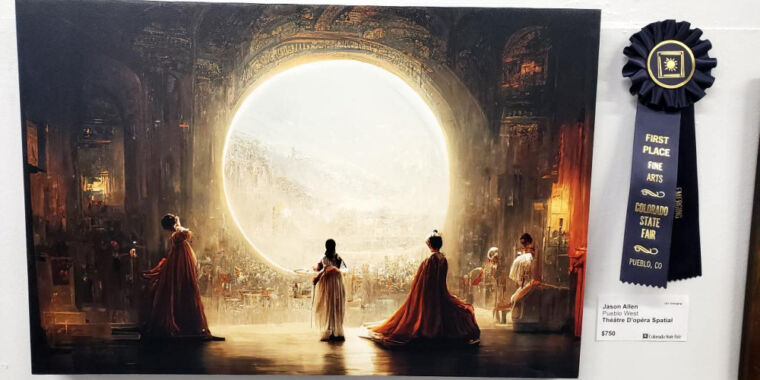
I’ve generally been against giving AI works copyright, but this article presented what I felt were compelling arguments for why I might be wrong. What do you think?
I’ve generally been against giving AI works copyright, but this article presented what I felt were compelling arguments for why I might be wrong. What do you think?
Copyright itself is weird.
That said, a simpler way to handle this would be that the image generator model is a tool. And it doesn’t really matter if your input is through a paintbrush or a prompt in an image generator, you’re responsible for that piece of content thus you have copyright over it.
You can further couple it with the argument @luciole@beehaw.org used, that AI art is derivative work, and claim that the authors of the works used to train the model shall have partial copyright over it too.
To me this is a potential can of worms. Humans can study and mimic art from other humans. It’s a fundamental part of the learning process.
My understanding of modern AI image generation is that it’s much more advanced than something like music sampling, it’s not just an advanced cut and paste machine mashing art works together. How would you ever determine how much of a particular artists training data was used in the output?
If I create my own unique image in Jackson Pollock’s style I own the entirety of that copyright, with Pollock owning nothing, no matter that everyone would recognize the resemblance in style. Why is AI different?
It feels like expanding the definition of derivative works is more likely to result in companies going after real artists who mimic or are otherwise inspired by Disney/Pixar/etc and attempting to claim partial copyright rather than protecting real artists from AI ripoffs.
[Warning: IANAL] The problem is that you guys assume that those generator models are doing something remotely similar to humans studying and mimicking art from other humans. They don’t; at the end of the day the comparison with music sampling is fairly apt, even if more or less complex it’s still the same in spirit.
Furthermore from a legal standpoint a human being is considered an agent. Software is at the best seen as a tool (or even less), not as an agent.
Quantifying “how much” of a particular artist’s training data was used in the output is hard even for music sampling. Or for painting, plenty works fall in a grey area between original and derivative.
Following this reasoning (it’ll get misused by the American media mafia), it’s simply better off to get rid of copyright laws altogether, and then create another legal protection to artists both against the American mafia and people using image generators to create rip-offs.
Certainly no disagreement from me on this point
Copyright is absolutely a can of worms. It always has been.
But it does matter whether your input is a brush or a prompt.
If you physically paint something with a paintbrush, you have a copyright over your work.
If someone asks you to physically paint something by describing what they want, you still have copyright over the work. No matter how picky they are, no matter how many times they review your progress and tell you to start over. Their prompts do not allow them to claim copyright, because prompts in general are not sufficient to claim copyright.
You’re ascribing full human intelligence and sentience to the AI tool by your example which I think is inaccurate. If I build a robot arm to move the paintbrush for me, I would have copyright. If make a program to move the robot arm based on various inputs I would have copyright. Current (effective) AIs prompts are closer to a rudimentary scripting rather than a casual conversation.
It’s not a matter of intelligence or sentience. The key question is whether the output of a prompt is fully predictable by the person who gave the prompt.
The behavior of a paintbrush, mouse, camera, or robot arm is predictable. The output of a prompt is not (at least, not predictable by the person who gave the prompt).
Predictable? How are people ‘predicting’ those abstract paintings made by popping balloons or spinning brushes around or randomly flinging paint around. Where does predictable come in? Humans have been incorporating random elements into art for ages.
After you’ve spun enough brushes or popped enough balloons, the results will be fairly predictable. And some elements, for example the color of paint in the brushes/balloons, would be under full control.
Even if the final result is not completely predictable, an artist only needs to establish that a significant part of it is a form of creative expression.
By “thus you have copyright over it”, I’m saying that it should apply equally to both (paintbrush vs. image generator), not that it currently does.
So if someone asks you to paint something and gives you detailed instructions about what they want to see in your painting, do you think they should have copyright over your work?
Under the spirit of copyright law (that, again, I criticise), and depending on how detailed those instructions are, that wouldn’t be “my work”. It would be “our work”, because the person in question is actively creating the work alongside me.
Transposing this reasoning to images generated by Stable Diffusion etc., you’d get co-authorship between the person inputting the prompt and the people who made the works used to feed the model with. You could even theoretically argue a third author - the person/people coding the model. (It’s a legal nightmare.)
No, under copyright law it would be your work and your work alone.
Someone who is providing suggestions or prompts to you is not eligible to share the copyright, no matter how detailed they are. They must actually create part of the work themselves.
So for instance if you are in a recording studio then you will have the full copyright over music that you record. No matter how much advice or suggestions you get from other people in the studio with you. Your instruments/voice/lyrics, your copyright.
Otherwise copyright law would be a constant legal quagmire with those who gave you suggestions/prompts/feedback! Remember, an idea cannot be copyrighted, and prompts are ideas.
In the case of Stable Diffusion, the copyright would go to Stable Diffusion alone if it were a human. But Stable Diffusion is not a human, so there is no copyright at all.