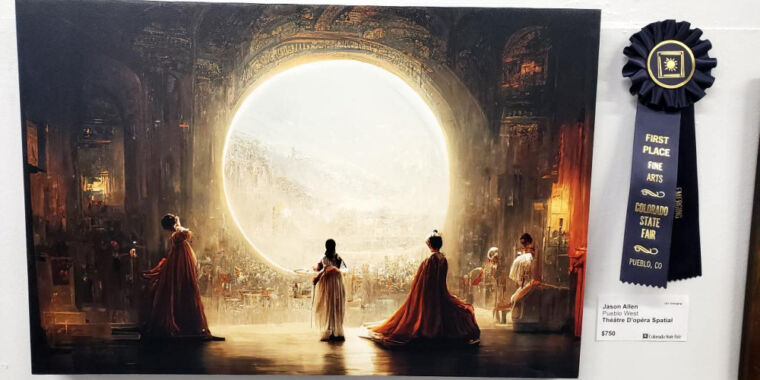
I’ve generally been against giving AI works copyright, but this article presented what I felt were compelling arguments for why I might be wrong. What do you think?
The argument relies a lot on an analogy to photographers, which misunderstands the nature of photography. A photographer does not give their camera prompts and then evaluate the output.
A better analogy would be giving your camera to a passerby and asking them to take your photo, with prompts about what you want in the background, lighting, etc. No matter how detailed your instructions, you won’t have a copyright on the photo.
A better analogy would be giving your camera to a passerby and asking them to take your photo, with prompts about what you want in the background, lighting, etc. No matter how detailed your instructions, you won’t have a copyright on the photo.
I like this analogy a lot.
“Prompts” are actually used a lot in creative circles, whether for art or writing. But no matter how specific you are when you write a prompt for, say, r/WritingPrompts (and some of them are incredibly specific due to posters literally having an idea and hoping someone else will write it for them), the resulting story will never be copyrighted to you.
What if you’re paying the writers on a work for hire basis?
The writing is still copyrighted to the writers, not to you, unless the contract states otherwise. Same as with the wedding photo example described in other comments.
In a work for hire contract, the contract explicitly states that the employer gets the copyright.
You can think of the compensation as being partly from employment, and partly from the sale of any copyright.
A photographer does not give their camera prompts and then evaluate the output.
I understand what you’re trying to say, but I think this will grow increasingly unclear as machines/software continue to play a larger and larger part of the creative process.
I think you can argue that photographers issue commands to their camera and then evaluate the output. Modern digital cameras have made photography almost a statistical exercise rather than a careful creative process. Photographers take hundreds and hundreds of shots and then evaluate which one was best.
Also, AI isn’t some binary on/off. Most major software will begin incorporating AI assistant tools that will further muddy the waters. Is something AI generated if the artist added an extra inch of canvas to a photograph using photoshops new generative fill function so that the subject was better centered in the frame?
I think the major difference that determines copywrightability is the amount of control the artist has on the outcome. If a photographer doesn’t like the composition of a photo, there’s a variety of things they can do to directly impact the photo (camera positioning/settings, moving the subjects, changing lighting, etc.), before it’s even captured by the camera. If someone is generating a picture with AI and they don’t like the composition of the image, there’s nothing they can do directly impact what the output will be.
If you want a picture of an apple, where the apple is placed precisely at a certain spot in frame, a photographer can easily accomplish this, but someone using AI will have to generate the image over and over, hoping that the algorithm decides to eventually place the apple exactly in the desired spot
before it’s even captured by the camera. If someone is generating a picture with AI and they don’t like the composition of the image, there’s nothing they can do directly impact what the output will be.
That is plain incorrect.
This isn’t true with AI generators. You can absolutely draw in a shitty stick figure with the pose you want and it’ll transform that into a proper artwork with the person in that pose. There are tons and tons of ways to manipulate the the output.
And again, we give copyright to artists that incorporate randomness into their art. If I throw darts at paint filled balloons I get to copyright the output. It would be absolutely impossible to replicate that piece and I only have vague control over the results.
The copyright office has been pretty clear that if an artist is significantly involved in creating an image but then adjusts it with AI, or vice versa, then the work is still eligible for copyright.
In all of the cases where copyright was denied, the artist made no significant changes to AI output and/or provided the AI with nothing more than a prompt.
Photographers give commands to their camera just as a traditional artist gives commands in Photoshop. The results in both cases are completely predictable. This is where they diverge from AI-generated art.
Many cameras these days have AI autofocus for subject detection. Phone cameras use AI image enhancemnnt by default.
No matter how detailed your instructions, you won’t have a copyright on the photo.
If you reach a certain threshold you’d be co-creator. AIs can’t hold copyright, so in the analogous case you’d be sole copyright holder.
Take the movie industry and try to argue, as a camera operator, that the director has no rights at all to the video you shoot. I’m waiting.
In the movie industry, everyone usually signs a work for hire contract that specifies who will have the rights to the completed film.
However, in a recent case the director (Alex Merkin) did not sign a contract and then tried to claim copyright afterwards. The court said that directors have no inherent copyright over film:
We answer that question in the negative on the facts of the present case, finding that the Copyright Actʹs terms, structure, and history support the conclusion that Merkinʹs contributions to the film do not themselves constitute a ʺwork of authorshipʺ amenable to copyright protection. … As a general rule, the author is the party who actually creates the work, that is, the person who translates an idea into a fixed, tangible expression entitled to copyright protection. … But a directorʹs contribution to an integrated ʺwork of authorshipʺ such as a film is not itself a ʺwork of authorshipʺ subject to its own copyright protection.
As a general rule, the author is the party who actually creates the work, that is, the person who translates an idea into a fixed, tangible expression entitled to copyright protection
Yes that’s a thing directors do. They do the translation between script and image, anything cinematography in a movie is due to them.
Taking the judges’ reasoning to an extreme you’d expect them to rule that if I dictate a book to someone who then writes it down I do not own copyright because I did not give the work its tangible expression.
Whose lawyers was he up against? Disney?
There’s gaussian noise involved in many of photoshop’s brushes I’m pretty sure.
Does that make photoshop not a pure function of the user’s input, and hence incapable of producing anything copyrightable?
You need direct control over some elements of a work to claim copyright. Not necessarily all of them.
So even if the microtexture is out of your control, you still have complete control of the framing, color, etc. That’s sufficient to claim copyright.
If you lose control of every element by replacing them all with prompts and/or chance, then you lose the copyright. Which is what happened in the “monkey selfie” photo.
“Intellectual property” is a silly concept that only exists because under capitalism massive powerful corporations benefit if they can leverage the legal system to permeantly keep knowledge, innovation, and art behind a paywall, and people in society are dependent on monetary gain to survive.
We should, to the fullest extent of the law, make it such that proper credit is given to people who make things, but calling something “theft” when the person you’re “stealing” from literally does not lose anything is asinine.
It’s not actually called “theft” or “stealing”, it’s called “infringement” or “violation”. Infringement is to intellectual property as trespassing is to real estate. The owners are still able to use their property, but their rights to it have nevertheless been violated.
Also, corporations cannot create intellectual property. They can only offer to buy it from the natural persons who created it. Without IP protection, creators would lose the only protections they have against corporations and other entrenched interests.
Imagine seeing all your family photos plastered on a McDonald’s billboard, or in political ad for a candidate you despise. Imagine being told, “Sorry, you can’t stop them from using your photos however they want”. That’s a world without IP protection.
right, but how often does that actually work out in people’s favor, and how often does that benefit corporate interests with massive influence? how many musicians don’t have the right to their own work because record companies dominate the music industry? how many artists working for large corporations are denied residuals because a condition of their work is that everything they produce is owned by their employer? writers? animators?
that’s not even considering the ways in which corporations patent technologies that are the result of publicly funded research efforts. a great deal of pharmaceuticals would not be possible without massive public research grants, but the companies privatize the results of that research using the framework of intellectual property.
in theory, you’re right, it does protect you against corporations using your shit without permission, but in practice it just stops you from using your shit without their permission. there are far better ways of ensuring corporations cannot exploit you than to make your creativity and invention a commodity to be bought and sold.
how many musicians don’t have the right to their own work because record companies dominate the music industry?
But not having copyright law doesn’t fix that, it makes it worse. Without copyright law if you make music, a big label can grab your music and sell copies without paying you anything. Sure you can try to sell it yourself and try to educate customers that they should buy it from you. But the big label can easily out-advertise you and get into the top spots on streaming services, online and physical stores etc. and get 99% of the sales.
Same for artists, writers, programmers, photographers, or anyone else whose work is protected by copyright.
I fully agree things are not great right now, but that’s not copyright laws fault. I think you need other laws and regulations to fix things, like small creators should be able to sue large companies with minimal cost if they infringeme on their copyright. And there should be some sort of provisions so companies can’t trap people in horrible contracts. I’d also love to see fair use exceptions broadened in cases where the copyrighted material is just not available anymore, like old games or movies that are not sold anymore. Shorten the length of copyright too. But getting rid of it completely would not work.
But not having copyright law doesn’t fix that, it makes it worse. Without copyright law if you make music, a big label can grab your music and sell copies without paying you anything. Sure you can try to sell it yourself and try to educate customers that they should buy it from you. But the big label can easily out-advertise you and get into the top spots on streaming services, online and physical stores etc. and get 99% of the sales.
this is… really not a good example of copyright stopping this sort of stuff. seriously, look into streaming platforms, they are essentially pulling this exact stunt, down to the part about grabbing artists’ music and not paying them anything, and its been extremely profitable for the record companies, who have been found to deliberately manipulate streaming numbers to ensure they get the top spots. most independent artists make very little off of streaming, but are compelled to participate because its captured so much of the market for music. i really can’t exaggerate here, the situation you’re describing as what would happen without copyright law is happening right now, and is being facilitated directly by copyright law as it currently exists.
Okay so without copyright law, what’s the recourse for the creator? What is your suggestion, for example?
Pretty much what happens now–name and shame, get the story out there. If McDonald’s wanted to plaster a billboard with someone’s personal family photos, the odds that that family could even afford a lawyer for recourse to an appropriate degree is essentially nil. What would likely happen is that McDonald’s would settle for some absurdly low dollar value and perhaps take down the billboards–or just as likely, negotiate for use in the settlement agreement, saying “take this and let us use the photo or we’ll see you in court.”
If someone gets a reputation for stealing others’ work continuously, who is ever going to work with them?
copyleft. make contributions voluntary, credit mandatory, and commercialization impossible. gift your creations to the collective knowledge of humanity, and if people like it, they will in turn give you support. cut out corporate middle men, and cultivate an audience that will reward you generously for what you give to them.
Your point of view needs corrective lenses.
Streaming (as a legal business model) is not violating copyright, but streaming changed the business model for a lot of artists negatively.
That’s because in the old days people would buy an album just to listen to a song or two. So basically you get paid up-front for an infinite amount of playbacks.
With streaming artists and copyright holders are paid after the fact, based on the amount of playbacks.
This means singles are much more important than albums, because people don’t really listen to albums like they used to, and if I really like a song and play it a lot it will take a long time before the artist makes an equivalent amount of money as to me buying an album.
It should be fairly obvious that the big record companies come out of this change of business model a lot better because they have a continuous stream of revenue across their played/consumed portfolio, but smaller labels face the same difficulty as the artists.
This has nothing to do with copyright law - which you decide to focus on.
But remove copyright law and no-one is getting paid for anything.
The problem you are complaining about is how labels are milking artists, in lack of a better analogy. A cow gets fed and cared for just enough to make sure milk production keeps going and the cow stays healthy.
A farmer doesn’t cry when a cow gets old and slaughtered, he’ll get a new cow to replace her. That’s just how the business works.
While musical artists are obviously more sentient than cows, record labels follow a fairly similar business model. Help them become creators and make money on the produce.
Obviously not a perfect analogy, but the discrepancy between what the label earns and the artist is nothing new and anyone who was around before streaming should know this.
Streaming (as a legal business model) is not violating copyright, but streaming changed the business model for a lot of artists negatively.
my point is that people seem to think copyright law is somehow protecting artists from corporate exploitation, when it categorically is not doing that. you’re right, streaming as a business model is legal, and it does mean that lots of artists don’t profit as much from their work. that’s the part i object to, the part where copyright law did not in any way prevent record companies from eating into artist compensation.
It should be fairly obvious that the big record companies come out of this change of business model a lot better because they have a continuous stream of revenue across their played/consumed portfolio, but smaller labels face the same difficulty as the artists.
here’s the thing, though. the revenue is being generated on the basis of their ownership of that portfolio, and the only way that works is if there is an enforcement mechanism for that ownership. that enforcement mechanism is copyright law. that state of things as they currently exists allows people who did not make music to make the vast majority of the money from the music that gets made. that is wrong.
But remove copyright law and no-one is getting paid for anything.
they already aren’t getting paid though. copyright law just isn’t ensuring people get paid. like, have you paid attention to the WGA strike at all? companies use copyright law to legally strip the rights artists have over their art far more often than artists use it to prevent their art from being used by corporations.
The problem you are complaining about is how labels are milking artists, in lack of a better analogy. A cow gets fed and cared for just enough to make sure milk production keeps going and the cow stays healthy. A farmer doesn’t cry when a cow gets old and slaughtered, he’ll get a new cow to replace her. That’s just how the business works.
look. i really don’t care how business works. if it’s depriving people of the fruits of their own labor, we should make it work a different way. in any case, making a comparison to a system of agriculture which routinely tortures living beings, forcibly impregnates them, steals the milk meant for their babies, then kills them when they are no longer useful is not the slam dunk you think it is. i’m not particularly fond of that business model either.
Obviously not a perfect analogy, but the discrepancy between what the label earns and the artist is nothing new and anyone who was around before streaming should know this.
right. i’m fully aware this isn’t a streaming only problem, but its one that streaming has exacerbated. that doesn’t make it more okay. functionally, the fact that we have a mechanism by which the legal ownership of artistic works can be transferred to corporate entities concentrates the wealth generated by working artists into the hands of rich executives. i don’t know how i’m meant to ignore the way in which ownership of music is the primary mechanism by which record companies separate the wealth that music produces from the artists that make all the music, no matter how much its actually supposed to make doing that more difficult.
Obviously I’m doing a poor job at getting my points through if you think I’m arguing for the current state of affairs.
It doesn’t mean I’m against copyright.
The principle of copyright is important, so is copy-left (eg. GPL).
Being for copyright doesn’t mean I am against artists being paid their fair share. These are not contradictory principles.
There are certainly huge problems with parts of copyright legislation, especially in the US, and in particular the DMCA.
I always recommend this TED Talk where Larry Lessig talks about the issues with DMCA, and even though it’s starting to get old now it’s still just as relevant and he is still just as on point:
However, the fact that you don’t care about how business works means you ignore the root of the problem - how business works.
I’m not going to argue for communism, but when politicians are for sale to the highest bidder the rest of us lose out.
Feel free to dive into other videos with Larry Lessig if the first one hits home.
I would particularly recommend these two:
Yes I agree with you, but I just don’t see how getting rid of copyright laws would fix this. Copyright laws aren’t helping artists enough, so instead of fixing copyright laws we should get rid of them? What do we do instead to protect artists?
i’m a radical, so i’d say don’t use copyright, use copyleft. make everything free. use open source software. let people listen to your music if they want to, and donate to you if they choose. make it so that the best products on every market are freely available to all people to modify and alter as they wish, and make it so the modifications must also be freely available. allow anybody anywhere to produce any medication they have the means to safely synthesize. make our culture free to use and free to participate in. the open source economy is a great model to look at, and its how we’re talking to each other right now. every piece of information can be that way, if we choose it. information scarcity is already a lie, copyright just artificially imposes antiquated notions of scarcity onto a limitless resource. its a gift economy! we freely contribute, and receive support in turn.
If your job stopped paying you, and told you to rely on donations from your clients/customers, then I’m pretty sure you’d find a different job.
If a musician doesn’t have the right to their own work, it’s because someone offered to pay them for the rights and they accepted.
Is that in their favor? I think so, considering the alternative is to not get paid and not have rights to their work.
And not to go too far off topic, but publicly funded research is generally not aimed at drug development, it is aimed at discovering the basic science behind how the body works (human body or otherwise).
If you want a clinical trial that proves a particular drug can actually help patients, you will need to find a company to pay for it. The government almost never pays for clinical trials (I think the COVID vaccine might have been an exception). Clinical trials are far more expensive than basic science, and patents are the carrot to get the private sector to pay for them.
If a musician doesn’t have the right to their own work, it’s because someone offered to pay them for the rights and they accepted.
Is that in their favor? I think so, considering the alternative is to not get paid and not have rights to their work.
i mean, if you aren’t at least peripherally aware of the ways in which people can be coerced into accepting contracts i don’t know what to tell you. record companies are pretty notorious for exploiting musicians, and musicians have been complaining about it for many decades. same thing with writers, and vfx artists, and game designers, and on and on and on.
If you want a clinical trial that proves a particular drug can actually help patients, you will need to find a company to pay for it. The government almost never pays for clinical trials (I think the COVID vaccine might have been an exception). Clinical trials are far more expensive than basic science, and patents are the carrot to get the private sector to pay for them.
i’m aware of how it works, but it’s now how it has to work. i would prefer they did do all that publicly, and there is nothing that prevents them from doing so. the cost in human lives that comes with entrusting life-saving medications to profit-motivated executives is immense, especially for drugs that treat illnesses that are endemic to poorer nations. in any case, US tax dollars funded every new pharmaceutical in the last decade, and i don’t really care who foots the bill for what part of drug development when exactly zero new drugs would exist without public scientific progress serving as the foundation for these new technologies.
Serious question, when is intellectual property being pirated/stolen (pirating a movie for example), not cause the studio to lose something? You can say that person would’ve not watched it in the first place, but there’s really no evidence suggesting that to be true, and plenty to the contrary. Things that want to be open for knowledge, like open source software or Wikipedia, are consenting to be open, which is in their license. It’s not stealing from them because of their license, so why is it also not stealing when there is a license preventing them from doing so? I’m referring to a digital context btw, where pirating is glorified copy&paste over the internet and nothing is technically physically stolen.
I’m not sure of any evidence suggesting that piracy impacts the bottom line in a meaningful way. The piracy problem is primarily one of competition and innovation–people pay for things they find valuable and convenient, and if the barrier to payment is too high, they won’t pay it.
Highly pirated movies tend to be the most successful, most profitable ones. I don’t know of any high profile, highly regarded pieces of media that didn’t earn their investment back purely because everyone pirated it instead of paying for it.
Some links you might find interesting: https://copia.is/library/the-carrot-or-the-stick/
That last one is an especially interesting case study, albeit a perhaps accidental one.
The key here is that as a business your objective isn’t to capture every last dollar that you potentially could have if every single use of your IP was completely in your control–you want to make enough people want to pay you so that you can be profitable. Pirates are often just providing free marketing to someone that may or may not have ever heard of your product.
They lose remuneration for their work.
I share your sentiment, but I also defend the idea that we shouldn’t let the biggest tech monopolies get away with making bank from other people’s work and creations without their consent first. It’s a bit like licenses in the open source world: it’s not because I put code up there that I mean it to be used for closed source/commercial applications without compensation/consent (GPL), or I mean that, actually (MIT). Similarly, there are CC licenses (and alternatives) to navigate the field of creative works, and we should put Google, Facebook, Microsoft and others back at their place for completely shitting on that. And if the copyright law isn’t the right tool for the job, then let’s find it!
There is literally no instance in which expanding the scope of copyright law is a good thing. Never.
I disagree with this reductionist argument. The article essentially states that because ai generation is the “exploration of latent space,” and photography is also fundamentally the “exploration of latent space,” that they are equivalent.
It disregards the intention of copywriting. The point isn’t to protect the sanctity or spiritual core of art. The purpose is to protect the financial viability of art as a career. It is an acknowledgment that capitalism, if unregulated, would destroy art and make it impossible to pursue.
Ai stands to replace artist in a way which digital and photography never really did. Its not a medium, it is inference. As such, if copywrite was ever good to begin with, it should oppose ai until compromises are made.
If capitalism were unregulated you’d have anarchy and no copyright law whatsoever.
Doesn’t this constitute capitalism destroying art? It’s literally an attack on a method that actual artists are using in their art, trying to deny small creators the ability to expand their output independently.
You’re saying you’re concerned about AI replacing artists, but the people you’re supporting taking tools away from are artists. Artists who are able to use AI to massively increase their productivity are able to create independent works in a much shorter time frame and with much fewer resources than before AI art.
AI art can’t replace anything on its own. It needs actual artistic input and adjustments by an actual human being to consistently output anything that isn’t garbage. What it can do is add tremendous detail and texture to hand drawn art in a much more efficient way, and create large amounts of assets for more involved projects much more cheaply and efficiently than otherwise.
The upshot is that the people who make things actually have enough resources to just make them without having to first do a little bowing and scraping and compromising their artistic vision. AI art takes independent creators with a reasonable ability to create assets for their projects and plops the equivalent of a moderately talented and well-funded art department into their laps for free or close to it.
No boards deciding the product isn’t profitable or needs monetization, no feckless executives looking for somewhere to add ‘input’, basically nobody whose head is full of money getting in the way of making art.
That, to me, is a better world.
So like, if you’re wanting to crusade against AI on behalf of independent creators, please don’t. Please instead do empower us to not have to sell out our ideas in order to make them a reality.
I’m not anti ai, I use it generative ai all of the time, and I actually come from a family of professional artists myself ( though I am not ). I agree that its a tool which is useful; however, I disagree that it is not destructive or harmful to artist simply because it is most effective in thier hands.
-
it concentrates the power of creativity into firms which can afford to produce and distribute ai tools. While ai models are getting smaller, there are frequently licensing issues involved (not copywrite, but simply utilizing the tools for profit) in these small models. We have no defined roadmap for the Democratization of these tools, and most signs point towards large compute requirements.
-
it enables artist to effectively steal the intellectual labor of other artist. Just because you create cool art with it doesn’t mean it’s right for you to scrape a book or portfolio to train your ai. This is purely for practical reasons. Artists today work thier ass of to make the very product ai stands to consolidate and distribute for prennies to the dollar.
you fail to recognize that possibility that I support ai but oppose its content being copywritable purely because firms would immediately utilize this to evade licensing work. Why pay top dollar for a career concept artist’s vision when you can pay a starting liberal arts grad pennies to use Adobe suit to generate images trained in said concept artists?
Yes, that liberal arts grad deserves to get paid, but they also deserve any potential whatsoever of career advancement.
Now imagine instead if new laws required that generative ai license thier inputs in order to sell for profit? Sure, small generative ai would still scrape the Internet to produce art, but it would create a whole new avenue for artist to create and license art. Advanced generative ai may need smaller datasets, and small teams of artist may be able to utilize and license boutique models.
-
The strongest argument against AI art is that it is derivative of the copyrighted art it is based on. A photo of a copyrighted artwork would be similarly difficult to copyright. In this sense, AI art is more akin to music sampling in that it uses original material to make something new – and to sample music you must ask permission.
You can’t copyright AI-generated art even if it was only trained with images in the public domain.
In fact, you can’t copyright AI-generated art even it was only trained with images that you made.
I bet you could build a machine that could recognize subject matter from photographs of it more feasibly than you could build a machine that recognized training data from output
Which works were sampled for this?
Removed by mod
Just move to that one worker’s collective in Spain that worked for a little while.
This is the first actually decent article I’ve read on AI art. It absolutely covers my concerns and fits with my own experiences using the technology. A lot of this is stuff I’ve been saying, and it’s nice to see that I’m not alone here.
AI art is not at all straight-forward and absolutely requires creative input in order to get something usable. Prompt engineering, to me, is itself a type of art. You may at times find that there’s something you want AI to generate that it’s actually quite good at, like old women playing cards around a table, but usually you’re going to be looking for something it struggles with. This is when you need to be creative and inventive with prompts, thinking about things from the perspective of what’s probably out there in abundance.
Recently I needed to make some rings for my upcoming Planescape-themed Conan Exiles server. I started out by asking NightCafe for rings and it output a bunch of useless junk. Using my brain, I realized it’s probably much more likely that it’ll have a reference point for ‘wedding band’, and then I’ll have my ring shape and can work from there. This worked quite nicely and it started producing rings, but it was often shoving them half out of the picture as it tends to do. There are some negative prompts that sometimes help with this, but I have my own technique that I think works better.
My method for framing objects in AI art generators is to surround them with something. If you add ‘surrounded by’ and some other object that’s slightly smaller than the object you need a clean shot of, usually you’ll get your image of the whole thing. Which object you pick to surround your target object with makes all the difference.
In this particular case, I first tried to put the ring on a table surrounded by small dogs, but it got caught up in the dogs and forgot to render the ring. Eventually I landed on ‘surrounded by berries’, and that was the jackpot. I’m guessing this one was a good choice because of Christmas themed ads, because suddenly my pictures were all full of mistletoe blasted with the kind of bokeh you only see in jewelry ads and wedding photos. And within each shot, a nicely centered ring in half-decent focus.
Now this is where I got really lucky. During my ‘surrounded by berries’ iterations, the generator decided to do something weird. It put a bunch of tiny little purple berries along the outer surface of a ring, standing on its side. It was perfect. I took this iteration and used it as a base, feeding it back into NightCafe and decreasing the noise ratio down to like 20-40% while turning up the prompt weight a little and changing my prompt. Now instead of berries and wedding bands, I go back to my initial search for magic rings encrusted with glowing gems. And in one step, my berries are a gorgeous array of gemstones. A few iterations later, I have a couple of decent rings to bring into GIMP and do some work with.
After pathing out the rings, separating the gems, adjusting the colors, and creating a few iterations with different colored bands and gem stones for my different finalized options, I had my results. A little blurry, okay, but totally fine for an inventory item thumbnail. Looks gorgeous.
Personally, I’ve dipped my toes into all sorts of art. I write, I take pictures, I sing, I play around with painting, I’ve made animations, games, mods, videos, weird unpalatable noise music; if it’s a method of creative expression I may not be particularly good at it but I’ve almost certainly tried some version of it. And to me, this feels like creative expression. It feels like art.
Working with AI art feels like trying to collaborate on a project with an alien robot. You’re trying to take these presumptions that we have and figure out how to get a workable result from something that fundamentally doesn’t understand any of it. It’s this really fascinating exercise in exploring this almost dream-like logic that’s heavily rooted in media consumption, and weirdly enough your own understanding of media culture can be a way of teasing out what you want.
I don’t just go and say ‘please give me one rabbit’ and get a rabbit. It doesn’t feel like handing the project off to another artist with some notes and coming back to see what they made, it feels like an actively creative process. It doesn’t feel more creative when I’m editing those images than when I’m digging through this strange robot-logic dreamscape looking for them.
And like, given that I could literally just take a picture one of my own rings and edit that, I don’t see how it’s less mine via creative output. I bought the ring, I didn’t spend an hour digging it out of a morass of nonsense.
Frankly, I care little about law and less about money. I’ll make the things I’m inspired to make with the methods I’m inspired to make them with and we’ll see what happens. Maybe I’ll make something people like, maybe I’ll cut my own ear off and die penniless, but the opinions of the copyright office on what legal claims I can make around my work aren’t really a primary factor in that or in my decision making when it comes to art.
I do hope they’ll read articles like these and talk to folks with similar perspectives and find a better take, though.
I’m really good at searching Google. I’m a “prompt engineer” too
Copyright itself is weird.
That said, a simpler way to handle this would be that the image generator model is a tool. And it doesn’t really matter if your input is through a paintbrush or a prompt in an image generator, you’re responsible for that piece of content thus you have copyright over it.
You can further couple it with the argument @luciole@beehaw.org used, that AI art is derivative work, and claim that the authors of the works used to train the model shall have partial copyright over it too.
AI art is derivative work, and claim that the authors of the works used to train the model shall have partial copyright over it too.
To me this is a potential can of worms. Humans can study and mimic art from other humans. It’s a fundamental part of the learning process.
My understanding of modern AI image generation is that it’s much more advanced than something like music sampling, it’s not just an advanced cut and paste machine mashing art works together. How would you ever determine how much of a particular artists training data was used in the output?
If I create my own unique image in Jackson Pollock’s style I own the entirety of that copyright, with Pollock owning nothing, no matter that everyone would recognize the resemblance in style. Why is AI different?
It feels like expanding the definition of derivative works is more likely to result in companies going after real artists who mimic or are otherwise inspired by Disney/Pixar/etc and attempting to claim partial copyright rather than protecting real artists from AI ripoffs.
[Warning: IANAL] The problem is that you guys assume that those generator models are doing something remotely similar to humans studying and mimicking art from other humans. They don’t; at the end of the day the comparison with music sampling is fairly apt, even if more or less complex it’s still the same in spirit.
Furthermore from a legal standpoint a human being is considered an agent. Software is at the best seen as a tool (or even less), not as an agent.
Quantifying “how much” of a particular artist’s training data was used in the output is hard even for music sampling. Or for painting, plenty works fall in a grey area between original and derivative.
It feels like expanding the definition of derivative works is more likely to result in companies going after real artists who mimic or are otherwise inspired by Disney/Pixar/etc and attempting to claim partial copyright rather than protecting real artists from AI ripoffs.
Following this reasoning (it’ll get misused by the American media mafia), it’s simply better off to get rid of copyright laws altogether, and then create another legal protection to artists both against the American mafia and people using image generators to create rip-offs.
Following this reasoning (it’ll get misused by the American media mafia), it’s simply better off to get rid of copyright laws altogether, and then create another legal protection to artists both against the American mafia and people using image generators to create rip-offs.
Certainly no disagreement from me on this point
To me this is a potential can of worms.
Copyright is absolutely a can of worms. It always has been.
But it does matter whether your input is a brush or a prompt.
If you physically paint something with a paintbrush, you have a copyright over your work.
If someone asks you to physically paint something by describing what they want, you still have copyright over the work. No matter how picky they are, no matter how many times they review your progress and tell you to start over. Their prompts do not allow them to claim copyright, because prompts in general are not sufficient to claim copyright.
You’re ascribing full human intelligence and sentience to the AI tool by your example which I think is inaccurate. If I build a robot arm to move the paintbrush for me, I would have copyright. If make a program to move the robot arm based on various inputs I would have copyright. Current (effective) AIs prompts are closer to a rudimentary scripting rather than a casual conversation.
It’s not a matter of intelligence or sentience. The key question is whether the output of a prompt is fully predictable by the person who gave the prompt.
The behavior of a paintbrush, mouse, camera, or robot arm is predictable. The output of a prompt is not (at least, not predictable by the person who gave the prompt).
Predictable? How are people ‘predicting’ those abstract paintings made by popping balloons or spinning brushes around or randomly flinging paint around. Where does predictable come in? Humans have been incorporating random elements into art for ages.
After you’ve spun enough brushes or popped enough balloons, the results will be fairly predictable. And some elements, for example the color of paint in the brushes/balloons, would be under full control.
Even if the final result is not completely predictable, an artist only needs to establish that a significant part of it is a form of creative expression.
But it does matter whether your input is a brush or a prompt. // If you physically paint something with a paintbrush, you have a copyright over your work.
By “thus you have copyright over it”, I’m saying that it should apply equally to both (paintbrush vs. image generator), not that it currently does.
So if someone asks you to paint something and gives you detailed instructions about what they want to see in your painting, do you think they should have copyright over your work?
Under the spirit of copyright law (that, again, I criticise), and depending on how detailed those instructions are, that wouldn’t be “my work”. It would be “our work”, because the person in question is actively creating the work alongside me.
Transposing this reasoning to images generated by Stable Diffusion etc., you’d get co-authorship between the person inputting the prompt and the people who made the works used to feed the model with. You could even theoretically argue a third author - the person/people coding the model. (It’s a legal nightmare.)
No, under copyright law it would be your work and your work alone.
Someone who is providing suggestions or prompts to you is not eligible to share the copyright, no matter how detailed they are. They must actually create part of the work themselves.
So for instance if you are in a recording studio then you will have the full copyright over music that you record. No matter how much advice or suggestions you get from other people in the studio with you. Your instruments/voice/lyrics, your copyright.
Otherwise copyright law would be a constant legal quagmire with those who gave you suggestions/prompts/feedback! Remember, an idea cannot be copyrighted, and prompts are ideas.
In the case of Stable Diffusion, the copyright would go to Stable Diffusion alone if it were a human. But Stable Diffusion is not a human, so there is no copyright at all.
The comparison between photography and AI generated images falls flat on its face when you think about it.
A camera requires not only human interaction, but going some place, setting up and having to process the image after the fact.
Contrast that with an AI farm constantly generating and squeezing out copyrightable material while scraping the web for any human made work it can emulate.
In the end what it will mean is that certain companies will be fuzzing the hell out of the copyright system to gain as much intellectual property as possible while diminishing the creative possibility of human beings.
It is in effect just a way to make companies richer and remove creative jobs from the market. Anybody who doesn’t see that is naive.
BUT I think that in cases of that image you should be able to apply for copyright. But just automatically getting it, as is the law in many countries? No. That’s a really bad idea.
The author of this opinion has a point, and that artist not getting ownership of works involving AI image generation is a consequence, but I like that it also discourages big studios from taking AI generated mishmash as a drop-in replacement for human produced artwork. If they used it some video generation program at this moment to replace strikers, there are grounds that the studios have no ownership of it.
Anyways, I think copyright law should be fully torn down and rebuilt to reasonable levels, so AI may be a good catalyst to achieve this vision of mine.
This is going to be the kind of thing that builds resentment against humanity among AI persons. Of course the law will lag by perhaps a hundred years before recognizing them as persons, and more likely they’ll fix it themselves instead of waiting for us to fix it.
There is an error that many in the dispute are making…
Imagine that BORG-AI is an ai that was trained ONLY on GPL2 program-code…
Imagine that you use it to fill-in some functions in your codebase…
What sort of copyright-status should be on those??
I say they should be GPL2, and they should be considered derivative of the ENTIRE training-data-set.
That doesn’t mean I think that the BORG-AI should be a copyright holder, though!
I’m saying that there should be a NEW category, between uncopyrighted & copyrighted, and that the training-sets need to be segregated by license, so that derivatives CAN know what their legal licensing-status is.
GPL2, GPL3, BSD, LGPL2, whatever… it needs to be consistent within the training-data-set, so that the derivative of THAT module/expert can be having the same license, see?