0x4E4F@infosec.pub to Programmer Humor@programming.devEnglish · 2 years agoNot my problem sortinfosec.pubimagemessage-square48linkfedilinkarrow-up1619arrow-down112
arrow-up1607arrow-down1imageNot my problem sortinfosec.pub0x4E4F@infosec.pub to Programmer Humor@programming.devEnglish · 2 years agomessage-square48linkfedilink
minus-squareBatmanAoD@programming.devlinkfedilinkarrow-up117·2 years agoReminds me of quantum-bogosort: randomize the list; check if it is sorted. If it is, you’re done; otherwise, destroy this universe.
minus-squarexmunk@sh.itjust.workslinkfedilinkarrow-up80·2 years agoGuaranteed to sort the list in nearly instantaneous time and with absolutely no downsides that are capable of objecting.
minus-squarefrezik@midwest.sociallinkfedilinkarrow-up39·2 years agoYou still have to check that it’s sorted, which is O(n). We’ll also assume that destroying the universe takes constant time.
minus-squareBatmanAoD@programming.devlinkfedilinkarrow-up36·2 years agoIn the universe where the list is sorted, it doesn’t actually matter how long the destruction takes!
minus-squareBenjaben@lemmy.worldlinkfedilinkarrow-up8·2 years ago We’ll also assume that destroying the universe takes constant time. Well yeah just delete the pointer to it!
minus-squarevithigar@lemmy.calinkfedilinkarrow-up14·2 years agoExcept you missed a bug in the “check if it’s sorted” code and it ends up destroying every universe.
minus-squaredb2@lemmy.worldlinkfedilinkarrow-up5·2 years agoThere’s a bug in it now, that’s why we’re still here.
minus-squareZaphod@discuss.tchncs.delinkfedilinkarrow-up20·2 years ago The creation and destruction of universes is left as an exercise to the reader
minus-squareBatmanAoD@programming.devlinkfedilinkarrow-up5arrow-down1·2 years agoCreation is easy, assuming the many-worlds interpretation of quantum mechanics!
minus-squareNaN@lemmy.worldlinkfedilinkarrow-up13·2 years agoInstead of destroying the universe, can we destroy prior, failed shuffle/check iterations to retain o(1)? Then we wouldn’t have to reload all of creation into RAM.
minus-squareBatmanAoD@programming.devlinkfedilinkarrow-up6·2 years agoDelete prior iterations of the loop in the same timeline? I’m not sure there’s anything in quantum mechanics to permit that…
minus-squareSubArcticTundra@lemmy.mllinkfedilinkarrow-up12·2 years agoWhat library are you using for that?
minus-squareSkaveRat@discuss.tchncs.delinkfedilinkarrow-up10·2 years agoIn Python you just use import destroy_universe
minus-squarefrezik@midwest.sociallinkfedilinkarrow-up2·2 years agoSince randomizing the list increases entropy, it could theoretically make your cpu cooler just before it destroys the universe.


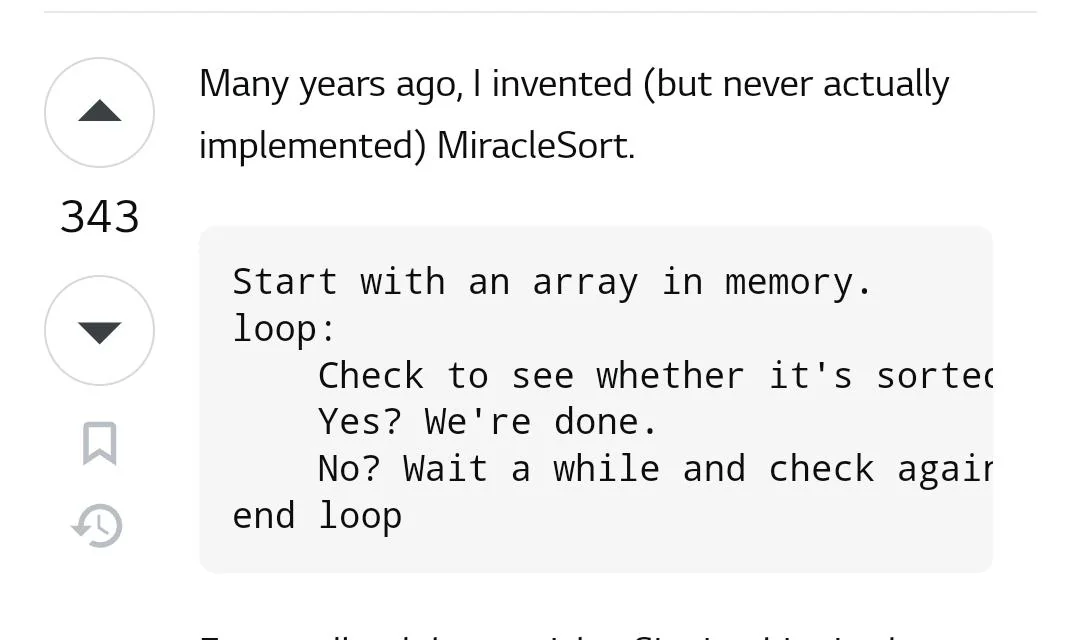
Reminds me of quantum-bogosort: randomize the list; check if it is sorted. If it is, you’re done; otherwise, destroy this universe.
Guaranteed to sort the list in nearly instantaneous time and with absolutely no downsides that are capable of objecting.
You still have to check that it’s sorted, which is O(n).
We’ll also assume that destroying the universe takes constant time.
In the universe where the list is sorted, it doesn’t actually matter how long the destruction takes!
amortized O(0)
Well yeah just delete the pointer to it!
universe.take()Except you missed a bug in the “check if it’s sorted” code and it ends up destroying every universe.
There’s a bug in it now, that’s why we’re still here.
deleted by creator
Creation is easy, assuming the many-worlds interpretation of quantum mechanics!
Instead of destroying the universe, can we destroy prior, failed shuffle/check iterations to retain o(1)? Then we wouldn’t have to reload all of creation into RAM.
Delete prior iterations of the loop in the same timeline? I’m not sure there’s anything in quantum mechanics to permit that…
What library are you using for that?
In Python you just use
import destroy_universeSince randomizing the list increases entropy, it could theoretically make your cpu cooler just before it destroys the universe.