

7·
1 month agonot if both upvotes and downvotes are zero ❗️
not if both upvotes and downvotes are zero ❗️
lol hardcoded shit everywhere. that codebase is so bad it’s entertaining. you should make a standalone post about this here and crosspost to !programming_horror@programming.dev

Technically it’s not really a horizon if it “opens up” allowing you to observe events from the inside afterwards. But of course in any realistic setting (including that experiment) it will open up eventually, so no horizon. But nature doesn’t know that it will open up, so maybe it should behave like a horizon until nature knows, resulting in a criteria like you said. I think the criteria is loosely equivalent to saying “the acceleration must change the speed by almost c”, so your centrifuge probably wouldn’t lead to radiation.
But I really am not sure about any of this. The right way to do this is to actually calculate the mode function. One day when I’m better with QFT and all these stuff I’ll try to do it.
So I did a bit more reading. It seems like acceleration alone is not enough for invoking equivalence principle and saying we have Unruh radiation. If it was enough, non-blackholes objects would Hawking radiate like both of us were suspecting. Apparently physicists are quite confident only blackholes can Hawking radiate.
There is another picture that may work better for us. Instead of thinking of Unruh radiation (which would require doing serious QFT in curved spcetime calculations), we can think of the radiation coming from ripples popping up near the horizon (the black hole horizon for Hawking, the Rindler horizon for Unruh).
In this picture you absolutely need a horizon to get radiation. So on the centrifuge you won’t feel any radiation 🤷♂️
For a finite game with no draws you are indeed able to.
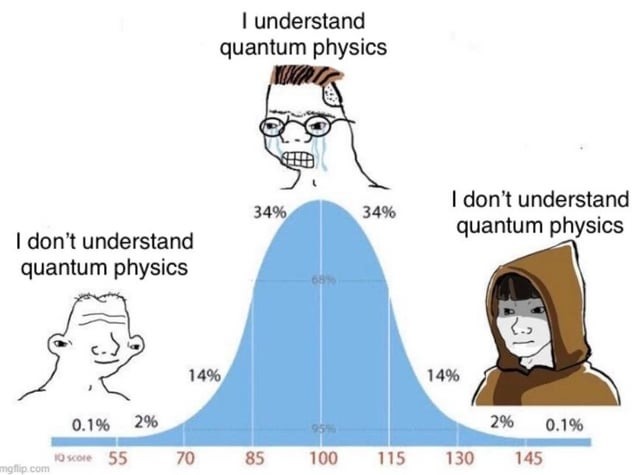
good meme!
by the equivalence principle, even earth’s 1g gravitational field should already lead to some Unruh radiation for us, so you don’t even need a centrifuge!
but your centrifuge is interesting. from the PoV of someone at rest angular momentum needs to be conserved so as you get fatter the rotation must slow down as @herrpfad@feddit.org said. but from the troll’s PoV why should they slow down? it’s a thermal spectrum, and acceleration is radially inward, so why should there be a retrograde force? (like, what makes the retrograde direction more special then prograde?)
i think the resolution is you don’t get exactly Unruh radiation (because your acceleration isn’t actually constant (its rotating)), but how exactly that affects the mode functions i have no idea
also let’s tag @surrealpartisan@lemmy.world
It is giving you exactly what you ask for.
To people complaining about this: I hope you will be happy in the future where all LLMs have mandatory censors ensuring compliance with the morality codes specified by your favorite tech oligarch.
It’s a math trick. Not a physical theory.
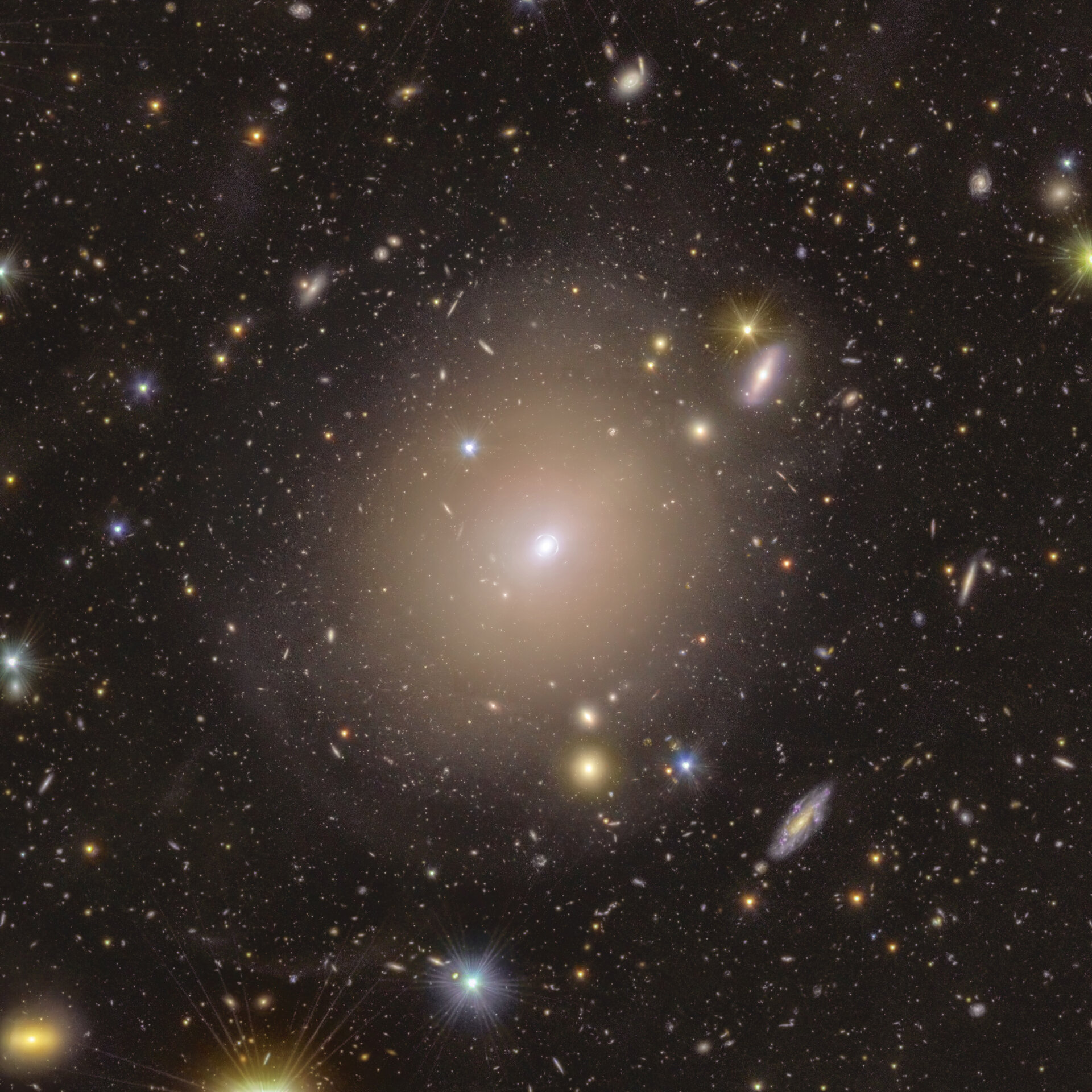
I think we just differ on the terminology of invention versus observation. What draws the line between a well-supported theory and an observation in the end comes down to how tangible you think the data is.
I must admit I don’t know that much about MOND being tested. But yeah, from a Lambda CDM point of view it is unsurprising that MOND would not work well for every galaxy.
WIMP is only one model of dark matter. A favorite of particle physicists. But from a purely astrophysics point of view there is little reason to believe dark matter to have any interaction beyond gravity.
But it is a model we invented no? To explain the astrophysical and cosmological observations.
Among all those observations, a commonality is that it looks like there is something that behaves like matter (as opposed to vacuum or radiation) and interact mostly via gravity (as opposed to electromagnetically, etc.). That’s why we invented dark matter.
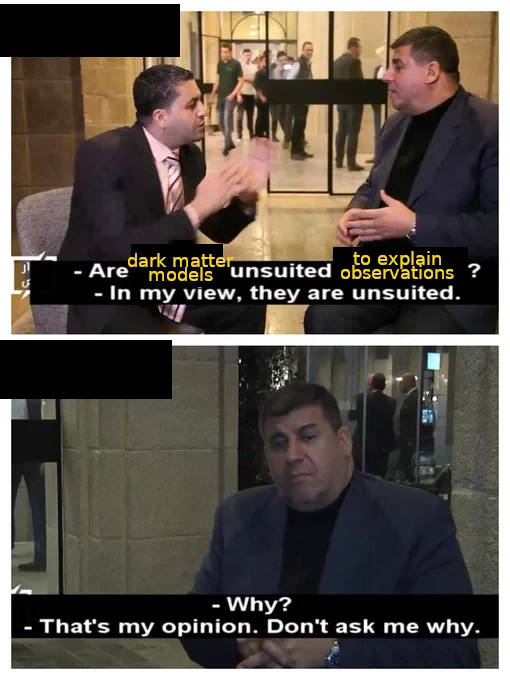
The “it is unsuited” opinion in this meme is to poke at internet commentators who say that there must be an alternate explanation that does not involve new matter, because according to them all things must reflect light otherwise it would feel off.
Once you believe dark matter exists, you still need to come up with an explanation of what that matter actually is. That’s a separate question.
(I’m not trying to make fun of people who study MOND or the like of that. just the people who non-constructively deny dark matter based on vibes.)
Particle physicists love the Weakly-Interacting Massive Particle dark matter model. But from a purely astrophysics point of view there is little reason to believe dark matter to have any interaction beyond gravity.
I’m still far from convinced about MOND. But I guess now I’m less confident in lambda CDM too -_-
I’m inclined to believe it’s one or many of the potential explanations in your second link. But even then, those explanations are mostly postdictions so they hold less weight.
MOND is a wonderful way to explain rotation curves but since then with new observations (bullet cluster, gravitational lensing, …) MOND doesn’t really hold up.

Someone managed to run it on a cluster of Mac Minis lol https://blog.exolabs.net/day-2/
Earth is in this case not an inertial reference frame. If you want to apply Newton’s second law you must go to an inertial reference frame. The 9.81m/s/s is relative to that frame, not to earth.
That is one very impressive feather.
Restricting ourselves to feathers made by non-human animals
🤔🤔🤔
Re your first point: I was imagining doing the two experiments separately. But even if you do them at the same time, as long as you don’t put the two objects right on top of each other, the earth’s acceleration would still be slanted toward the ball, making the ball hit the ground very very slightly sooner.
Re your second point: The object would be accelerating in the direction of earth. The 9.81m/s/s is with respect to an inertial reference frame (say the center of mass frame). The earth is also accelerating in the direction of the object at some acceleration with respect to the inertial reference frame.







Usually 0/0=NaN and NaN compared with a number would be false.
Maybe the (up-down)/(up+down) is just what AmazingWizard summarized from the code. But from what we have seen of the quality of that codebase I won’t be surprised if it’s literally this expression, division by zero and all. Lol