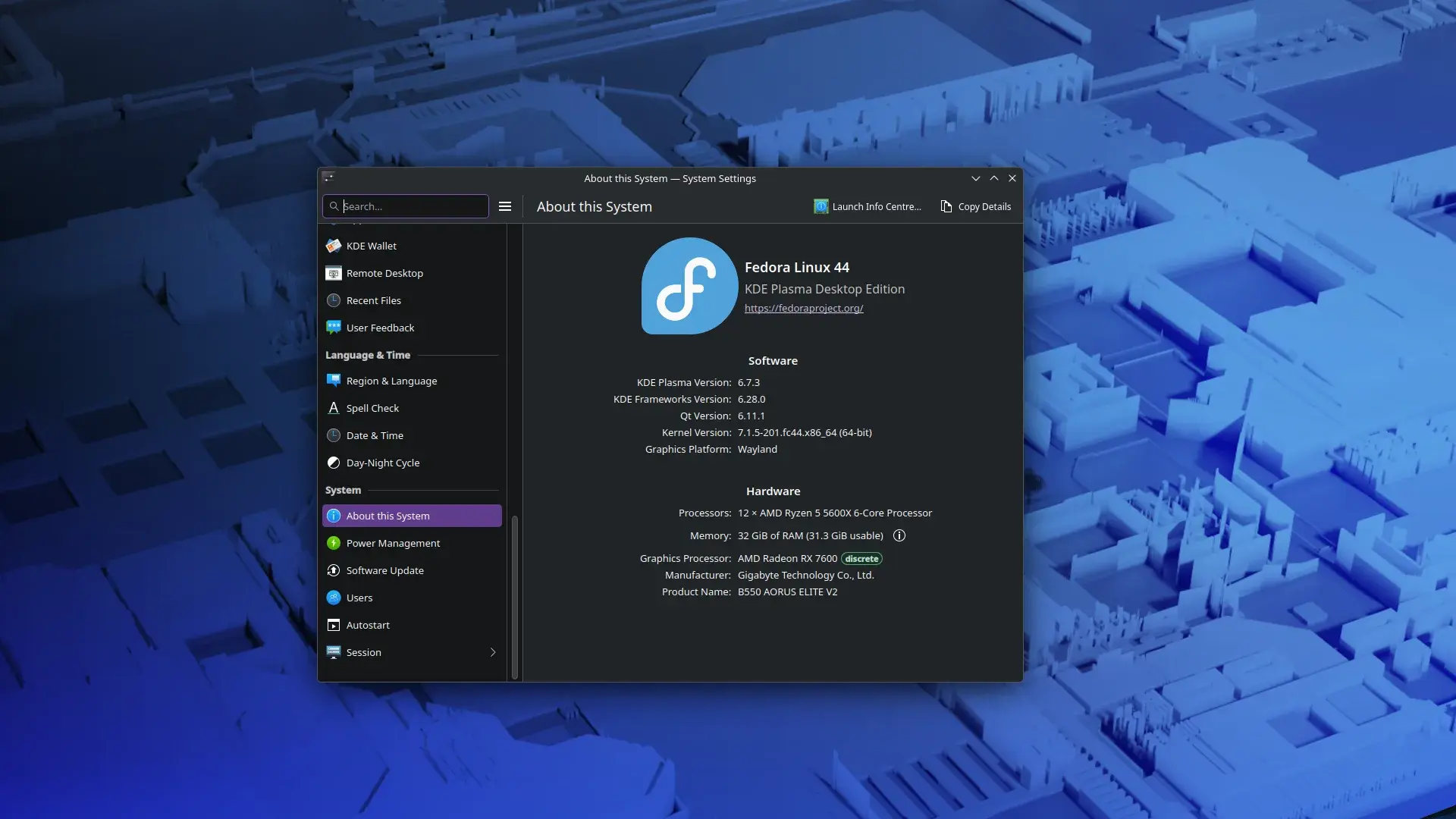
Two years into full-time Linux and I’m finally burning the distro-hopping cycle. I fell for the Arch/AUR trap for a while, but I got tired of spending my weekends debugging file manager crashes instead of maintaining my home lab.
Switched back to Fedora, and it’s boring in exactly the way I need it to be. It’s a stable launchpad for my projects, not the project itself.
NixOS for everything except my phones (one clean iPhone with Lockdown mode enabled and one Pixel 9a with GrapheneOS).
Fedora for fun, OpenSUSE for work.
Nobara for fun, rocky for work.
I worked on United Linux, with suse. Never again.
Uh, twenty years ago? Why’s that?
Debian for server, NetBSD for tinkering
I don’t do either of those things tho
Selinux
Rootless podman networking
These things are awful on their own to comprehends for those of us without comp-sci degrees, but fedora has me boxing with them more than I expected and fuck everyone involved with that!
Kinoite user here - no urge to hop. Distrobox if I need something else
I fell for the Arch/AUR trap for a while, but I got tired of spending my weekends debugging file manager crashes instead of maintaining my home lab.
What sort of file manager crashes were you having?
Right mouse click, it was an intermittent issue and never did get to the bottom of it as the only forum posts I could find were from 10 years ago. Yes I know I could of used the keyboard shortcuts but my muscle memory is more mouse orientated than keyboard lol
I did the same thing. Settled om Baazite
Me too, on all my desktop PCs. Aurora on my work laptop. Ublue rocks.
Don’t get comfy, I used to be fedora, then debian, then arch. Mint + Cinnamon is my final resting place.
I like cinnamon. Haven’t run desktop Linux since slackware, so it was a breath of fresh air on Nobara.
I have been on this Linux jam since 1996 with a CD copy of Red Hat that came with a magazine (Byte, maybe?). In 2018 I made the jump to Debian based distros specifically because I got tired of the surprises. Now my lab runs LMDE. The only thing more stable and boring is Debian Stable itself.
Like you said, I want to focus on my projects, not have the OS be my project.
it’s kind of strange hearing about all this stability and everything on debian stable (and lmde by extension), when it was constantly broken for me and i had to do all kinds of weird fixes
i have a lenovo thinkpad t490s too so it’s not like im running on brand new components or anything either
been running fedora kde for a few months and it’s been running like a dream
That is strange.
it is!
i’m wondering if i have some special version of the t490s cus thinkpads are supposed to co-operate well with linux
fastfetch says the host is “20NYS0FU00 (ThinkPad T490s)” if that rings a bell to anyone
I had Debian stable on my T480 for some time (maybe 3 years) and had no trouble at all. I was running XFCE at that time.
At the same time, Ubuntu is so dumbed down thst certain things are impossible via the UI. I spent a whole day and 5 reinstalls to be able to install an encrypted OS next to another partition. This used to be trivial though the infstaller.
My first Linux distro was Red Hat 6 around 1996 I would suspect. It came with a Linux book that I bought.
I am pretty sure I started with either Halloween or Mother’s Day because Red Hat Linux for Dummies came with Red Hat 2.1 which I am pretty sure came out in 96 or 97. I know Red Hat 6 was released in 1999, because I was neck deep in Y2K work at the time I installed it on my Compaq laptop.
I found the O’Reilly Red Hat 6 book online and it came out in August 1999. I would have pegged it earlier than that but I guess not.
Debian for servers and fedora for desktop for me.
Some people I will put on Mint for desktop use, if they are super non-technical.
I love mint and I’m at least a little technical. Although I’m still mad I couldn’t get fedora working on my laptop.
What did you struggle with?
The live USB would boot, but the install would fail. It was my only computer at the time, so I needed it up and working and couldn’t really troubleshoot. In fairness, ASUS is not known for it’s Linux support.
Bazzite has lots of customizations built-in if you download the Asus spin.
Interesting! I’ll have to check it out. I’m a little wary of immutable distros though. I do a fair amount of tinkering and random package installs. And I dont love flatpak.
They are not as restrictive as people make them out to be. Ostree works quite well for installing a primary app like a different browser.
If you want to avoid dependency conflicts entirely, You can have a look at distro shelf. It allows you to run a container for nearly any distro, install packages and then export those apps to run like native apps. I use it all the time when something is only supported via package and not flatpack, or some other distro only.
The container still maps to your same home folder for file and config access.
I have 3 containers, a fedora workstation one for standard apps I don’t want to do via Flatpak or AppImage. An Debian one for deb packages. And lastly a Arch one, which is for the more experimental apps. If I end up breaking something, I can just wipe the container and start again.
Well, I think I know what I will dive into next when my free time opens back up. First things first is rebuilding my homelab after drive failure. Thanks for the tips!
Exactly what I do
Holy shit me three. Although I am currently running an experiment where my partner, who is less technically inclined, is using zorin instead of mint. Been about 2 weeks since I refreshed their laptop. They still haven’t turned it on. Will report back.
Insert spongebob time meme.
Luckily for me, I switched from Cachy to Fedora kde right before the AUR attacks started happening. Fedora honestly feels like home to me now. I customized it to have a very Gnome like workflow, and its working flawlessly for me.
Why not fedora gnome? 🤔
Isnt gnome a bit more resource intensive? also like the option of more customization if i ever wanna change the layout or aesthetic.
You can customize gnome pretty far. The code to have normal human minimize/maximize/close buttons is all still there, and the window bar is there as well. You just have to know which programs to pull from dnf that know what
registrydconf settings to adjust. I have yet to find a use case for nautilus between Dolphin (KDE) and using a terminal.Huh good to know. Will be honest I’m a pretty slow learner, but I do find it pretty fun to explore all the options I get on linux. Knowing me it will probably be years until I find a de (or maybe a tiling window manager) thats perfect for me. Been using linux for maaaaybe 1 1/2-2 years but I still feel like a beginner in a lot of ways.
Install gnome-tweaks. It’ll be under “Accessories” or you can search for it in their activities travesty. There are some gnome-shell-extension-X things to install as well before you head into the tweaks program. They all used to be part of gnome-tweaks and now they’re not. If I recall a helpful web lookup occurs when you’re messing with that stuff and tells you what package to install.
gnome can be rough until you tailor it to your usage or if you’re in an austere environment with no internet. I think all those settings can be changed via editing dconf directly, but I don’t know how, and at this point in my life I don’t really feel like trying to hack a user experience provided to me into usefulness (no root, admin doesn’t want to use linux at all so he sets up the minimal least risky thing he can and won’t change it). gnome’s interpretation of “minimal” is pretty painful.
I use LXQT when I can. I’ll get around to trying modern KDE at some point.
I also settled on fedora with kde but the fans in my laptop keep spinning up every few seconds, even when locked. It’s very annoying.
Is your computer Lenovo by chance? I experience the same with my Lenovo laptop. I could figure out some tweqks to calm it down a little bit, but it’s still running quite often despite a minimal load.
It is; it’s a Lenovo Legion 5. Or something like that.
This issue seems symptomatic to Lenovo Legion laptops, as far as I know. Something seems to trigger the cooling effect. Mine also is a Lenovo Legion laptop.
That’s strange, I hadn’t heard that thanks. Time to do some research.
I get the opposite with any Linux distribution I’ve tried on my HP laptop. Windows, fans never shut up but with Linux just pure silence!
I sometimes dual boot into windows on the same laptop and it also hits the fans hard, especially after booting up, but it doesn’t suffer the periodic fan problem. Not that I’m shilling for windows. I hate windows and use Linux on my server.
I’ve recently had some issues with Fedora (KDE). After I install any update it tells me to restart to finish installing. So I restart and it still tells me the same thing. Probably time I distrohop again.
With the usual restriction of “either upstream or Mint, otherwise you’re doing it wrong”. There are 6 options. Ubuntu is obviously out. Arch is not my cup of tea. Fedora is already ruled out. Debian/Mint aren’t as secure as Fedora/OpenSUSE. That leaves me with going back to OpenSUSE Leap.
But the proprietary media codecs on OpenSUSE come from the AUR … looks like I’m out of options.
This might not be your issue, but I remember for me there’s this button in the tray that appears after all updates are downloaded. You click it and there’s an option to restart and update. If you just go to the main menu to restart, it doesn’t always show this “restart and update” option, and just restarts without installing the updates. Though even if you make this mistake you shouldn’t need to re-download the updates. Just go to KDE Discover and check for updates again, and the button will appear in the tray again. I think.
Also maybe you’d like the Fedora atomic distros, like Bazzite or Aurora. Unlike installing the updates during reboot, they install them in a “disabled state” while the system is running. Then you reboot and it automatically boots to the new version, no need to wait for any installation. What’s neat is that it’s really hard to break. Even if you pull the power while it’s installing updates, it will just use the previous version and try installing again. No risk of corruption.
What’s the security issue with Debian and Mint? Debian is usually my goto but I don’t want to expose myself to security issues
Linux in general is not secure for desktop users. There’s basically never sandboxing, and when there is it’s usually weak, antivirus is rarely used, and developers aren’t vetted as stringently as with paid software. Apparently Fedora and OpenSUSE take these issues more seriously, and SE Linux does somewhat restrict what malicious things a piece of software can do.
It’s a pretty widely held view that Fedora and OpenSUSE are more secure than Debian, Ubuntu, and Arch for desktop users but I’m not really an expert so I’m mostly retroactively justifying what I’ve heard second-hand.
There’s also https://secureblue.dev/
Tried it. Firstly it wouldn’t install. Secondly, the developer lead developer is a very private person and I don’t trust a Linux distro made by someone who is so secretive.
I got fed up with Discover’s whole reboot-to-update thing and just disabled it.
Eventually, I ended up just disabling updates through discover altogether, I’d rather just use my little bash script anyways.
With LUKS the whole “reboot to update” thing is 1000 times as inconvenient. I set it to install updates immediately, and even automatically, but the update process just isn’t going great for me in a bunch of ways.
Yeah, LUKS or multiboot make things much more complicated. I think it’s well intentioned, but I’ve never had any stability issues skipping it, so it seems unnecessary for most folks. Also, snapper-boot is just a better solution to the upgrade stability problem.
Agreed. Fedora is great. Although I do prefer gnome.
What makes you prefer Gnome? To me, it always felt too simple, as if they’re treating the user like a child learning how a computer works. I have the same issue with MacOS too
I could make any de do what I want, but gnome is closest to what I’d build out of the box. And that’s a very simple interface. I particularly like the finger gestures on my laptop touchpad. Once you train your brain, you zoom between desktops and programs on a single screen laptop equivalent to multiple monitors.
Additionally, I’ve found a few simple extensions that I’m sure have kde equivalents, but I’m a creature of habit. Grid is awesome, makes window tiling and snapping awesome. Caffeine for keeping things alive. And a few others. Mostly though it’s just speed of use - especially on the laptop.
One thing though I hate about gnome though is its high dpi monitor scaling support with Wayland when gaming. There’s four or five really dumb things it does. Sometimes it’s easiest to just change the resolution to what you want prior to launching the game.
same reasons as OP. I want my desktop OS to be simple, and I focus on my homelab
Isn’t gnome the default DE on Fedora?
I’ve stuck with Debian on my server and EndeavourOS (Arch, btw) on my PC. Both have been rock solid.