
The country claiming to have the most “freedom” of any country has the highest incarceration rate of any country.
Not so fun fact: the constitution allows for slavery as long as it’s a punishment for a crime.
Hmmm… Nah, those dots don’t connect at all.
And many plantations converted to prisons that are still in operation to this day.
And many states can’t reduce their prison populations because then they’d lose free labor.
And some states use prison labor to staff the governor’s mansion with butlers.
Here in California, prisoners are employed to fight wildfires.
Until very recently, former prisoners were not allowed to be employed as firefighters when they got out. That was corrected by Newsom in 2020.
Man, I fucking love that guy and what he’s been doing. Him and my governor, as well as the governor of Michigan have been having a pissing contest to see who can be the best governor, and we’re all winning.
Go read about the nightmare this Angola prison in Louisiana.
It’s even worse. The original US Constitution does not prohibit slavery. It wasn’t until the Thirteenth Amendment was passed seventy years later - after a Civil War tore apart the country - that slavery was abolished. With the express exception of punishment for a crime. No qualifications for the severity of the crime. And that exception gets frequent use to this day in the penal system
The original US Constitution is explicitly pro-slavery. Not only does it explicitly require non-slaveholding states to return fugitive slaves to their oppressors, but it has multiple mechanisms intended to ensure the dominance of slave states in the federal government.
The Constitution was never a unified idealist vision of liberty. It was a grungy political compromise between factions that did not agree on what the country should be. These included New England Puritans (religious cultists; but abolitionist), New York Dutch bankers (who wanted the money back they’d loaned to the states), Southern planters (patriarchal rapist tyrants), and Mid-Atlantic Quakers (pacifists willing to hold their noses and make peace with the Puritans and planters).
Not only does it explicitly require non-slaveholding states to return fugitive slaves to their oppressors
The Fugitive Slave Law wasn’t part of the Constitution.
but it has multiple mechanisms intended to ensure the dominance of slave states in the federal government.
Again, not part of the Constitution. Those were the various compromises that the South kept getting pissy about foreseeing the end of Slavery, so they kept threatening rebellion.
If anyone tries to tell you the civil war was about states rights, not slavery… These are pretty obviously about slavery. But if they don’t believe that, just let them read the Southern States Declarations of Secession. They say what the civil war’s about in their own words.
The Fugitive Slave Law wasn’t part of the Constitution.
The Fugitive Slave Clause, which authorized it, certainly is though!
There’s a great documentary called 13th about this and racial inequality in America
Not even just the highest rate. The highest number of incarcerated people! Countries with over 1b people still have fewer prisoners, total.
https://worldpopulationreview.com/country-rankings/incarceration-rates-by-country
The Star-spangled Banner (where the phrase “Land of the Free” comes from) was written in 1814, 51 years before slavery was abolished. The idea that America is or ever was the land of the free is a total joke.
The third verse of “The Star-Spangled Banner” is not typically sung today. It refers to “the hireling and slave” among the foes of the Republic. “The hireling” refers to the mercenaries employed by the British crown in fighting the American revolutionaries. It is unclear whether “slave” is intended to derogate all British subjects as “slaves” of the crown, or if it specifically refers to enslaved Africans who were offered their freedom by the British if they fought against the revolution.
That’s what Lincoln said! America’s enemies point to slavery and use it to call the ideals of liberty lies.
This is actually not true any longer, El Salvador now has the highest incarceration rate
… and built its initial wealth on slavery revenue.
It’s a shame because there are a lot of other great things to be proud about when it comes to the US. I guess when people boast about US freedom, what they mean is democracy, and starting the end of the colonial era, inspiring a tidal wave of democratic uprisings around the world, which is accurate. I wish they didn’t use the word “freedom” for that.
That’s not all that exciting. All of Europe (and basically every other are of the world) was built on slave labor as well, that’s literally what the colonial period was about. Also vikings were primarily about capturing slaves, Rome and Greece were mostly slaves, serfdom wasn’t significantly different than slavery.
Sure; but it still bothers me that the US is part of it and yet is often associated with freedom by American nationalists. The same way I’m annoyed that France (my native country, I’m a naturalized American) boasts itself the “pays des droits de l’homme” (“the country of human rights”), despite freedom of speech and of religion having gigantic asterisks, even though they feel like such basic human rights to me. It’s just like, if your national identity happens to not be the greatest at something, maybe don’t boast about being the best at it!
But anyway, this leads me to wonder… I feel like US slavery is discussed and depicted in arts a lot more often, and I genuinely wonder why that is. What do you think? Is it just that American culture chooses to address it head on when a lot of others don’t, or do you think there’s more to it?
Yeah, of all the words that can follow the legaly declared prohibition of slavery, except might be one of the dumbest you can pick…
That’s sounds 100% right and is 100% right
Many companies are making profits off of this. So many states have for profit prison systems and will get fined of they don’t have enough people in those prisons. That is above the free labor most people have talked about.
you are loved and deserve happiness
Fuck Lemmy is unexpectedly wholesome
Bullshit and lies.
No one loves me, and i deserve nothing, for I am trash.
♥️
I love this!
perfect answer, everyone needs to be reminded this sometimes
Awwww <3 that’s something that should be taught at school AND home
A broken clock is right twice a day, but a clock running backwards is right four times a day.
A broken clock is right twice a day, but a running clock is probably never right.
At this point you get into a philosophical discussion about what “right” really means
Two wrong don’t make a right, but three left turns do.
I’m really picky when it comes to clocks. They need to be ±1 minute. If they aren’t it really starts to bother me.
My grandfather clock is correct* about once a week when I wind and correct it
*It must be correct as it’s very slightly fast (less so than can be fixed with a quarter turn off the pendulum screw) and I set it slightly in the past
time dilation ftw!
Depends how fast is going backwards
Also depends how the other clock is broken, if we’re this picky about it.
That’s why the correct term is ‘a stopped clock’ not a broken one.
This only works with 1-dimensional time though.
Luckily we don’t build clocks for n-dimensional time
A day on Venus is longer than a year on Venus.
If you start to think about how these lengths of time are defined it becomes clearer.
1 day = time to rotate on it’s axis once 1 year = time to complete a full rotation around the sun
For Earth, it takes us ~24hrs to rotate on our axis and 365.25 days to orbit the sun.
However, because Venus’ axial rotation is so slow (and another interesting fact, it rotates in the opposite direction to other planets) it actually completes a full orbit of the sun before 1 axial rotation.
Hence, a year is shorter than a day
For those interested:
1 Venus day = 243 earth days 1 Venus year = 225 earth days
Colloquially, most people use “day” to mean how long it takes the sun to get to the same place in the sky. Solar day vs sidereal day, the difference is only about 4 minutes on Earth, but can be much greater elsewhere. Venus’ solar day is about 117 Earth days, so you would see a couple sunrises/sunsets each Venusian year.
This is the most interesting one I’ve read so far.
Wow! That’s another thing I learned from QI recently. Great fact though, and nice to see it mentioned here 🙂
Really interesting.
Cleopatra was born closer to the invention of cellphones than the building of the pyramids
We live closer in time to the T-Rex than the T-Rex to the stegosaurus. Which makes the land before time a fictional story not based on true events.
Also the T in T-shirt stands for tyrannosaurus because it has short arms, just like the T-Rex.
Where did you get that the T stands for Tyrannosaurus? 😂
It looks like a T, that’s why it’s called T shirt, imo, no source either.
I always love this one, just it sounds so crazy
The closest planet to Earth is Mercury.
On average that is. Mercury is actually the closest planet to every other planet in average. Because when it’s on the other side of the Sun, it’s still pretty close.
Wow, you’re absolutely correct!
The average distance from Earth to Mercury is about 1.04 astronomical units (au), which is the average distance between Earth and the Sun.
In comparison, the average distance between Earth and Venus is approximately 1.14 au, while the average distance between Earth and Mars is around 1.7 au.
You can check that in Wolfram Alpha.
I learned this from QI recently. Great piece of trivia!
deleted by creator
You’re still right, though - talking about closest planet on average isn’t very useful, because it’s always going to be the closest planet to the sun. Asking “what planet can get closest to some [Planet]” is more interesting and enlightening.
All the planets in the solar system can fit in the space between the Earth and the Moon
But putting them there is almost definitely a bad idea.
deleted by creator
this is actually a misconception! the gravity of the planets combined would cause them all to crash into each other!
This is a simple statement that the space between the earth and the moon can allow for the diameters of each planet to fit in between. Obviously it is not saying that such an arrangement would be stable for said astronomical bodies. Not at all “a misconception.”
further proof that /j is always necessary, no matter how obvious the joke
Wouldn’t that take even lesser space?
yes but we would all die (due to planet exploding)
Now you have me wondering if there’s any combination of paths that would have them all pass through that alignment and continue on their way after slingshotting around each other. And, if not, how many bodies could do that.
The northern most part of Brazil is closer to Canada than it is to the southern most part of Brazil.
What is this sorcery?
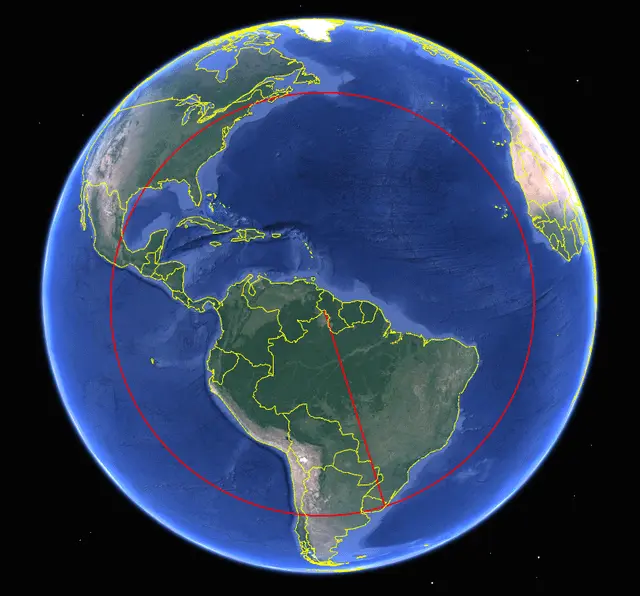
Mercator Projection be like.
That Mercator bastard has been lying to us for centuries. Wake up sheeple!
Ain’t no way!
General Motors, Firestone Tire, Standard Oil, and Phillips Petroleum were convicted of an actual conspiracy related to the monopolization of transit systems, which replaced beloved streetcar (rail) systems with rubber-tired oil-burning buses.
https://en.wikipedia.org/wiki/General_Motors_streetcar_conspiracy
Isn’t this Judge Doom’s plan?
Wasn’t this the plot of Who Framed Roger Rabbit?
Almost every atom in your body has been part of other living organisms thousands if not millions of times before.
Every breath you take has at least 1 atom that was in your mother’s brain when she gave birth to you.
Settle down, Sting.
That’s why I moved to the opposite side of the world.
Every atom in your body was either created from the beginning of the universe or was created inside the heart of a massive star.
As Carl Sagan put it … we are all made of star stuff
The can opener was invented 30 years after the can.
Well, wouldn’t it be weird if it was the other way around?
“Yooo, check this out, I made a new invention, it’s called a can opener!”
What does it do?
“idk”Surely you understand that the remarkable part is the duration between the inventions, not the chronological order.
Crazy amount of not understanding jokes in this thread.
I mean i can invent a time machine opener right now.
The USA is not a true democracy in the academic sense of the word.
A democratic republic more specifically
That’s virtually meaningless. A “republic” is virtually any country that doesn’t have a monarchy or dictator.
So drawing a distinction between a “democracy” and a “democratic republic” in this manner is a waste of time. There plenty of democratic monarchies, which are equally democracies, too.
There has never been a true democracy anywhere and anytime in history, even today.
Every democratic government in existence currently today is severely affected or influenced by monied, corporate, aristocratic, hereditary or powerful interests to some degree. Some countries manage it better than others but all of them fall short of a true democracy … a system that is controlled by the people and benefits everyone equally.
What would it be called from an academic standpoint?
It’s currently deemed a flawed democracy. That is, primarily democratic, but with some authoritarian or illiberal features.
Democratic republic
Can’t a system be a true democracy and a democratic republic at the same time? I don’t see how adding some republic detracts from the democracy.
Republic: “A state in which supreme power is held by the people and their elected representatives, and which has an elected or nominated president rather than a monarch.”
Democracy: “A system of government by the whole population or all the eligible members of a state, typically through elected representatives.”
Well they are just different. It’s like saying a despotism is a monarchy. Technically a despotism is a monarchy, but having a monarchy doesn’t necessarily mean it’ll be a despotism.
Its just not a democracy.
IMO the US is de-facto like the ancient Roman republic, where plebeians, could vote but only for patricians, so “everybody” (ofc slaves and womens rights were neglected back then) could vote but all questions that were ever discussed in the senate were interests of patricians, same goes for political “coverage” and campaign elections.
So there was dissent and processes that were democratic on the surface but they exclusively revolved around the interests of the patricians.
The US is like that where patrician interests are replaced with capital interests. You can only vote multi-millionaires into the white house and the only issues to ever change are the issues of a fraction within the capitalist class (meaning someone living off of someone elses labour rather than their own).
If you belong to those capitalists you enjoy democratic representation, if not you can only decide which capitalist position you find better and vote for that.
And it was never designed to be. It was always meant to be a republic.
We first were a confederation. Were your idea of a true democracy was more or less in place. The revolutionary war was won in 1783. The constitution wasn’t ratified till 1789, and the bill of rights written until 1793. Before that the US had almost no central government, and each state was independent from one another. Had their own currency, banking system, laws, and military.
States still have a lot of that same autonomy today, but there was no central government tying them together. If the US went to war and a state didn’t want to go, they wouldn’t. A little more complex than that, but generally that’s what it amounted to.
Having this type of system created a bunch of problems and came to a head when Shay’s Rebellion happened. I won’t go into depth about it, but mainly confederated Massachusetts couldn’t fight off the rebels attempting to take over the state. Since the US was a confederation there was no central government the state couldnt call on for help, and all the other states more or less said ‘meh sucks for you’.
This incident lead to the Constitutional Convention that wrote the document we still uphold today, and bringing in more of a centralized Federal Republic, and not a decentralized confederated one.
My ranty point is, we tried the whole true democracy thing and it failed. So we went to a Federal Republic, still very much democratic, but moved away from a true democracy.
Interesting, didn’t know about the Shay Rebellion.
“republic” is opposite to “monarchy”. It is unrelated to democracy or authoritarianism. Nazi Germany was a republic. France is a republic.
Your republic is flawed by design. Your founders didn’t trust democracy so they weakened it, the country hasn’t managed to improve the democracy since.
Australia is also a Federation, but a monarchy not a republic. Australia is quite a bit more democratic than America
Ok
Air is a fluid.
What… how?
fluid includes both liquids and gasses.
It flows
what about a glacier? it’s solid but it kinda flows too
So does glass almost, glass is not a liquid, there are more than 5 stated of matter, a lot more, but glass is still a type of solid. It has some characteristics that recemble the characteristics of a really slow moving liquid.
Well glaciers contain both solid and liquid parts. When you compress ice it turns to liquid. Water isn’t really easy to compress, liquid water can be lower than 0c (freezing), which is called super cooled, and it turns to ice when it’d not compressed anymore. You can make super cooled water or even soda at home, and if you give the bottle a shake it will turn to ice in a couple of seconds. Also the ground under the glacier will be moved together with the ice and water, there is do much force there. When a part of a glacier breaks off it’s called calving, like when a cow gives birth to a calf
According to any hydrodynamics code, so are solids.
99.99% of population have more arms than average value.
What about the legs? What happened to the legs?
Maine is the closest US state to Africa.
Is that really true haha
Edit: seems like it, so cool!
https://www.sciencealert.com/which-us-state-is-closest-to-africa
They are the most West, so yea
weast
Potato, tomato
Actually, here’s my fun fact: Alaska is the farthest North, East, and West state in the U.S.
You are technically correct the best kind of correct
I once read a blog from a sailing group that pointed out that there is possible sea route where you could sail from Halifax, Nova Scotia in a straight line and end up in Vancouver, British Columbia.