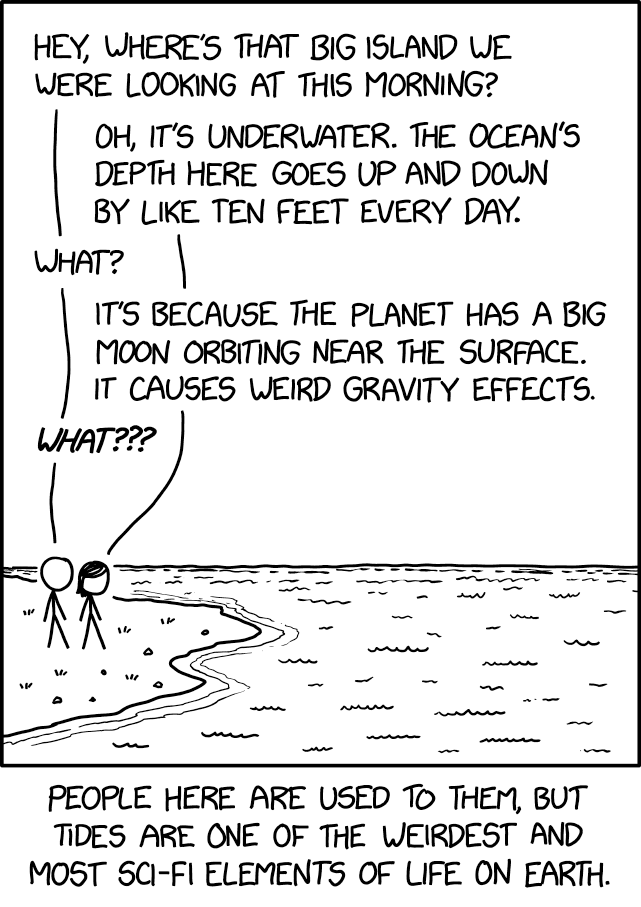

Alt text: They’re up there with coral islands, lightning, and caterpillars turning into butterflies.
You must log in or # to comment.
I think it’s more wild that not only are big moons rare, ours is literally the same size as the sun from our point of view.
It also makes almost exactly 13 laps for every lap the earth makes.
Which is why a 13 month calendar all having 28 days would have made more sense
It makes 12 months because the lap the Earth makes is deducted from the 13 the moon makes, so effectively it makes 12 cycles around the Earth.
You don’t know what you’re talking about
13x28=364. The moon makes 14 sidereal orbits, not 13. The reason the year is split into 12 months is a combination of Roman dipshittery and the fact that 12 is divisible by 2, 3, 4, and 6. The number of factors of 12 made 12 and 60 way easier to work with for societies that hadn’t invented the decimal point yet.
Then please explain how the Hebrew calendar, and all other lunisolar calendars (calendars which follow both the solar year and the lunar cycle) have 12 months most years? https://en.wikipedia.org/wiki/Lunisolar_calendar
“The majority of years have twelve months but every second or third year is an embolismic year, which adds a thirteenth intercalary, embolismic, or leap month.”
12 is an easier number to work with because of how many factors it has
hmm, how about 12 months each with 30 days, plus 5 days every year that’s not part of any month?
plus 5 days every year that’s not part of any month?
Get this Roman bullshit outta here
13*28=364 so even 13 months and 28 days doesn’t work.
If we had 28 days in a month then the week needs to be something other than 7 days. Three out of four times February / March fucks me over by having the same weekday/ day of the month.
Only for pre-decimal society. Nowadays it’s not a problem
Didn’t some cultures do that?
A bit late, but the moon does not make “almost exactly 13 laps”. Info from https://en.wikipedia.org/wiki/Lunar_month
If going by phases of the moon (synodic month), it makes 12.37 laps in a year. Not close to a round number.
If going by position in the sky relative to the stars (sidereal month), it makes 13.37 laps - one more than the former measure, because of Earth’s year cancelling out one month.
There are also other ways to measure it, but none of them get anywhere close to an integer number per year.
It’s almost like someone put it there on purpose 😉
Gross
By far the coolest and most unique aspect of the Earth-Lunar system is solar eclipses. The size and orbital distance is just right to allow for the spectacle we get today.
This is even more true when you consider that the Moon’s average orbital radius is increasing by 3" (76mm) each year. In a million years, the Moon will be too far away to fully cover the Sun. A few million years ago it was close enough to fully cover the corona
I get similar feelings about earth when I can see the moon during the daytime. Something about seeing it with clear craters against the blue sky makes it feel much more like we’re just floating in space with a cratered barren partner.
And the sci-fi cliche is to have enormous moons filling the sky, but realistically, ours is comically large. Even planets in our solar system mostly see moons the way we see those planets. You get a dot.
I wonder if life would exist on our planet if there were not tides.
The Sun also creates tides, just not as strong as lunar tides. So we would still have tides, even if we had no Moon.
The Sun also creates tides
The second worst British tabloid? I highly doubt it.
The ol’ Lemmy-roo!
You should check out king tides https://en.wikipedia.org/wiki/King_tide
Can’t forget magnets. How do they work?
They have small pieces of gravity in them.
So basically … like Miller’s Planet?
So… is the moon a black hole?
Some places only get 1 tide a day, some get 2, and some get a weird mix.
I always wondered how quickly the tides actually change. If the moon is directly overhead, does the tides at the lowest or the highest? Or does it just pushes things around and it’s just different?
Think about the moon like a flashlight beam. Where the center hits the ocean, it keeps a consistent pull upwards, and moves the bulge of water as it orbits. Towards the edges of focus, it’s dropping a bit of water and it’s rippling away as it falls. I am no scientist, but I liked this explanation when I saw it because it was simpler to understand.
It’s because the center of mass between the earth and moon is off center, nearly 3k miles from the core, and constantly moving as the moon orbits.
So it’s not due to a direct pull upwards alone, and the earth’s orbit around the sun technically has a slight wobble due to it.
Edit: For more info, look up info on the barycenter of the earth and moon.
Sounds super complex. No clue how anyone can predict the tides.
deleted by creator
The tides are also likely responsible for advanced life on this planet. So there is that.
It’s your turn Cueball.
I’ve always thought this about Opal stone. It looks like a made up stone from an alien planet.
I’m sorry 1k upvotes? Did I accidently open Reddit without noticing?!
And over a hundred comments. Where the hell did all this come from?
Makes you appreciate how much daily life depends on celestial geometry.
Okay, now I need to read a sci-fi book where someone gets on this weird sci-fi planet, and maybe at the middle or end we find out that those are aliens and the planet is Earth. Sounds like a great premise and I’m sure such book was written. Please, someone tell me in the comments, I need to know.