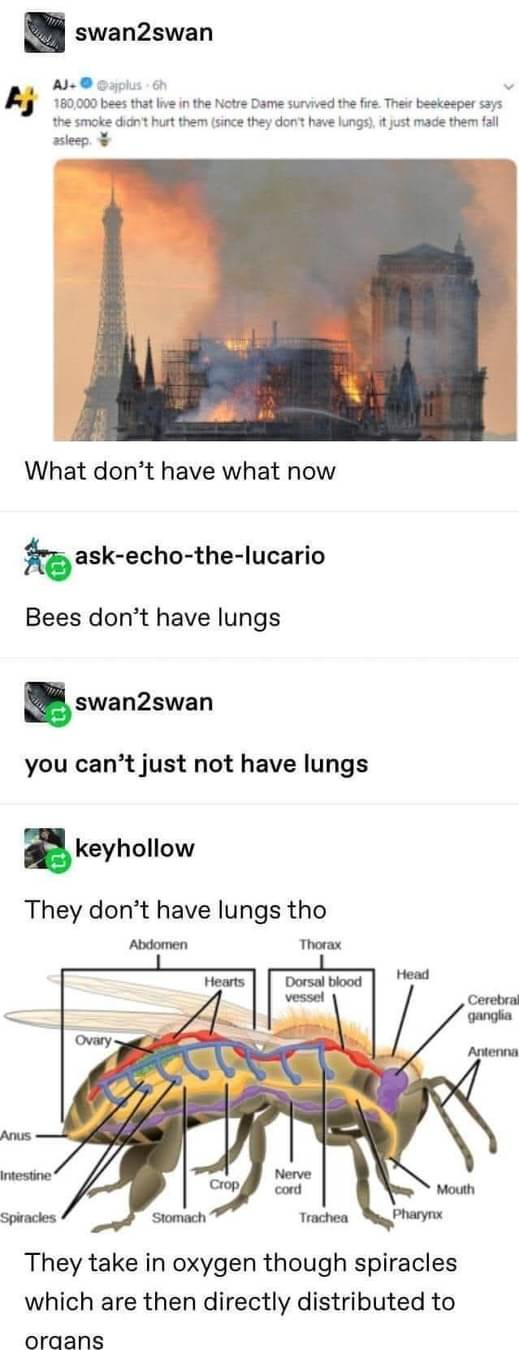
I think insects have little holes all over their bodies, in which air gets inside by itself through some physics shenanigans. It doesn’t need to be actively sucked in like with lungs, it just happens because they’re so small.
This method doesn’t scale up though since if you’re bigger, you need more air, and having little holes all over your body won’t cut it. Thats when you know you need lungs, and that’s why you don’t see insects the size of a dog these days (thankfully).
There used to be times in the Earth’s history (Carboniferous) where the air’s composition was different though, and since it had more oxygen in it, insects could grow a lot larger.
Fun fact: Cutaneous respiration (aka “Skin breathing”) is something we humans do too. But it accounts only for 1% to 2% of our oxygen input.
However, the cornea of our eyes doesn’t have its own blood vessels to supply it. Therefore, it relies on direct gas exchange with the environment—in other words, skin respiration.
Adding to this, the holes (spiracles) connect to the tracheae, which connect to air sacs. While respiration is almost entirely passive in smaller species, larger species actually force air through the system to aid the otherwise passive process.


No because you’re likely too big (no offense) :(
I think insects have little holes all over their bodies, in which air gets inside by itself through some physics shenanigans. It doesn’t need to be actively sucked in like with lungs, it just happens because they’re so small.
This method doesn’t scale up though since if you’re bigger, you need more air, and having little holes all over your body won’t cut it. Thats when you know you need lungs, and that’s why you don’t see insects the size of a dog these days (thankfully).
There used to be times in the Earth’s history (Carboniferous) where the air’s composition was different though, and since it had more oxygen in it, insects could grow a lot larger.
Fun fact: Cutaneous respiration (aka “Skin breathing”) is something we humans do too. But it accounts only for 1% to 2% of our oxygen input.
However, the cornea of our eyes doesn’t have its own blood vessels to supply it. Therefore, it relies on direct gas exchange with the environment—in other words, skin respiration.
Our eyes breath like bees.
So what you’re saying is I have two eyes in my beeholes?
I like this fact. That’s why it’s so important to take out certain kinds of contacts at night.
1-2% is more than I’d have imagined!
Adding to this, the holes (spiracles) connect to the tracheae, which connect to air sacs. While respiration is almost entirely passive in smaller species, larger species actually force air through the system to aid the otherwise passive process.
https://en.m.wikipedia.org/wiki/Respiratory_system_of_insects
Side note: Spiders have book lungs. They’re not insects, but like insects, they are arthropods.