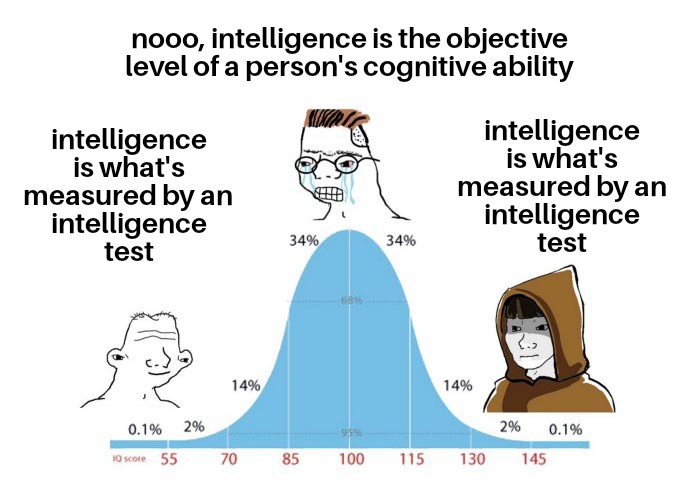

I’m just going to point out the irony of using this meme format to make that point.
The meme is about the journey to acquire wisdom, not intelligence. It fits IMO, despite representing the lack of wisdom as low intelligence.
It just makes it that more delicious.
People who boast about their IQ are losers ~Stephen Hawking
The purpose of IQ is to measure some sort of “g factor” which is a model of “general intelligence.” This was based on the idea that people who tend to do good at some kinds of tests tend to also be good at other kinds of tests.
The IQ test is “reliable” - ie its consistent and you’ll usually get the same results +/- an acceptable amount every time. However, there are lots of concerns about its “validity” - whether it measures what it purports to measure - ie, the “g factor.”
Of note is the “Flynn effect” - that performance on the test in the general population has been improving over time, so the test has to be renormalized. (IQ is a “normalized” test - so about 68% of the population needs to be within 1 standard deviation of the mean. I think standard deviation is about 15 - so 68% of people are going to score between 85 and 115.)
The question then would be - are people getting “smarter” or is it just that people are more adapted to taking tests on pattern recognition and mathematics/logical thinking? How would that measure the intelligence of a tribal person who has not seen abstracted geometrical shapes?
You can bring in alternative models of intelligence - like Gardner’s multiple intelligence - but then that doesn’t really have much of the psychometrics behind it.
(In general, I think a huge issue in psych research is a lack of critically examining the validity of psychometric instruments. It seems we often stop at being reliable.)
Intelligence is what my sorcery damage scales with
Isn’t that charisma-based?
I’m going by Dark Souls system
Intelligence is the Intel core i3 4th gen
Anyone who hasn’t listened to the podcast “My Year in Mensa” by Jamie Loftus, do yourself a favor.
Its one of my favorite podcasts ever.
Bro there are different categories of intelligence
I got the red one.
Wow. That means you’re thinking really fast!
plus if you have RGB strips on your head, it goes even faster!
It’s fine, it’s a really long test.
I don’t get it? I’m still in the middle of the graph.
The average person (and to be fair, most psychologists) thinks of intelligence as the innate, fundamental characteristic of a person to think across all cognitive areas. However, this concept is not easily falsifiable and therefore arguably exists outside the realm of science.
For example, say I wanted to come up with a concept called “sportsness” which is the ability to be good at sports. I could test a bunch of people in a battery of sports-related tasks, and I’d probably get a nice bell curve where some people have high sportsness across all tasks and others have low sportsness across all tasks.
But does that prove the existence of sportsness? Or did I just measure a spurious correlation caused by the fact that some people are just more likely to be playing many different sports than others, or that some body types may lead to being better at sports related tasks, or some people are just better at handling the pressure of athletic performance tests, or some combination thereof? Of course most would say the latter, but then maybe some would defend the concept of sportsness by saying sportsness is just an emergent property of those things or something like that. But then is sportsness useful as a concept at all? You get the idea.
Yeah sure buddy, sportness is all made up by —let me guess— Big Sportness? Clearly you’re just mad that you’re not very sportnant. /s
I like the comparison to measuring physical attributes, but I think a better analogy for IQ testing would be “trying to measure athleticism by trying to measure who’s best at playing basketball.”
Defining “athleticism” itself is hard. It might include reaction time, coordination, strength, speed, flexibility, etc. There are some naturally occurring differences in those attributes, but to a degree they are also changeable. Any bottom-line, all-in measure is going to include some arbitrary decisions about the relative value of each attribute.
Trying to measure athleticism by who’s best at basketball adds another layer of problems. Basketball (analogous to test taking, cultural context, etc.) involves skills that are separate from whatever you’re calling athleticism. It’s also a game where a big factor in success – height – is also probably something a lot of people would consider separate from athleticism.
The left side is the position that definitions of intelligence are all arbitrary, and that psychologists just make up tests and call what it measures “intelligence.”
The middle is the position that there is a real thing that can be called “intelligence,” which can be defined in different (meaningful) ways, and that intelligence tests are objective ways to measure it.
The right side is the position that intelligence is probably still real and can probably still be defined in different (meaningful) ways, but that we can never directly measure intelligence and instead observe it indirectly through observable indicators like someone’s performance on an intelligence test. This means that any practical statement about intelligence, while probably real and definable, are contingent on the specific test used to measure it.
Broke: The results of IQ testing are dependent on a person’s intelligence. Intelligence is an objective reality that can be observed and measured with IQ testing.
Woke: The results of IQ testing are independent of a person’s intelligence. Intelligence is an objective reality but complex and impossible to perfectly measure.
Bespoke: A person’s ‘intelligence’ is dependent on the results of IQ testing. Intelligence is a social construct and IQ testing is a means to reinforce that construct.
I recently had a psychological assessment that led to ASD and ADHD diagnoses. Part of it was intelligence testing and it led me to have some additional context I didn’t have before. I always knew I was “smart” - at the very least I had the numerical data of always doing really well in school. As an adult I continued to have people tell me I was really smart, and my response was usually (internally) like “Sure, Jan” or “K” like, maybe in some ways but it seemed like kind of a pointless thing to think about. I’ve never felt any amount of superiority about being smart - my brain is what it is and I didn’t really do anything to earn it so it seems weird to feel any certain way about it.
In my assessment, there were 6 intelligence factors that were measured. In 4 of them, I scored 95-98th percentile, one around 80th, but the last one I scored exactly average. That last one was processing speed. According to my assessor, it’s more or less true that a brain wants to be similar levels across the board. Otherwise you basically have perceived bottlenecks in your processing. And I thought that was really interesting and resonated, because my brain can do some really cool things, but yeah it always feels like when it comes to actually articulating and thinking in certain ways, I basically have to slam the brakes. It was helpful to explain certain things, and apparently having a discrepancy with processing speed can be caused by unmedicated ADHD. I’m still unmedicated but hopefully that will change soon.
No idea what I’m trying to say about this. Maybe I just want to shout out to the void lol. But the meme definitely resonates. I guess I have some nuance in that, I agree with what I read to be the intent of the meme, that IQ is just a measurement that doesn’t mean anything in a lot of ways. But this lense was new to me - that there are several axis of intelligence, and it’s more typical that people are similar across all axes (whether low, high, or average), and spikiness on these axis can lead to dysregulation and other issues.
How it called this meme format? I want see more of this examples
Thank you!

deleted by creator