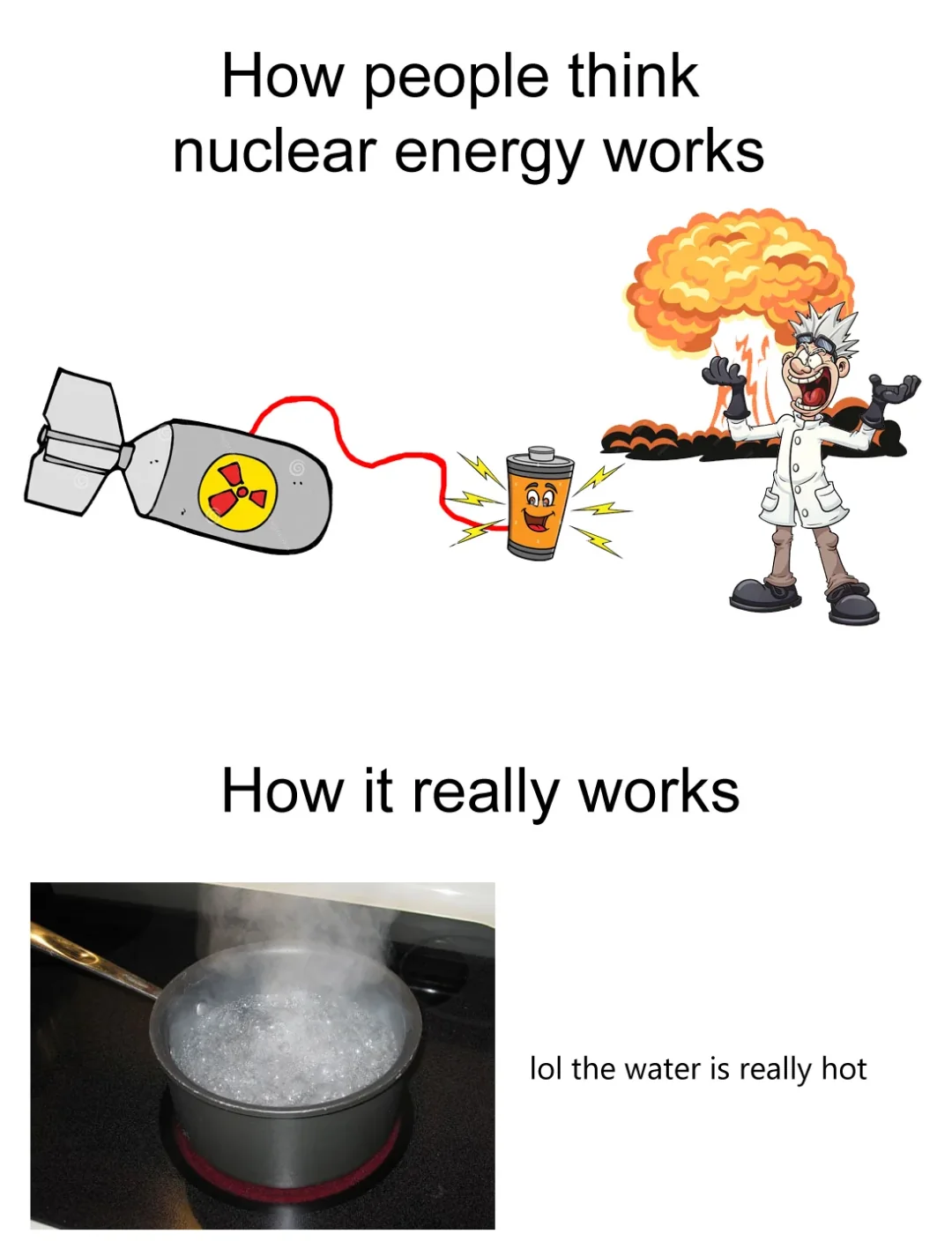
We’ve had this discussion here on lemmy a few days ago: practically all electricity generation is by making turbines spin.
Hydropower means river makes turbine spin. Wind power means wind makes turbine spin. Coal/gas power means combustion makes turbine spin. Nuclear means hot steam makes turbine spin.
However, that doesn’t mean that all electricity sources are spinny things.
- solar cells have no mechanically moving parts
- batteries utilize chemical energy directly
solar cells have no mechanically moving parts
ironically, large grid tie systems are starting to “emulate” the spinning mass behavior of turbine generators, since there’s an exponential failure issue waiting to crop up if you aren’t careful, as texas has already learned, a very significant part of your solar generation can just, go offline, if it decides grid conditions aren’t suitable, which can lead to LARGE drops in power production and frequency, which is likely to kill even more generation.
So the solution is to make it emulate the physical mass tied to a turbine, or at least, more generously provide power in fault like conditions, to prevent this sort of exponential breakdown of the grid. You could of course, use a large spinning flywheel to regulate grid frequency, as is being used in a few places right now. I’m not sure how popular that is, outside of wind energy. It’s likely to get more popular though.
weird little side tangent, but the frequency of electricity on the grid is essentially directly tied to the rotational speed of all turbines currently on the grid, meaning there is a very large inertia in the grid frequency, it’s weird to think about, but makes perfect sense, and it provides for an interesting problem to solve at large scales like this.
Batteries are really fucking cool btw, the fact that you can just chemically store electricity, and then use it, is really fucking crazy. The fact that it’s the most accessible technology is also insane to me. But maybe it’s just the adoption being the way it is.
I think people underestimate the value of intertia in power generation. I liken it to the way capacitors regulate voltage changes or coilovers absorb bumps and vibrations.
The inertia of the generators connected to the grid helps stabilize frequency changes caused by blackouts, power plant issues, etc. by resisting and thereby slowing down frequency decline. It buys time for grid operators to find a way to balance loads in a way that doesn’t weaken or disable the grid as a whole.
Here’s a great NREL report explaining how this all works, and what other systems we use to stabilize grid frequency.
I think people underestimate the value of intertia in power generation. I liken it to the way capacitors regulate voltage changes or coilovers absorb bumps and vibrations.
the best way to think about it is a literal flywheel, because that’s what this is, just at a grid scale, and directly tied to the frequency.
The inertia of the generators connected to the grid helps stabilize frequency changes caused by blackouts, power plant issues, etc. by resisting and thereby slowing down frequency decline. It buys time for grid operators to find a way to balance loads in a way that doesn’t weaken or disable the grid as a whole.
TLDR it moves the “OH SHIT OH FUCK” window from about < 1ms worth of time in the worst cases, to the much more manageable, seconds window.
It’s a potential challenge with moving to renewables, but not a significant one, i think. This is also a big advantage to having sources based on thermal generation, like nuclear.
That’s just another way to turn heat into electricity. Those thermocouples could also be used on a campfire.
You think that’s hot shit: https://www.sciencedirect.com/science/article/abs/pii/S2468606921000538
In theory, if you made it small enough, you could make a gamma rectenna. Considering gamma rays are often smaller than an atom, you’d have to make the antenna out of something other than atoms though. Good luck.
This exists, but it’s generally only used in spacecraft.
Most terrestrial uses of RITEGs have resulted in tragedy.
Water is last year’s news. Helium is the new water now.
Humans only have one good way to turn hot into lightning.
i mean… This is how most electricity production works.
Hydro, solar, wind…
hydro works in the exact same way, just with water instead of steam, solar works using PV technology, so it’s fairly novel.
And wind is basically the same thing, just using the air, instead of steam.
It’s all mechanically the same at the end of the day, excluding solar. The primary difference is that we don’t burn fuel for heat to make steam, we use potential, or kinetic energy from our environment instead.
Also to be clear, if we’re being pedantic and nitpicky, when i say most i mean percent of production. The vast majority of production globally is through coal, oil, and natural gas. All using thermal processes. And some nuclear, though not as much as solar/wind though.
The half life of fall-out from the Hiroshima and Nagasaki bombs was a couple of decades.
The half life of nuclear waste from powerplants is anywhere from thousands of years to millions of years, depending on the mix of isotopes.
anywhere from thousands of years to millions of years
only in a strictly thermal reactor environment, if you’re using a fast reactor, something like the SSR that is currently being worked on in canada, it can both burn waste, and reduce it’s lifespan to a much more reasonable length.
As always, development is the problem, if we had more energy being focused on this, we would be farther along, but such is scientific development.
If it hasn’t been already said: the issue is public perception. If you ask any American in the street what they relate to nuclear power the majority will tell you: Chorynobyl. Even though anyone that’s looked up anything knows that technology is leaps ahead of that disaster, that’s the fear mongering that everyone jumps to.