I feel like instead of a giant push for veganism, there should just be a push to eat what’s sustainable.
Beef and dairy? Causes huge amount of greenhouse gasses and with current methods of production, it is not sustainable
Blue fin tuna? These things have been way over fished and are endangered. Not sustainable, just try it once and move one with your life.
Tilapia ? These things grow like weeds and can be fed efficiently. Go ahead, good source of protein for your diet.
Honey? We need bees and they are an important pollinator for crops. Go nuts (just watch your sugar intake}
Almonds? Takes huge amounts of water to grow and exacerbates droughts in the areas they are farmed. Eat less of these.
Potatoes? Grow stupid easily in all sorts of conditions. Go nuts.
I’d already be very happy if everyone took your approach, but it’s not the entire story for veganism. Sustainability is an important factor for myself and many others, but so is animal welfare.
It’s a bummer that animal welfare is pretty much inversely correlated with emissions. Packing chickens together and making their lives miserable is much better for the environment than having them roam free.
Veganism happily aligns with environmental sustainability. But when you believe we shouldn’t exploit animals at all, just pushing to eat what’s sustainable ignores a lot of pain and cruelty.
This is probably a hot take but I have the opinion that nature isn’t any more merciful than we are. Existence is suffering and every animal ends up as feed for another.
Is it better to be raised in horrid conditions in a farm, or to spend every moment of your life scavenging for food, running for your life, while probably infested with parasites just to be torn to pieces, alive, by a wolf or other predator?
Humans at least have the decency to sedate or knock unconscious our food. Wild animals have to experience being eaten alive.
This is a false equivalence; the answer is “neither”.
Veganism doesn’t seek to end all animal suffering, but not to exploit animals for humans’ sake. We don’t need animal products to survive, so we shouldn’t add to whatever misery already exists naturally.
In the case of livestock, we should just stop breeding them. No vegan is arguing for dumping all cattle in the savannah to be hunted by lions.
False equivalence is the anthropomorphism, animal farming misinformation agendas and generalisations being thrown like it has meaning…
This guy would own slaves
“But I rationalize it so well!”
This is pure bullshit. Pigs, cows, chickens all if left to their devices form societies, display complex emotions, and have just as unique of personalities as humans do.
Humans don’t even permit most of those animals to live past “teenage” years. Its not decent treatment, I recommend the documentary Pignorant if you want to see first hand what a gas chamber is like.
Potatoes are kinda OP imho.
(I also agree with you btw).
Yeah exactly, people arguing whether dragon fruit or some shit is a “super food”. The super food is right in front of us, potatoes (and onions).
What other food has been so vital to our survival that its disappearance could ravage a population (Irish potato famine)
No offense to dragon fruit, blue berries or whatever exotic fruit, but if they went extinct, not that much could change.
Obligatory Irish potato famine was a result of British policy. But I agree with your sentiment
Potatoes OP must nerf
The last time it was nerfed, the Irish were pissed to say the least
Why you wanna starve Captain Blond Beard Mark Watney? Uncool.
About honey: we do need bees. But taking away their honey which they work really hard for to sustain their colony during the winter and replacing it with sugar water is really bad for them and makes their colony weak. They can get viruses, bacteria and fungi much faster, which they can spread to other colonies or when splitting up when their queen dies.
Next to that, bees we use for honey are a very aggressive territorial species. They claim their territory and all the other bee and whasp species are killed and pushed out. There are many bee and whasp species who do not live in colonies but are very important for the biodiversity. Replacing them with our bees, which will die and get sick faster because we take away their nuteician rich honey, is a bad idea.
We do need our bees, but in reduces quantities to keep the balance. But we shouldn’t take their food.
I’d say the issue is that if honey isn’t vegan because you’re causing harm to bees, isn’t most of modern vegetable agriculture at least equally harmful to bees & other insects due to all the pesticides being used?
Or is it just if we directly involve bees, it’s bad, but if we inflict greater harm in a less direct way, it’s acceptable?
Not just insects. Vermin control is critical and often not very ethical. Here in Australia, rabbits and kangaroos can be a big issue for farmers too and are often killed to protect crops when they become too numerous. Ducks can be a big issue for rice farmers here and permits are issued to shoot ducks on crops.
We do need bees, but that doesn’t mean the honey industry is sustainable.
https://www.greenmatters.com/p/how-honey-industry-affects-environment
I agree for the most part. I would like to point out that fish farms are actually very damaging to the ecosystems that they sit in. The excrement ends up dropping down in single locations, burying the seafloor in it. IIRC, this often leads to the oxygen levels in the water dropping, which further kills off the surrounding aquatic life.
EDIT: more context
Turns out that what’s sustainable is often what is vegan. Vegans are constantly discussing the edges of all this stuff trying to come to a better understanding, its somewhat natural that they would provide some of the most well-reasoned and substantiated arguments.
Honey and tilapia are not sustainable currently. Its a demand issue. Rules and regulations will never prevent an industry from meeting demand. Thats why we currently use practices at large scale we never would at small scale.
Beef and dairy? Causes huge amount of greenhouse gasses and with current methods of production, it is not sustainable
what makes you think this?
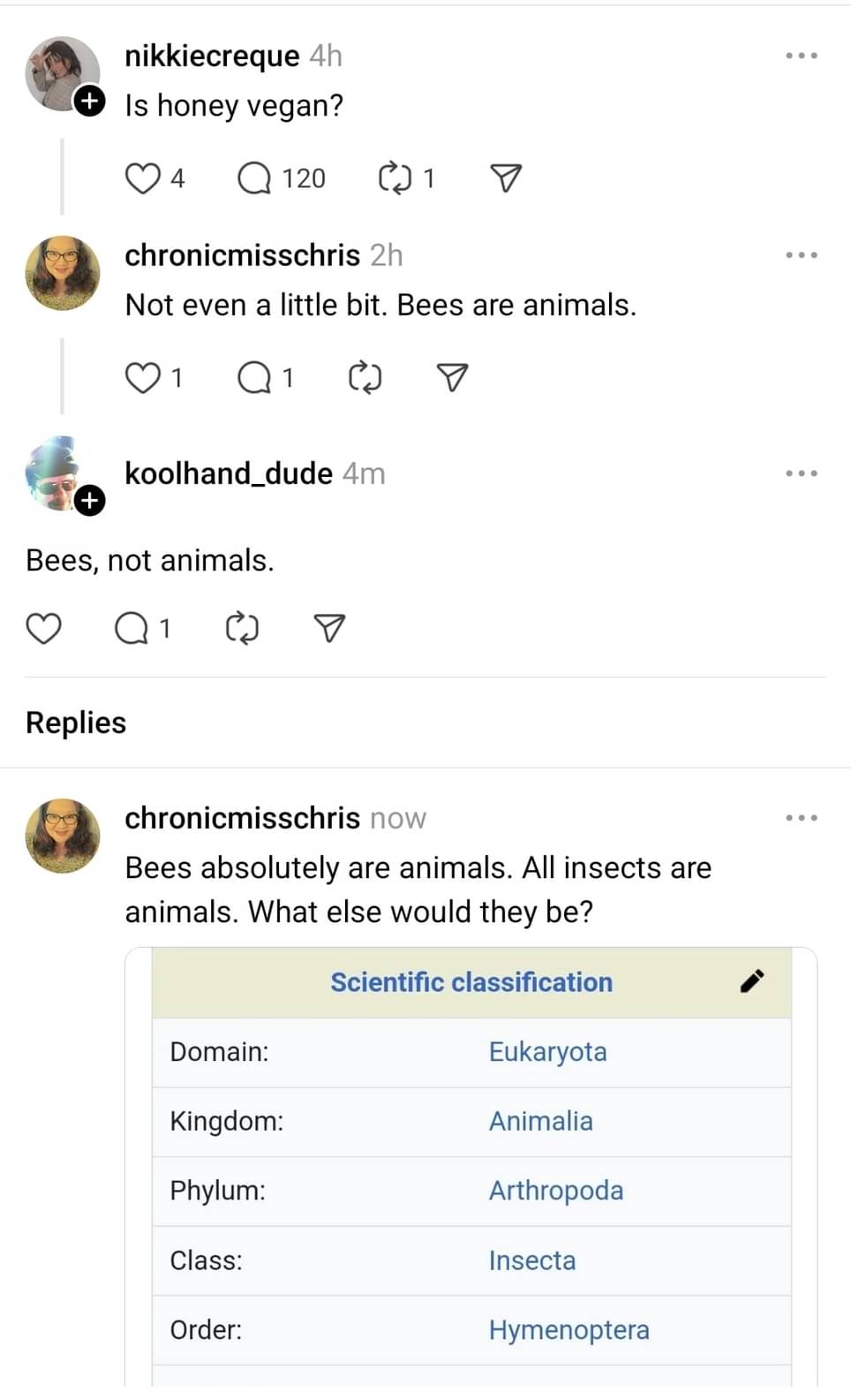
I’ve had an unreasonable number of arguments against people who seemed to think animal was a synonym for mammal. Thankfully, we’re now in an era where you can look it up and show them now mobile data is cheap, so it’s become a winnable argument.
Sure, but remember that there’s sometimes a scientific term used incorrectly, but it’s so widespread it has non-scientific definition in dictionary. Although thinking that insects are not animals is indeed stupid.
I feel like bees are a bit of a grey area. We’re not eating them, we’re kind of like landlords that give them a nice place to stay and they pay rent in honey. I’m not vegan so I’m not quite sure what the rationale is for bee stuff.
Well landlords are the badguys so…
What if the hives are rent controlled?
Sounds spooked with extra steps
Couple of reasons. One, honey is made not from local pollinators but from European honey bees. Two, European honey bees are really good at producing honey, which means they’re more efficient at removing pollen and nectar from flowers, denying food for native pollinators. Three, while only a few bees are directly harmed during honey harvesting, the need for their honey to be harvested means that they’ve been bred to make big, uniform honeycombs and a glut of excess honey. This makes them more susceptible to diseases, even before you factor in the monoculture nature of their existence.
Essentially, it’s not that eating honey is harmful to bees. It’s that the creation of honey at scale is cruel both to the bees producing the honey and the native pollinators who get pushed out by them. We (my household) do have honey on occasion, but only from local, small scale honey producers.
So my wife went vegan for a bit and the logic is basically any living thing we take advantage of or make their lives more of a labor. So eggs, honey, milk aren’t vegan because companies put those animals in situations they normally wouldn’t be in in the wild to take advantage and harvest products from them.
Yeah, some vegans draw the line at the animal kingdom. (Plants, algae, mushrooms - these are all living things as well, but one has to eat something.) Some vegans I know do eat honey though. It depends on what feels like animal exploitation to the person.
I don’t think comparing beekeeping to landlordism makes it sound very ethical at all
Eh, I doubt most people care about being vegan for the sake of being vegan, but as has been said, honey bees are bad for pollinators, so from a moral viewpoint, you get to the same conclusion.
Ultimately, though, honey isn’t hard to give up. Certainly nothing that I felt was worth contemplating whether it’s grey area or not.
At best, it’s annoying, because the weirdest products will have honey added. One time, I accidentally bought pickles with honey, and they were fucking disgusting.honey bees are bad for pollinators
Hm? What do you mean?
From this paper:
A. mellifera appears to be the most important, single species of pollinator across the natural systems studied, owing to its wide distribution, generalist foraging behaviour and competence as a pollinator.
This is a genuine question btw.
I read an article on this a while back that made me refrain from actually getting bees. I can’t find it right now, but the gist is that domesticated honeybees will compete with a lot of other pollinators (mainly solitary bees) over the exact same food sources.
However, the honeybees have a gigantic advantage in being supervised, housed and generally looked after by the apiary. Which will also employ methods to stimulate hive-growth, driving the hives demand for food.
That is something a solitary bee - or another pollinator depending on the same nutrition - cannot compete with, driving them away.
So, in a nutshell: adding bees to a place already rich in honeybees? Whatever. Adding honeybees into a local ecosystem not having them rn? That will drastically lower biodiversity
Most honey bees are of the European variety, they have a habit of displacing native bees when they are farmed
I’m no biologist, but as for why they’re bad for other pollinators, yeah, what @frosch@sh.itjust.works said sums it up quite well.
I’d like to add that, to my understanding, they’re actually relatively ineffective pollinators, too. They might do the highest quantity in total, but I’m guessing primarily because of how many honeybees there are.
I believe, the paper you linked also observes this, at least they mention in the abstract:With respect to single-visit pollination effectiveness, A. mellifera did not differ from the average non-A. mellifera floral visitor, though it was generally less effective than the most effective non-A. mellifera visitor.
…but I don’t understand the data. 🫠
As for why this is the case, for one, honeybees are extremely effective at collecting pollen, with their little leg pockets, which reduces the amount of pollen a flower has to offer.
But particularly when they’re introduced into foreign ecosystems, pollinators that are specialized for local plants get displaced.
This may mean just a reduction of pollination effectiveness, or it could mean that the honeybees turn into “pollen thieves”, i.e. they collect pollen without pollinating the plant.
Here’s a paper, which unfortunately no one may read, but the abstract describes such a case quite well: https://pubmed.ncbi.nlm.nih.gov/20583711/
deleted by creator
even though the sheep is harmed in the process
This is such a funny typo
The dark vegan. Eats only food that causes as much suffering as possible.
It’s more accurate to say carnivore cannibal.
I mean it’s accurate because wool shearers are often rushed with the sheep, hurting them to meet the quota of the day.
As long as we canot ask them, if it’s ok if we take their honey (consent), it’s not vegan. For an counter example, it’s fairly easy to get consent from a dog to touch them. Most people are able to tell if they are fine or not.
I find vegan intellect fascinating. I love hearing their responses to my epistomology. They all make it up as they go along. It’s very similar to religious beliefs in the way it is personal. Each has their own set beliefs on where to draw the line of what is vegan and what is not.
My personal understanding of the world is that plants aren’t so different from animals that they can be classified separately from other food sources. For example, how much different is r-selected reproduction from a fruiting plant. Plants react differently to different colors of light and so do we.
It helps to understand the goal of a vegan. The extent to which we are tied to every living thing on Earth means that many vegans have set impossible goals.
Just fascinating.
I’ve always wondered if vegetables from a farm that uses horse-drawn tills instead of tractors would be vegan… It’s a real question, but everyone I ask thinks that I’m trolling.
Or animal manure, or pesticides
I mean vegans want veganic produce the most. But it’s not widespread enough to be able to only eat that. It’s not about being perfect but doing what you can.
Here’s my weird question: if faux leather is plastic and someone is vegan for environmental reasons, would leather be preferable? What if it’s a byproduct and would otherwise be trashed? These are things I think about as someone who tries to reduce my impact on the environment as much as I feasibly can in a capitalist society.
Each vegan will have their own answer. If you are truly curious, and a vegan is sharing their mindset with you, ask them.
If insects are animals then are vegans getting all of their food from 100% organic gardens that grow in a cooperative manner?
Oooooooh, even using tractors could be considered non-vegan, if they’re powered by fossil fuels, then they’re powered from the remains of dinosaurs, which were very much animals
ethical vegans (and not people who eat plant-based for nutritional reasons, and often get conflated with people doing it for ethics reasons) generally agree on one very simple rule:
To reduce, as much as possible, the suffering inflicted upon animals.
That’s it.
Where that line is drawn of course depends on your personal circumstances. Some people require life-saving medicine that includes animal products, and are generally still considered vegan.
I’d like to see what about this confuses you and your epistomology [sic, and that word doesn’t mean what you think it means]
I am not confused. I am curious and fascinated on how people come to their conclusions. I know exactly what epistomology means. I have used it for conversations with many vegans about their choices as well as on other personally held beliefs. I could be a lot better at it but it has helped me show that I am curious and respectful.
I’m curious, how do you use a branch of philosophy, that’s concerned with the abstract theory of knowledge and the limits of human reasoning, in conversations?
it’s epistemology, btw
Thank you for the correction. It can be applied in the Socratic method. I ask questions to understand someone’s position and continue into how they came to those conclusions. At no point do I pressure for answers though. The idea is just to keep the person talking so you can understand their poimt of view to the best of your ability. It has a side effect of healthy personal reflection for all parties involved.
Alright, fair enough. The Socratic method I know and can respect. I still wouldn’t call it epistemology, but at least I know what you mean now c:
What a word salad. Your comment can be applied to anything because people are different lol. All my friends who are dads have different ideas on how to be a dad. Fascinating. It helps to understand the goal of a parent. All my friends with jobs define success in different ways. It’s like they’re all making it up as they go along. Fascinating. It helps to understand the goals of a worker.
It’s ok to set “impossible” goals if you view them as directions rather than destinations.
Fascinating huh?
Yes, it is fascinating indeed, how applicable to many different actions and intentions that statement was. Thank you for pointing it out.
I feel so kindred with the way you see things. You’re making an observation and you’re curious about the “why” of everything. I feel people often read my similar interest in a subculture as critical. Kind of like how bluntness can be perceived as rude, I guess. Do you ever have a similar response happen to you?
Just look at the other responses to my comments.
In real life it can be better or worse. Some of the closest people in my life get immediately defensive. It’s sometimes easier to talk with strangers. More often than not, I will find a passion point that is the limit of conversation. At those times I just listen as much as possible. How much I engage depends on how they rect to my questions.
Reacting to stimuli like the colour of light is irrelevant. My phone camera would fall into the same category, then. A light switch reacts to getting pressed and turns on a light, it’s reacting to a stimulus.
What matters is sentience, which plants cannot possess, since they don’t have a central nervous system. And even if they did, a diet that includes meat takes more plants, since those animals have to be fed plants in order to raise them.
They all make it up as they go along. It’s very similar to religious beliefs in the way it is personal. Each has their own set beliefs on where to draw the line of what is vegan and what is not
The extent to which we are tied to every living thing on Earth means that many vegans have set impossible goals.
Regarding these two, is this any different from human rights? Where people draw the line regarding slave labour, child labour, which type of humans they care about (considering racism, homophobia, trans phobia, ableism etc). I’m sure lots of people have impossible goals regarding human rights, but working to get as close to those as possible is still sensible.
The response to light color does not stand on its own. That is merely one parallel from many. It is true plants do not have a nervous system like animals, but they do have similar responses to stimuli. Parallels can be drawn to sight, sound/touch and smell/taste.
Sentience is another topic that is defined subjectively. From context it is clear you make a central nervous system a foundational requirement. I could also apply this to technology, so I would need clarification from you to understand what it means to you. I do not hold to a personal definition for sentience because I have found neither a universal nor scientific understanding of the idea.
As for the last paragraph: yup.
Again, all of these reactions to stimuli can be explained as direct, chemical reactions, not signals that get sent to a central unit, are processed, being “felt”, and then being reacted to. There is no one thing or being in plants like the central nervous system of animals that is capable of feeling something.
Regarding the topic of sentience, I propose looking at it like this:
There’s a range of definitions that is somewhere around it being the capacity to perceive, to be aware, to be/exist from ones own perspective. However you define it, a central nervous system or other type of similar central unit would have to be a requirement, because that is what would actually be sentient. You are your brain, your hand is just part of your body, if it was chopped off, it by itself is not sentient.
And whatever vague definition of it you go with, there’s two options: Either sentience is real, or it isn’t. If it isn’t real, literally nothing matters, gg. If it is real, non-human animals with central nervous systems, and therefore sentience and the capacity to suffer, deserve ethical consideration, and we should do what is reasonably possible to reduce their suffering and death.
Since we don’t know the answer to the existence of sentience, we should err on the side of caution. If we’re wrong, and we’re all as sentient as a rock, the inconvenience we’d have suffered in our efforts to protect fellow sentient-but-actually-not beings can’t be felt by us, no harm done. If we’re right, the suffering we’ll have prevented, in both scale and intensity, is indescribable.
However you define it, a central nervous system or other type of similar central unit would have to be a requirement, because that is what would actually be sentient
Without CNS there would be something else sophisticated enough to show sentience that would have been sentient. So to me it looks like this is not really a requirement, albeit it’s simpler to say that it is.
As a side note, I think that given how human-centric humans are (which is to be expected, really) even if we were living with another sentient species on the same planet we would argue they are not sentient for whatever reason we could come up with, and change sentience definition accordingly
Veganism has and always will be just dogma. I find it quite annoying how individuals can so freely push their moral philosophy onto others. Veganism should always be a personal philosophy.
Also, there are now many vegans (considered bottom-up vegans) taking the communist route and basically advocating for revolutions in order to cease animal food production.
I have conversed with quite a few vegans and none of them have pushed their morals on others. Some of them have been very upfront about their veganism. I am wondering where you are that you see vegans being so revolutionary.
When i speak of ones that push their moral philosophy on others (rather aggressively i might add), I’m talking about the vegans that walk into restaurants to cause a fuss. I’m talking about the ones that criticize and talk down on meat eaters for their habits. There are many who do practice veganism as a personal philosophy. I guess dogma always attracts “bad apples”
Also, i never claimed all vegans were revolutionary. I’m specifically referring to “bottom-up vegans” who advocate for more aggressive and hands-on methods in preventing animal farming rather than waiting for government reforms akin to a revolution.
Don’t you feel that you just see it that way because you’re on the opposing side on this? This sounds to me exactly the same as how a homophobe for example would describe gay rights activists.
Just go through all the points you mentioned in this and your previous comment, and replace those scenarios with the issues of various types of bigotry and ethical issues like transphobia, racism, child labour, slave labour etc.
Don’t get hung up on how bad these are in comparison to each other, that’s not the point. Just look at how they’re all ethical issues where a group of sentient beings are being harmed, and what kind of advocacy you’re in favour of to prevent that harm. And why you would see the one issue you might be on the side of the harm being carried out so differently.
Your analogy makes perfect sense, and i can understand from a vegan point of view why they would advocate in such manners even though i don’t agree on the equivalence of human rights issues and animal rights issues.
Same reasoning like in fish and christianity.
Bees produce honey. Chickens produce eggs. Can’t eat eggs. Can’t eat honey.
Idk I’m not a vegan either.
Chickens. Google what happens to male egg-laying chickens and you probably can figure out why it’s not vegan.
Usually things aren’t vegan due to the horrors of factory farming practices, even before any potential death occurs.
I mean anything commercial comes out to be pretty inhumane. They cut off the queens bees wings in commercial honey harvesting.
I guess bees aren’t as animal as chickens are?
It’s not like that bees are being strapped down and milked. It’s silly to not eat honey cause of veganism. If you’re that vegan move to the woods cause every product or archive you use in life has involved an animal in some way.
Kinda tongue-in-cheek questions, but: Honey isn’t an animal body part, it isn’t produced by animal bodies, so if it is an animal product because bees process it, is wheat flour (for example) an animal product because humans process it? How about hand-kneaded bread? Does that make fruit an animal product because the bees pollinated the flowers while collecting the nectar?
Bees make honey for their hive. Honey also does indeed contain bodily fluids from the bees.
The bread making human consents to you taking the bread (presumably). Breast milk and other human bodily fluids can be vegan for the same reason.
And insects pollinate plants not because they use the fruit, but for the nectar. They don’t care what happens after they leave the flower.
“and other bodily fluids”
I didn’t want to go into it in the original comment, but yes. It is a relevant debate whether it’s vegan to swallow another humans semen, or even saliva. And yes, it is, if the human consents. Consent is the more or less the basis of whether vegans find it moral to consume something. Humans can give consent to sharing their fluids. Other animals cannot.
it isn’t produced by animal bodies
Sure is, it’s concentrated bee spit with sugar. And spit is made of water and body cells.
Well basically yes, tho would need to get into the topic of exploitation and all that if we are talking about if something is viewed as acceptable to consume.
Reasons that I, as a vegan, do not use honey:
-
I cannot guarantee that the bees consented to their product being harvested. Some beekeepers clip the queen’s wings, which can prevent the colony from leaving.
-
I cannot guarantee that bees were not harmed in the process of harvesting (potentially getting crushed by the honeycomb frames, for example) or in the process of controlling the colony (like clipping the queen’s wings).
Regarding your second point, you also cannot guarantee that small animals like rodents are not harmed in the process of harvesting plants.
Bees can kill their queen and make a new one no problem.
If the colony would want to move away they would just do that. I don’t think clipping the queen wings would do nothing.
But I doubt any beekeeper colony would want to move as they are keep at a perfect environment so they can produce more honey that they would actually need to survive. Even industrial ones. It’s part of basic beekeeping that bees must be in a good place so they produce the most honey.
Hurt of mistreated bees would not produce honey. If they are mistreated the try to leave (and as stated they can just kill their Queen if she is crippled), they eat all the honey, or just die.
Bees are really complicate to get advantage of. Our relationship with them need to be symbiotic to work.
Not trying to convince anyone to consume honey if they don’t want to. As it’s basically just sugar so whatever.
Bees can kill their queen and make a new one no problem.
This doesn’t make the mutilation of the queen bee any less bad. It’s still harming the bee. I am not aware if a bee has the ability to make an informed decision on whether to kill the queen and relocate, so I cannot make an informed decision about whether the bees actually want to be in their current hive.
If the colony would want to move away they would just do that.
I don’t know if this is true. It’s possible the bees are being manipulated into staying at their current hive in some way.
I don’t think clipping the queen wings would do nothing
It would hurt the queen, which is more than I want to be involved in.
But I doubt any beekeeper colony would want to move as they are keep at a perfect environment so they can produce more honey that they would actually need to survive. Even industrial ones. It’s part of basic beekeeping that bees must be in a good place so they produce the most honey
Making an assumption about what the bees want is not strong enough of an excuse for me to be ok with their exploitation. I don’t believe we should have the right to make decisions for other organisms, and the bees are not able to tell us how they want to be treated, so we should not try to control them or take what they produce.
Hurt of mistreated bees would not produce honey.
This appears to also be an assumption. I do not know if it is true, so I cannot use it to make a decision
If they are mistreated the try to leave (and as stated they can just kill their Queen if she is crippled), they eat all the honey, or just die.
If this is true, there is likely to be a minimum amount of mistreatment before they take action. I do not know how much mistreatment a bee can take, so I cannot use this to make a decision.
Bees are really complicate to get advantage of. Our relationship with them need to be symbiotic to work.
I do not know if this is true. We take advantage of many animals without giving them much in return, so I am not sure if the bee-beeker relationship is actually symbiotic.
Now I’m just curious.
How do you manage the amount of animals that are hurt during agricultural process then?
Tons of invertebrates are killed by pesticides, while harvest or during the cleaning process of the vegetables.
It seems to me that being killed by pesticides or drown with water is worse fate that beeing in a nice artificial honeycomb where they may or may not clip the wings of one queen or make you a little sleepy once in a while with smoke.
On matter of animals hurted/killed during production process honey seems more vegan that most vegetables.
This comment section has led me to more deeply consider the effects that all types of food production have on animals. I previously have just been ok with any non-animal product, but I now realize that this is not enough, and I am still causing harm to animals with the products that I do use. I will try to ensure that I buy the lowest-impact food available in the future, but I don’t think it is even be possible to stay alive without causing harm to some animals.
I think using products produced by animals is generally going to be worse than harming animals to stop them from destroying crops, but I will need to consider this more deeply to make the best choice I can.
That seems well thought out to me, thank for this explanation.
Do you personally grow everything you eat? If not, animals (and humans) are absolutely harmed in the process. Commercial agriculture, even organic, kills huge numbers of small animals and destroys habitat just to prepare the soil, not to mention all the insects killed by pesticides. Farmers will also kill deer, wild pigs, birds, etc. to protect their crops. And agriculture in some places still relies on child and/or slave labor.
You are correct. There is more that i can and need to do. That still does not make it good to use honey.
Hey no wait you’re supposed to throw your hands in the air and just eat industrially farmed animal corpses because there are also negative outcomes of vegetable production so obviously the two are completely equivalent
Nice strawman, strawberry. The point is that avoiding honey to reduce possible harm is vain at best.
But since you want to talk about meat, I’m curious about your opinion of hunting.
Do you know how animals die in the wild? The lucky ones get hit by a car and die instantly. The rest die from disease and starvation, both agonizing slow deaths, or they are literally eaten alive by predators.
If the aim of veganism is to reduce animal suffering, surely you would support ethical hunting, right?
the goal of veganism is to reduce animal exploitation.
Do you avoid all sugar products, or just honey?
Sugar growing also kills animals. You cannot avoid all harm, so why discount honey for the harm you know, but not discounting harm from growing sugar?
Reducing harm, sure, but it seems selective to discount honey for small amount of harm, when other things you (assumed) eat do equal (potentially unknown to you) harm.
Do you need to know every process of growing/transporting something to eat it? Or does you list of edible products shrink as you learn every new form of harm?
The list of edible products shrink as I learn of new harm. As a modern human, I am addicted to sugar, but I do need to make more of an effort to use less of it, as well as lessen the impact of what I do use.
How much awareness of it’s existence do you think a bee has?
I dont care. In my opinion, the best way to live is to do as little harm as possible, and it appears that bees are harmed by the human collection of honey, so I will not use honey.
of its* existence
-
if it needs to be pollinated by bees or wasps, then it’s not vegan (insert troll emoji i guess)
I think that’s actually a very valid point. What level of involvement in producing the food makes it vegan or not vegan? If eating honey is unethical I would think so is eating food produced by the hard work of another person.
Can you milk a bee? I didn’t think so!
Bees have a nipple, Focker…
Let me get my milking gear. For the tiny udders.
fungi?
Honey can be vegan. I have a friend who keeps endangered bees and as an unintended side effect of fostering their growth has honey that she has to give away because she doesn’t want it
Genuine question, I would like to know if there is a reason. Why doesn’t she just let the bees keep it?
I believe it’s to encourage them to increase numbers, but I haven’t discussed that with her. She’s the type of nerd I know probably has a good reason so I never asked
Playing devil’s advocate, this could be sidestepping the issue, because the honey is only an unintended side effect from your friend’s POV, not the bee’s.
So, if they were endangered cows and your friend didn’t like milk, the milk would be vegan…?
Well veganism is about reducing suffering. If the cows didnt suffer to produce that milk, like no forced insemination, calfs aren’t separated from their mother, male calfs aren’t slaughtered, the cows don’t have unnaturally large udders, you only take the over production and not steal the food from the calf and the cows live a good life then you could argue that the milk is vegan. But milk is not produced like that so milk is not vegan.
Bees are gubbermint drones, and honey is simply concentrated 5G chemtrail juice that gives you super autism.
Non vegan here. 🤔
Soooooo honey is not extracted directly from the bees, so that would be an argument to declare honey vegan.
On the other hand, even with modern beekeeping tech and modular hives, one could argue the act of taking honey to be a serious intrusion on the bees’ life, so that could be an argument that honey is not vegan.
One could argue where the line lies with eusocial organisms. Do you consider the individual bees or do you consider the whole hive? Whole hive? Honey may not be vegan. Individual insects? Honey could be vegan.
It really depends on your standards. One vegan friend of mine does drink mead (honey wine, for the uninformed) for instance.
I appeal to the Director of Veganism!
How is there 4 posts but one reply? Who said something first, the “bees, not animals” thing?
the opened reply is “bees, not animals” and the replies below belong to that
Bees, are vegetals.
Just finished watching Tolkien stuff, so i got this:
Bees are kelvar: beings that are “capable of moving and escaping”! Except maybe for the queen bee, which may be an olvar.
Kelvar was a name used by the Valie Yavanna to refer to that part of her natural realm capable of moving or escaping, as opposed to the olvar which were rooted in place.
deleted by creator
Uh, that’s not the definition that biologists use. Kingdom animalia includes humans. (along with fish, birds, reptiles, insects, etc.) We’re mammals.
Also, a vast majority of people use this definition of the word “animal” when referring to the animals themselves and only tend to use other definitions (which typically ends up referring to non-human mammals or sometimes humans the speaker find distasteful for whatever reason) specifically when contrasting them to so called “civilized” humans.
You can look up the word “animal” in a dictionary and I garuntee you the kingdom animalia style definition will be the first one you see under the noun form of the word with all other definitions (the ones that exclude humans or insects) coming later. Dictionaries typically order their definitions by usage when there are multiple definitions of the same word.
deleted by creator
deleted by creator