There are a couple I have in mind. Like many techies, I am a huge fan of RSS for content distribution and XMPP for federated communication.
The really niche one I like is S-expressions as a data format and configuration in place of json, yaml, toml, etc.
I am a big fan of Plaintext formats, although I wish markdown had a few more features like tables.
The metric system, f*ck the imperial system. Every scientist sticks to the metric system, and why are people even still having an imperial system, with outdated measurements like stones for weight blows my mind.
Also f*ck Fahrenheit, we have Celsius and Kalvin for that, we don’t need another hard to convert temperature measurement.
You are allowed to say fuck here.
Imperial is used in thermodynamics industries because the calculations work out better.
I’ll fight you on fahrenheit. It’s very good for weather reporting. 0° being “very cold” and 100° being “very hot” is intuitive.
0 degrees Celsius, the water is freezing, 100 degrees Celsius, the water is boiling. Celsius has a direct link to Kelvin, and Kelvin is the SI unit for measurement temperatures.
Asterisk: At 1 atmosphere of pressure. Lots of people forget that part.
What do I care about water? I’m not dressing water for the weather, I’m dressing me.
Are you not made primarily of water?
0° being “very cold” and 100° being “very hot” is intuitive.
As someone who’s not used to Fahrenheit I can tell you there’s nothing intuitive about it. How cold is “very cold” exactly? How hot is “very hot” exactly? Without clear references all the numbers in between are meaningless, which is exactly how I perceive any number in Fahrenfeit. Intuitive means that without knowing I should have an intuitive perception, but really there’s nothing to go on. I guess from your description 50°F should mean it’s comfortable? Does that mean I can go out in shorts and a t-shirt? It all seems guesswork.
About the only useful thing I see is that 100 Fahrenheit is about body temperature. Yeah, that’s about the only nice thing I can say about Fahrenheit. All temperature scales are arbitrary, but since our environment is full of water, one tied to the phase changes of water around the atmospheric pressure the vast majority of people experience just makes more sense.
All temperature scales are arbitrary, but since our environment is full of water, one tied to the phase changes of water around the atmospheric pressure the vast majority of people experience just makes more sense.
But when it comes to weather, the boiling point of water is not a meaningful point of reference.
I suppose I’m biased since I grew up in an area where 0-100°F was roughly the actual temperature range over the course of a year. It was newsworthy when we dropped below zero or rose above 100. It was a scale everybody understood intuitively because it aligned with our lived experience.
But when it comes to weather, the boiling point of water is not a meaningful point of reference.
Well, the freezing point of water is very relevant for weather. If I see that the forecast is -1 degC when it was positive before, I know I will have to watch out for ice on roads.
And the boiling point as the other reference point makes complete sense.
This is strictly untrue for many climates. Where I live in Canada, 0F is average winter day, 100F is record-breaking “I might actually die” levels of heat.
-30C to 30C is not any more complicated or less intuitive than -22F to 86F
For traffic Celsius is more intuitive since temps approaching zero means slippery roads.
You’re long passed that with Fahrenheit. And on a scale from 0 very cold to 100 very hot, 32 doesn’t seem that cold. Until you see the snow outside.
32 isn’t that cold, even if it’s snowing. I do currently live in Minnesota though, so my sense of temperature is much different than someone from somewhere warm.
Minnesotan here. Can confirm that 32 is still long-sleeve shirt weather.
I regularly see people here walking into a store from the parking lot in T-shirts, in 32° weather. Wind chill makes a far greater difference. 38° from wind chill is far colder than 32° with no wind.
Ask someone in the north of finland how hot is “very hot”, and how cold is very cold. Then ask the same in middle Africa. Spoiler: it will vary alot.
IPv6. Stop engineering IoT junk on single-stack IPv4, you dipshits.
Ogg Opus. It’s superior to everything in every way. It’s free and there is absolutely no reason to not support it. It blows my mind that MPEG 1.0 Layer III is still so dominant.
Out of curiosity, why ogg as opposed to other containers? What advantages does it have?
Definitely agree on the Opus part, but I am very ignorant on the ogg container.
Large ISPs still don’t support it. It’s a fucking travesty.
I setup my opnsense firewall for IPv6 recently with Spectrum as an ISP. I followed this howto from The Other Site:
Even as someone who has a background in networking, I’d have no idea how to figure some of that stuff out on my own (besides reading a whole lot and trying shit that will probably break my network for a weekend). And whatever else you might say about Spectrum, they have one of the saner ways to implement it; no 6to4 or PPPoEv6 or any of that nonsense.
I did set the config for a /54, but Spectrum still gave me a /64. Which you can’t subnet in IPv6. Boo.
Oh, and I’m not 100% sure if the prefix is static or not. There’s no good reason that it should change, except to make self-hosting more difficult, but I have a feeling I’ll see it change at some point.
So basically, if this is confusing and limiting for power users, how are average home users supposed to do it?
There are some standardization things that could make things easier, but ISPs seem to be doing everything they can to make this as painful as possible. Which is to their own detriment. Sticking to IPv4 makes their networks more expensive, less reliable, and slower.
Love, love, opus. It’s a fantastic format.
It’s completely bonkers that JPEG-XL is as good as it is and no one wants to actually implement it into web browsers
Adobe is backing the format, Apple support is coming along, and there are rumors that Apple is switching from HEIC to JPEG XL as a capture format as early as the iPhone 16 coming out in a few weeks. As soon as we have a full blown workflow that can take images from camera to post processing to publishing in JXL, we might see a pretty strong push for adoption at the user side (browsers, websites, chat programs, social media apps and sites, etc.).
What’s so good about it?
- Existing JPEG files (which are the vast, vast majority of images currently on the web and in people’s own libraries/catalogs) can be losslessly compressed even further with zero loss of quality. This alone means that there’s benefits to adoption, if nothing else for archival and serving old stuff.
- JPEG XL encoding and decoding is much, much faster than pretty much any other format.
- The format works for both lossy and lossless compression, depending on the use case and need. Photographs can be encoded in a lossy way much more efficiently than JPEG and things like screenshots can be losslessly encoded more efficiently than PNG.
- The format anticipates being useful for both screen and prints. Webp, HEIF, and AVIF are all optimized for screen resolutions, and fail at truly high resolution uses appropriate for prints. The JPEG XL format isn’t ready to replace camera RAW files, but there’s room in the spec to accommodate that use case, too.
It’s great and should be adopted everywhere, to replace every raster format from JPEG photographs to animated GIFs (or the more modern live photos format with full color depth in moving pictures) to PNGs to scanned TIFFs with zero compression/loss.
deleted by creator
- The format works for both lossy and lossless compression, depending on the use case and need. Photographs can be encoded in a lossy way much more efficiently than JPEG and things like screenshots can be losslessly encoded more efficiently than PNG.
Someone made a fair point that having a format being both lossy and lossless is not necessarily a great idea. If you download a jpeg file you know it will be compressed, if you download png it will be lossless. Shifting through jxl files to check if it’s lossy or not doesn’t sound very fun.
All in all I’m a big supporter of jxl though, it’s one of the only github repos I actively follow.
While I agree that it’s somewhat bad that there is no distinction between lossless and lossy jxl in the file extension, I think it’s really not a big deal compared to the present situation with jpg/png.
The reason being that if you download a png file you have no idea if its been converted from jpg, if it’s a screenshot of a jpg, or if it’s been subjected to lossy reencoding by a tool or a website upload process.
The only thing you can really do to try and see if the file you’ve downloaded has suffered encoding loss is to do an image search on it and see if there are any better quality versions out there. You’d do the exact same thing with a jxl file.
Functionally speaking, I don’t see this as a significant issue.
JPEG quality settings can run a pretty wide gamut, and obviously wouldn’t be immediately apparent without viewing the file and analyzing the metadata. But if we’re looking at metadata, JPEG XL reports that stuff, too.
Of course, the metadata might only report the most recent conversion, but that’s still a problem with all image formats, where conversion between GIF/PNG/JPG, or even edits to JPGs, would likely create lots of artifacts even if the last step happens to be lossless.
You’re right that we should ensure that the metadata does accurately describe whether an image has ever been encoded in a lossy manner, though. It’s especially important for things like medical scans where every pixel matters, and needs to be trusted as coming from the sensor rather than an artifact of the encoding process, to eliminate some types of error. That’s why I’m hopeful that a full JXL based workflow for those images will preserve the details when necessary, and give fewer opportunities for that type of silent/unknown loss of data to occur.
Basically smaller file sizes than JPEG at the same quality and it also automatically loads a lower quality version of the image before it loads a higher quality version instead of loading it pixel by pixel like an image would normally load. Google refuses to implement this tech into Chrome because they have their own avif format, which isn’t bad but significantly outclassed by JPEG-XL in nearly every conceivable metric. Mozilla also isn’t putting JPEG-XL into Firefox for whatever reason. If you want more detail, here’s an eight minute video about it.
I’m under the impression that there’s two reasons we don’t have it in chromium yet:
- Google initially ignored jpeg-xl but then everyone jumped on it and now they feel they have to create a post-hoc justification for not supporting it earlier which is tricky and now they have a sunk cost situation to keep ignoring it
- Google today was burnt by the webp vulnerability which happened because there was only one decoder library and now they’re waiting for more jpeg-xl libraries which have optimizations (which rules out reference implementations), good support (which rules out libraries by single authors), have proven battle-hardening (which will only happen over time) and are written safely to avoid another webp style vulnerability.
Google already wrote the wuffs language which is specifically designed to handle formats in a fast and safe way but it looks like it only has one dedicated maintainer which means it’s still stuck on a bus factor of 1.
Honestly, Google or Microsoft should just make a team to work on a jpg-xl library in wuffs while adobe should make a team to work on a jpg-xl library in rust/zig.
That way everyone will be happy, we will have two solid implementations, and they’ll both be made focussing on their own features/extensions first so we’ll all have a choice among libraries for different needs (e.g. browser lib focusing on fast decode, creative suite lib for optimised encode).
didn’t google include jpeg-xl support already in developer versions of chromium, just to remove it later?
Chromium had it behind a flag for a while, but if there were security or serious enough performance concerns then it would make sense to remove it and wait for the jpeg-xl encoder/decoder situation to change.
It baffles me that someone large enough hasn’t gone out of their way to make a decoder for chromium.
The video streaming services have done a lot of work to switch users to better formats to reduce their own costs.
If a CDN doesn’t add it to chromium within the next 3 years, I’ll be seriously questioning their judgement.
Good news! I believe the Ladybird Browser intends to include support for JPEG XL.
ActivityPub :) People spend an incredible amount of time on social media—whether it be Facebook, Instagram, Twitter/X, TikTok, and YouTube—so it’d be nice to liberate that.
I mean, you’re in the right place to advocate for that 😜
Zigbee or really any Bluetooth alternative.
Bluetooth is a poorly engineered protocol. It jumps around the spectrum while transmitting, which makes it difficult and power intensive for bluetooth receivers to track.
I agree Bluetooth (at least Bluetooth Classic) is not very well designed, but not because of frequency hopping. That improves robustness and I don’t see why it would cost any more power. The hopping pattern is deterministic. Receivers know in advance which frequency to hop to.
Since nobody’s brought it up: MQTT.
It got pigeonholed into IoT world, but it’s a pretty decent event pubsub system. It has lots lf security/encryption options, plus a websocket layer, so you can use it anywhere from devices, to mobile, to web.
As of late last year, RabbitMQ started suporting it as a supported server add-on, so it’s easy to use it to create scalable, event-based systems, including for multiuser games.
I spun up a MQTT/Aedes/MongoDB stack on my network recently for some ESP32 sensors.
Fantastic protocol and super easy to work with!
I’m currently on the ZeroMQ boat. What made you go to Rabbit Mq? I need the Pair socket for zeroMq for a project.
Installed RabbitMQ for use in Python Celery (for task queue and crontab). Was pleasantly surprised it also offered MQTT support.
Was originally planning on using a third-party, commercial combo websocket/push notification service. But between RabbitMQ/MQTT with websockets and Firebase Cloud Messaging, I’m getting all of it: queuing, MQTT pubsub, and cross-platform push, all for free. 🎉
It all runs nicely in Docker and when time to deploy and scale, trust RabbitMQ more since it has solid cluster support.
I’ll give my usual contribution to RSS feed discourse, which is that, news flash! RSS feeds support video!
It drives me crazy when podcasters are like, “thanks for listening to our audio podcasts. We also have a video feed for our YouTube subscribers.” Just let me have the video in PocketCasts please!
Depending where you use it, but often tables are available in markdown.
markdown table x y |markdown|table| |--|---| |x|y|Fixed…cos you could only see rendered and not code.
Oh. Good one. Markdown everywhere. Slack always pissed me off for it’s sub par markdown support.
There is an option in the settings to use markdown formatting. I haven’t tried it but I guess it at least makes formatting less annoying.
It’s a (small, shitty) subset of markdown. Slack formatting just kind of sucks.
I fixed it for you (markdown tables support padding to make them easy to read):
markdown table x y |markdown|table| |--------|-----| |x |y |Markdown tables are terrible though. Try and put a code block in there. Adoc tables are amazing on the other hand, but much more verbose to write.
This isn’t exactly what you asked, but our URI/URL schema is basically a bunch of missed opportunities, and I wish it was better designed.
Ok so it starts off with the scheme name, which makes sense. http: or ftp: or even tel:
But then it goes into the domain name system, which suffers from the problem that the root, then top level domain, then domain, then progressively smaller subdomains, go right to left. www.example.com requires the system look up the root domain, to see who manages the .com tld, then who owns example.com, then a lookup of the www subdomain. Then, if there needs to be a port number specified, that goes after the domain name, right next to the implied root domain. Then the rest of the URL, by default, goes left to right in decreasing order of significance. It’s just a weird mismatch, and would make a ton more sense if it were all left to right, including the domain name.
Then don’t get me started about how the www subdomain itself no longer makes sense. I get that the system was designed long before HTTP and the WWW took over the internet as basically the default, but if we had known that in advance it would’ve made sense to not try to push www in front of all website domains throughout the 90"s and early 2000’s.
Don’t worry, in 5 or 10 years Google will develop an alternative and the rest of FAANG will back it. It will be super technically correct but will include a cryptographic signature that only big tech companies can issue.
This is actually exactly what I asked for, thank you!!
https://cuelang.org/. I deal with a lot of k8s at work, and I’ve grown to hate YAML for complex configuration. The extra guardrails that Cue provides are hugely helpful for large projects.
Oh this! YAML was a terrible choice. And that’s coming from someone who likes Python and prefers white spaces over brackets. YAML never clicked for me.
What you mean you can’t easily tell what this is?
- foo:
  -
  - :
    - bar:
      baz: [
        - -
      ]
Oh, this looks great!
I’ve been struggling between customize and helm. Neither seem to make k8s easier to work with.I have to try cuelang now. Something sensible without significant whitespace that confuses editors, variables without templating.
I’ll have to see how it holds up with my projectsHmm, what alternative? XML :-)? People hate Grade DSL just for not being xml
PGP or GPG, however you spell it. You can encrypt stuff, protect your email from prying eyes!
Also FOSS in general.
The tooling around it needs to be brought up to snuff. It seems like it hasn’t evolved much in the last 20+ years.
I had a small team make an attempt to use it at work. Our conclusion was that it was too clunky. Email plugins would fool you into thinking it was encrypted when it wasn’t. When it did encrypt, the result wasn’t consistently readable by plugins on the receiving end. The most consistent method was to write a plaintext doc, encrypt it, and attach the encrypted version to the email. Also, key servers are setup by amateurs who maintain them in their spare time, and aren’t very reliable.
One of the more useful things we could do is have developers sign their git commits. GitHub can verify the signature using a similar setup to SSH keys.
It’s also possible to use TLS in a web of trust way, but the tooling around it doesn’t make it easy.
Huge fan of PHP…I mean PGP, oh god auto correct, you scary 😳
I wish standards were always open access. Not behind a 600 dollar paywall.
When it is paywalled I’m irritated it’s even called a standard.
ISO 216 paper sizes work like this: https://www.printed.com/blog/paper-size-guide/
It’s so fucking neat and intuitive! How is it not used more???
Presumably you could just buy that paper size? They’re pretty similar sizes; printers all support both sizes. I’ve never had an issue printing a US Letter sized PDF (which I assume I have done).
Kind of weird that you guys stick to US Letter when switching would be zero effort. I guess to be fair there aren’t really any practical benefits either.
I’ve literally never even seen A paper in America. Probably would have to special order it from another country
Ah fair enough.
I mean I’d love to use it. Of course America is behind the times of civilized nations.
Also, A4 simply has a better ratio than letter. Letter is too wide, making A4 better to hold and it fits more lines per page.
Most preschool kids know what an A4 sheet is. Not sure how it can be used more.
Problem Details for HTTP APIs - I have to work and integrate with a lot of different APIs and different kinda implementations of error handling. Everyone seems to be inventing their own flavor of returning errors.
My life would be so much easier if everyone just used some ‘global unified’ way to returning errors, all in the same way
Please guys, stop using line-breaks mid-sentence. It’s not the 90’s anymore, viewers generally can wrap.
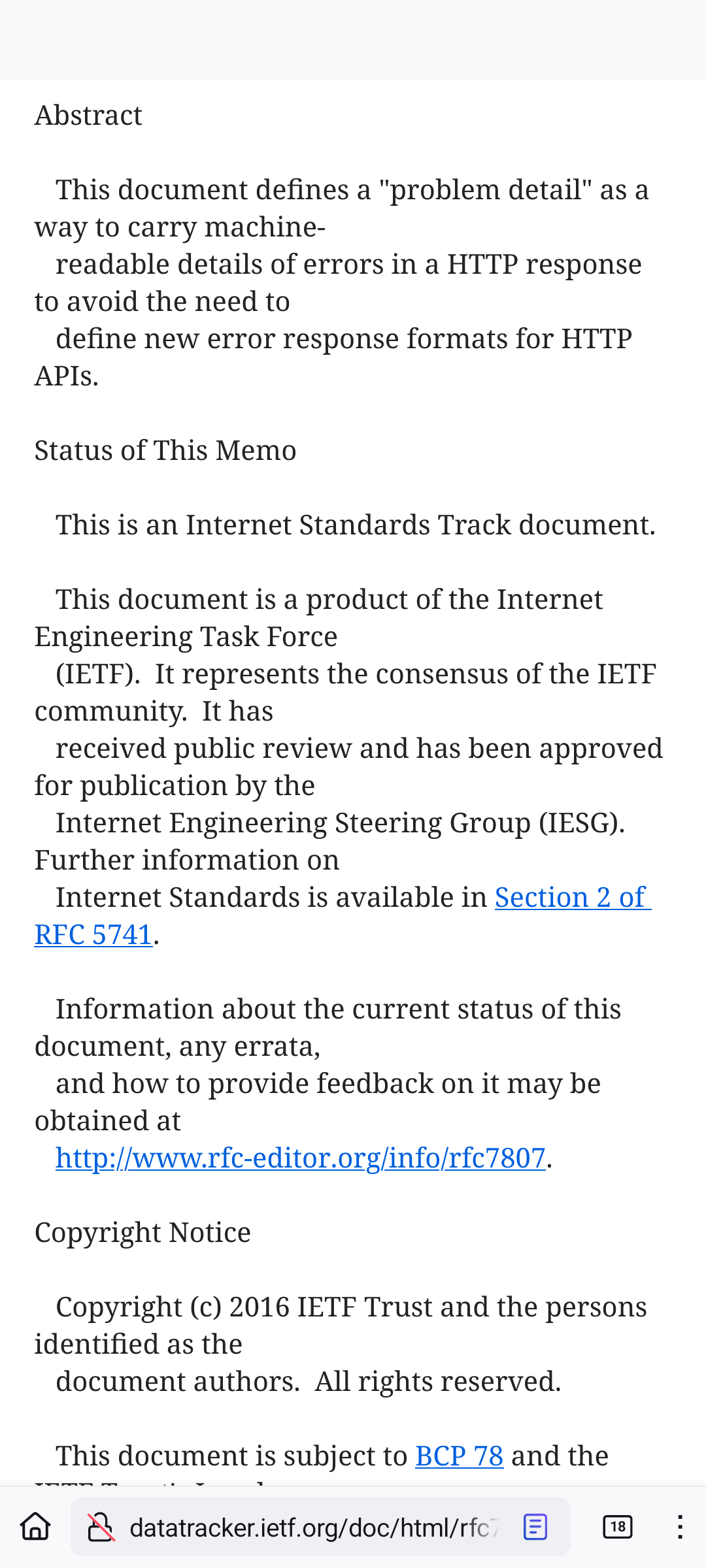
Maybe a bad markdown viewer?
viewergenerator?No, in general the markdown format suggests using line breaks in the middle of paragraphs to make the code just as readable as the output. That’s why two line breaks is what creates a new paragraph. So it’s the viewer showing it incorrectly here.
That would be nice. I have implemented this in the past but never once encountered an API that used it.
Best is when the API doesn’t match a PDF and says “500: Internal Error”
TOML instead of YAML or JSON for configuration.
YAML is complex and has security concerns most people are not aware of.
JSON works, but the block quoting and indenting is a lot of noise for a simple category key value format.
TOML is not a very good format IMO. It’s fine for very simple config structures, but as soon as you have any level of nesting at all it becomes an unobvious mess. Worse than YAML even.
What is this even?
[[fruits]]
name = "apple"

[fruits.physical]
color = "red"
shape = "round"

[[fruits.varieties]]
name = "red delicious"

[[fruits.varieties]]
name = "granny smith"

[[fruits]]
name = "banana"

[[fruits.varieties]]
name = "plantain"
That’s an example from the docs, and I have literally no idea what structure it makes. Compare to the JSON which is far more obvious:
{
  "fruits": [
    {
      "name": "apple",
      "physical": {
        "color": "red",
        "shape": "round"
      },
      "varieties": [
        { "name": "red delicious" },
        { "name": "granny smith" }
      ]
    },
    {
      "name": "banana",
      "varieties": [
        { "name": "plantain" }
      ]
    }
  ]
}
The fact that they have to explain the structure by showing you the corresponding JSON says a lot.
JSON5 is much better IMO. Unfortunately it isn’t as popular and doesn’t have as much ecosystem support.
You’re using a purposely convoluted example from the spec. And I think it shows exactly how TOML is better than JSON for creating config files.
The TOML file is a lot easier to scan than the hopelessly messy json file. The mix of indentation and symbols used in JSON really does not do well in bigger configuration files.
YAML is complex and has security concerns most people are not aware of.
YAML is racist to Norwegians.
If you have something like
country: NO(NO = Norway), YAML will turn that intocountry: False. Why? Implicit casting. There are a bunch of truthy strings that’ll be cast automagically.What in tarnation
People bitch about YAML but for me it’s still the preferred one just because the others suck more.
TOML like said is fine for simple things but as soon as you get a bit more complex it’s messy and unwieldy. And JSON is fine to operate on but for a config? It’s a mess. It’s harder to type and read for something like a config file.
Heck, I’m not even sold on the S-expressions compared to yaml yet. But then, I deal with so much with all of these formats that I simply still prefer YAML for readability and ease of use (compared to the others.)