The actual thing that matters is that the / is ignored so (unlike with XML I believe) you can’t self-close a non-void element by adding a trailing /. But “void elements should not have trailing slashes” is extrapolation on your part; the trailing slash improves readability and is kosher since it doesn’t act as a self-close.
It’s not extrapolation on my part, the HTML spec is pretty direct about it:
Then, if the element is one of the void elements, or if the element is a foreign element, then there may be a single U+002F SOLIDUS character (/), which on foreign elements marks the start tag as self-closing. On void elements, it does not mark the start tag as self-closing but instead is unnecessary and has no effect of any kind. For such void elements, it should be used only with caution — especially since, if directly preceded by an unquoted attribute value, it becomes part of the attribute value rather than being discarded by the parser.
For example, in the case of <div/>Some text, browsers interpret this as <div>Some text</div>, treating the slash as ignored and considering the div element to encapsulate the text that follows.
You should never rely on a browser interpreting a non standard use in a specific way. It can change at any moment, and wouldn’t be reliably reversed because it’s inherently non standard.


> Clicks on
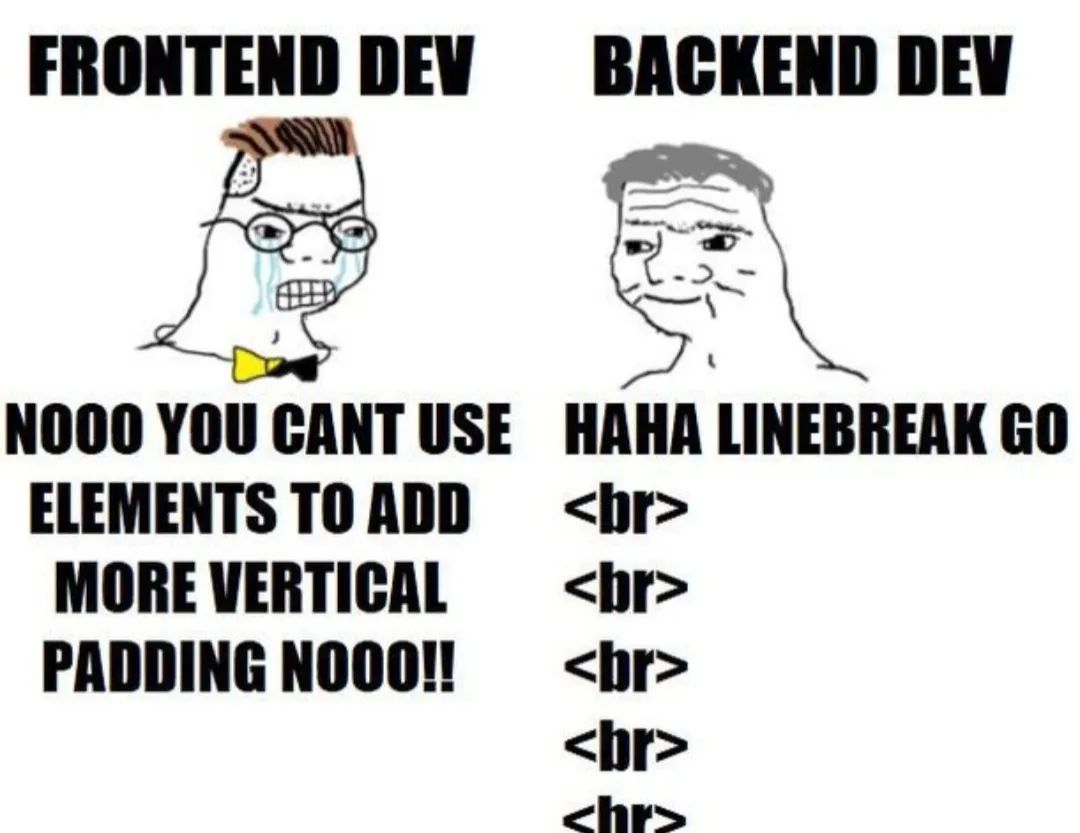
<br>> Example is
<br />The actual thing that matters is that the
/is ignored so (unlike with XML I believe) you can’t self-close a non-void element by adding a trailing/. But “void elements should not have trailing slashes” is extrapolation on your part; the trailing slash improves readability and is kosher since it doesn’t act as a self-close.It’s not extrapolation on my part, the HTML spec is pretty direct about it:
https://html.spec.whatwg.org/multipage/syntax.html#start-tags
I don’t think it’s an extrapolation to say that code which is “unnecessary and has no effect of any kind” should be omitted.
And yeah, I linked the MDN docs because they’re easier to read but if they disagree then obviously the spec is the correct one.
To be annoyingly nitpicky, how is “unnecessary” defined in this context? Whitespace is usually “unnecessary” but I quite like it for readability.
I broadly agree with you though, the W3C spec changes things.
Trailing slash lets you do this though:
This is terrible.
You should never rely on a browser interpreting a non standard use in a specific way. It can change at any moment, and wouldn’t be reliably reversed because it’s inherently non standard.