The problem is that people frequently use this type of argument when they are unable to spell or follow the basic rules of syntax and grammar instead of simply admitting they’re wrong.
Language does change, over time and across many cultures. It doesn’t mean that anything you write is automatically correct.
I’m a descriptivist but that doesn’t mean that there aren’t rules and that we can’t point out things still being wrong.
Descriptivism still describes rules as they’re used in the real world. Breaking those rules still subjects the speaker/writer to the consequences: being misunderstood, having the spoken or written sentence to simply be rejected or disregarded, etc.
“Colour” and “color” are both correct spellings of the word, because we are able to describe entire communities who spell things that way. “Culler” is not, because anyone who does spell it that way is immediately corrected, and their written spelling is rejected by the person who receives it. We can describe these rules of that interaction as descriptivists, and still conclude that something is wrong or incorrect.
Wrong according to… who? Who is the authority? Who granted them that power? By what mechanism can one appeal their decision?
What is “correct”?
There are standards, but you can only really say something is “wrong” or “incorrect” in relation to a particular standard. You typically wouldn’t write “senator yeeted his hat lol fr” as a newspaper headline. That doesn’t follow the standards for that context. But that doesn’t mean it’s “wrong” in some universal sense.


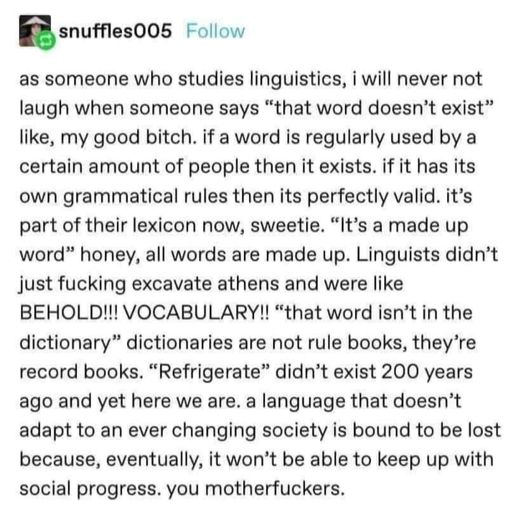
The problem is that people frequently use this type of argument when they are unable to spell or follow the basic rules of syntax and grammar instead of simply admitting they’re wrong.
Language does change, over time and across many cultures. It doesn’t mean that anything you write is automatically correct.
I’m a descriptivist but that doesn’t mean that there aren’t rules and that we can’t point out things still being wrong.
Descriptivism still describes rules as they’re used in the real world. Breaking those rules still subjects the speaker/writer to the consequences: being misunderstood, having the spoken or written sentence to simply be rejected or disregarded, etc.
“Colour” and “color” are both correct spellings of the word, because we are able to describe entire communities who spell things that way. “Culler” is not, because anyone who does spell it that way is immediately corrected, and their written spelling is rejected by the person who receives it. We can describe these rules of that interaction as descriptivists, and still conclude that something is wrong or incorrect.
One who culls is a culler.
“Culler” is a word, but it certainly will not be received by a reader as the same word as “color.”
True. My brain brought forward a seal clubber.
Wrong according to… who? Who is the authority? Who granted them that power? By what mechanism can one appeal their decision?
What is “correct”?
There are standards, but you can only really say something is “wrong” or “incorrect” in relation to a particular standard. You typically wouldn’t write “senator yeeted his hat lol fr” as a newspaper headline. That doesn’t follow the standards for that context. But that doesn’t mean it’s “wrong” in some universal sense.
Correct according to who? You? Lol
Fortunately, you are not the arbiter of the English language.
That’s what I was just saying to you, so I’m confused why you think that’s a rebuttal.
You said things people write aren’t automatically “correct” without defining what correct means.
I’m not surprised that you’re confused
You seem to be trying to be smug after you’ve communicated badly. Additionally, your understanding of how language works is not widely accepted.
The fact that you don’t understand your argument is facile and easily undermined only highlights your lack of understanding and maturity.
Your personal opinion doesn’t count as something being “widely accepted”.