A MONAD IS A MONOID IN THE CATEGORY OF ENDOFUNCTORS
Wow you sound so smart!
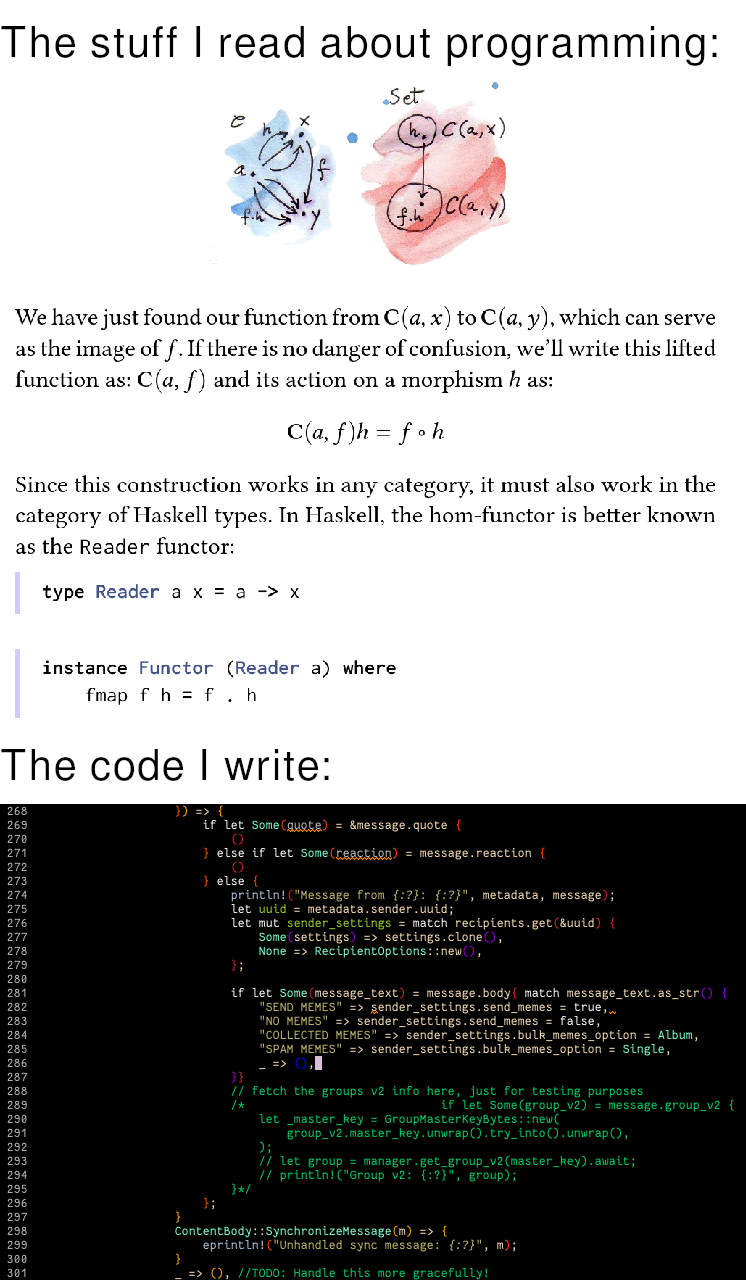
Typical Computer science vs typical computer engineering
Inside me are two wolves I guess…
Chief O’Brien:
Sorry about that transporter malfunction, sir! Won’t happen again!
Rust mentioned!
At least the code on the bottom is actual code and not just signatures
Instead of
if let Some(a_) = a{
    ()
} else if let Some(b_)=b{
    ()
} else {
    dostuff
}
you could just use
if a.isNone()&&b.isNone(){
    dostuff
}
Also if you don’t use the value in a match just use
_That’s a good point, thanks. Maybe I’ll go without the if entirely, the (janky) code is still very much in flux ;)
Doesn’t that construction only work in categories that also contain their own morphisms as objects since a profunctor maps
(Cᵒᵖ × C) → Setand not the same like(Cᵒᵖ × C) → C? Since the category of Haskell types special, containing its own morphisms, so the profunctor could be like(haskᵒᵖ × hask) -> hask? or I just don’t understand it.Hom functors exist for locally small categories, which is just to say that the hom classes are sets. The distinction can be ignored often because local smallness is a trivial consequence of how the category is defined, but it’s not generally true
I don’t nearly know enough to understand this but is anyone willing to help me get the thing on the top :>
To first give you some context, the thing on the top is from The “Representable Functors” chapter of Category Theory for Programmers. So technically, you only need to read 230 Pages of a maths textbook to get it ;)
But this isn’t exactly what you asked for, so I’ll try to help you get it as best I can with my limited understanding of the subject. First of all it would be helpful to know what your prior knowledge in Maths, especially Set theory, is?
deleted by creator
is this a section of a discord api implementation?
Almost, but not quite. It’s built against Presage