Your comment about current models, known energy types, and universal pixels seems to ignore the post’s topic (which isn’t really about known models or energy types).
A better way to disregard the post would be to just point out that solar systems aren’t that big in terms of scales of the universe, and that there’s no indication of any charges, electrons, or valance layers about.
planck length doesn’t come up even once, it all boils down to these things: 1. electron has momentum, and from that follows it has a wavelength, and at the same time 2. orbit is stable, which means that after every “rotation” electron has to end up with the same phase, which means there is only a finite number of solutions to time-independent schroedinger equation for (hydrogen) atom (don’t bother solving it on paper for anything with more than one electron) and these things are spherical harmonics


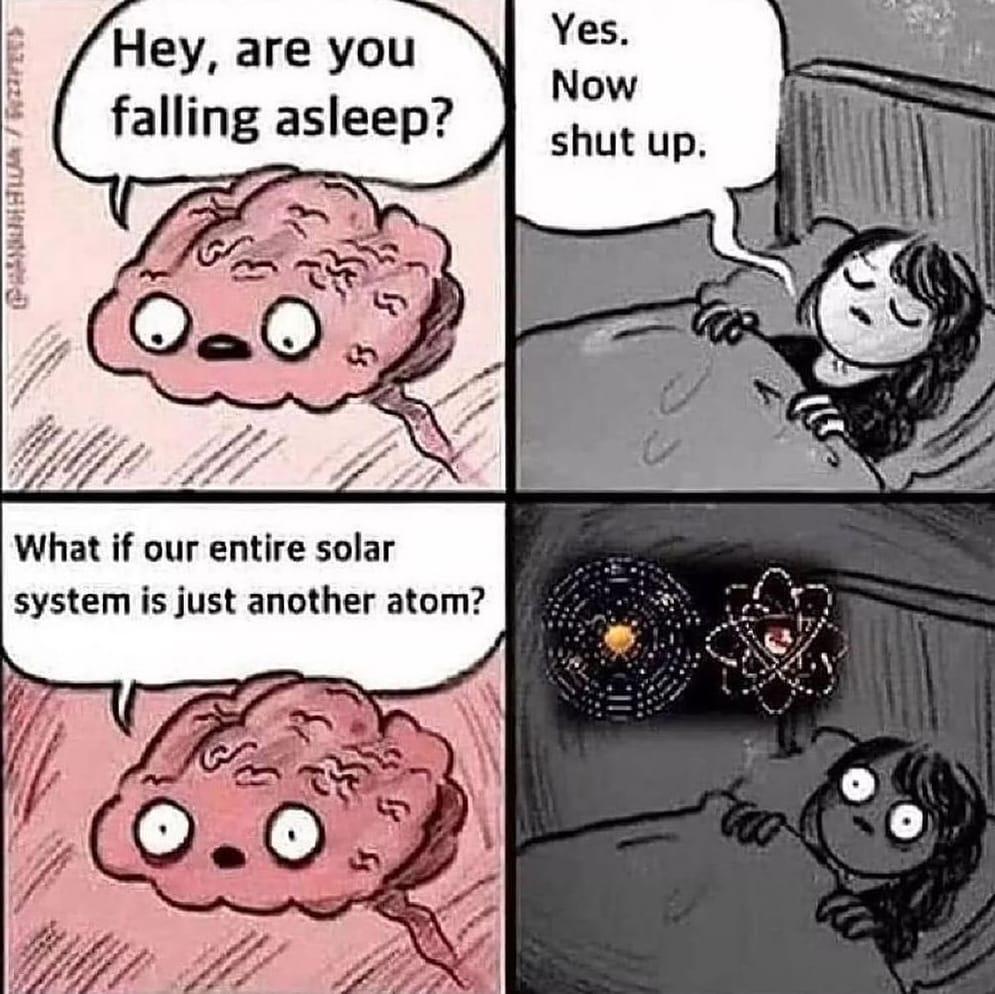
Or just reject planck length and all other dimensional limitations like it. Then you can have
turtlesuniverses all the way down.deleted by creator
Your comment about current models, known energy types, and universal pixels seems to ignore the post’s topic (which isn’t really about known models or energy types).
A better way to disregard the post would be to just point out that solar systems aren’t that big in terms of scales of the universe, and that there’s no indication of any charges, electrons, or valance layers about.
deleted by creator
No.
deleted by creator
planck length doesn’t come up even once, it all boils down to these things: 1. electron has momentum, and from that follows it has a wavelength, and at the same time 2. orbit is stable, which means that after every “rotation” electron has to end up with the same phase, which means there is only a finite number of solutions to time-independent schroedinger equation for (hydrogen) atom (don’t bother solving it on paper for anything with more than one electron) and these things are spherical harmonics