Have you ever been in an old house? Not old, like, on the Historic Register, well-preserved, rich bastard “old house”. Just a house that has been around awhile. A place that has seen a lot of living.
You’ll find light switches that don’t connect to anything; artwork hiding holes in the walls; sometimes walls have been added or removed and the floors no longer match.
Any construction that gets used, must change as needs change. Be it a house or a city or a program, these evolutions of need inevitably introduce complexity and flaws that are large enough to annoy, but small enough to ignore. Over time those issues accumulate until they reach a crisis point. Houses get remodeled or torn down, cities build or remove highways, and programs get refactored or replaced.
You can and should design for change, within reason, because all successful programs will need to change in ways you cannot predict. But the fact that a system eventually becomes complex and flawed is not due to engineering failures - it is inherent in the nature of changing systems.
My 100 year old house has marks on the floor that look like it was worn from a door swinging. Very distinctive arc pattern. Like it was there for many years and was under frequent use.
The problem is that there’s no door there, just a wall, which is also the edge of a dormer…so if there were a door there it would just open out onto a sloping roof.
Every time I register it I contemplate why it’s there and wtf happened.
There was most likely a closet or other crawl space storage area there. My house has closets like that but luckily full height entries to them so we can actually step in. I’ve seen other houses with 1/2 or 1/3 height doors leading to under-roof crawl spaces for storage.
This is so true.
Even if you do design clean modular code and document it, you’re getting a question a year from now about how it works, or someone just duct tapes on top of it.
I’ve even experienced this in the 3D printing community, where I design a highly parametric model and put lots of effort into making all of the major dimensions and qualities parameterized and dynamically adjustable, with lots of bounds checking and value clamping, with all the parameters at the top of my scad file with comments explaining what each variable does.
And then someone comes along to remix my model, says I don’t want to install openscad, and just scales the entire output stl to change the dimensions, squashing all the features of the model in the process (instead of having the size gracefully adjust with all the features moving around to account), and leaving anybody starting from their work with a hard to remix mesh with no parameters.
Or business decides all specs and design decisions that were made last quarter were actually garbage and yes we do want to be able to manually override every step of the carefully designed state machine. We’d like to be able to manually change all calculated sales data, but also the data needs to remain in a consistent state at all times. Oh and while you’re there, we decided the commission calculations will use a different system from now on. We expect it to be online by the end of the week, thanks.
Removed by mod
At least they can observe the patterns….
Bless your heart.
In my experience, this often doesn’t happen. So many developers are either inexperienced or cowboys, and there’s nothing inherently wrong with either. But at places where projects are small and numerous, teams often end up with nothing but a combination of the two.
As one of our office’s engineering “fixers”, I’ve taken over maintenance of several such projects. They usually have shattered remnants of code taken from other projects, open source libraries, internal libraries, stack overflow, and so on. Whole source files copied into the project, modified in ways that introduce impressive new failure cases while failing to add new functionality, and used in ways that completely ignore the features natively implemented in that code while those same features are bodged in as barely-working piles of if statements, balanced on a knife’s edge to avoid triggering the failure modes added by the project’s modifications of the copied code. I’m usually able to purge 20-30k lines of code from such projects in the first month, simultaneously closing multiple outstanding issues the PM had been led to believe were intractable.
That probably sounds like arrogance and/or shitting on everybody else’s work but it’s just reality at many workplaces due to a pace driven by unreasonable expectations from management. I just happen to be the person here that ends up sifting through the wreckage when a project reaches the inevitable osteoporosis phase, because of a natural disposition for reverse engineering. It would be great to escape for this and other reasons, as far as I can tell, most places aren’t that different.
This can work for junior devs who aren’t stuck in their ways. Unfortunately there are too many “senior” devs who are happy making crap. It’s hard to fight them constantly to do things properly (e.g. write actual commit messages rather than just “Fix #836”) so using tools like linters where possible is definitely a big improvement.
The ‘document’ part also seems to be insanely hit-or-miss from my amateur experience. Self-documenting design/code is… well, not. Auto-generated documentation is also usually just as bad IMO. Producing good documentation really is a skill in and of itself.
Also small personal opinion: If your abstraction layers or algorithms are based off a technical concept, you should probably attribute that concept and provide links to further research, to eliminate future ambiguity or in case your reader lacks that background. Future you will probably thank you and anyone like me who immediately gets lost in jargon soup will also be thankful.
public class AbstractBeanVisitorStrategyFactoryBuilderIteratorAdapterProviderObserverGeneratorDecorator { // boilerplate goes here }Okay, here we go. I’m going to spit out some bullshit and home someone corrects me if I’m wrong. I’ve looked for some explanations and this is what I’ve gotten.
Are you ready?
The Factory Pattern.
My understanding is that the purpose is a function to return any of several types of objects, but a specific type, not just an interface or whatever they might all inherit from.
I think most languages now have something like a “dynamic” keyword to solve this issue by allowing determination of the type only at runtime. (To be used with extreme caution.)
But most of the time I see the Factory pattern, it’s used unnecessarily and can only return one specific type. Why they would use a Factory pattern here and not just a plain old constructor confounds me.
Am I off base?
Factory pattern can return a mock type for testing or a production type, as needed, which makes it possible to unit test the code that uses the produced object.
This quick guide explains it well. Then it improves on it by explaining dependency injection.
Yeah most uses of the factory pattern are unnecessary and it’s mild code smell IMO. If your factory only returns one type you should definitely just use that type’s constructor.
You avoided writing spaghetti code.
Congratulations! Now maintain this piece of shit lasagna that takes place over multiple layers of abstraction and repositories.
deleted by creator
There is nothing more permanent than a temporary solution that works
I feel this personally today. I just looked at some code in a module where it started out with nice, short functions with good names. I looked back at it today, and it now has a 180 line mega function full of nested conditionals and I don’t know how this happened.
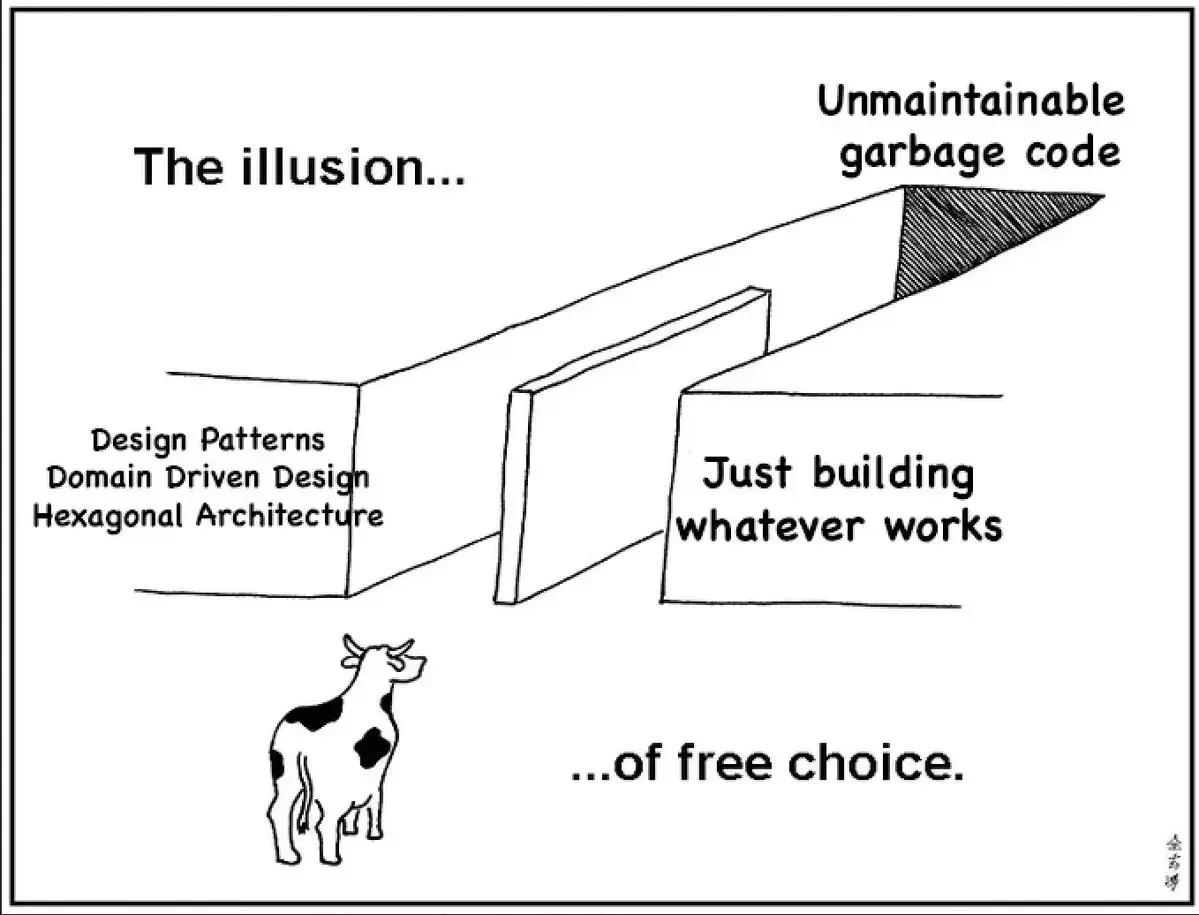
Huh? Hexagonal Architecture?
Onion architecture. Ports and adapters are other names for it, I think.