

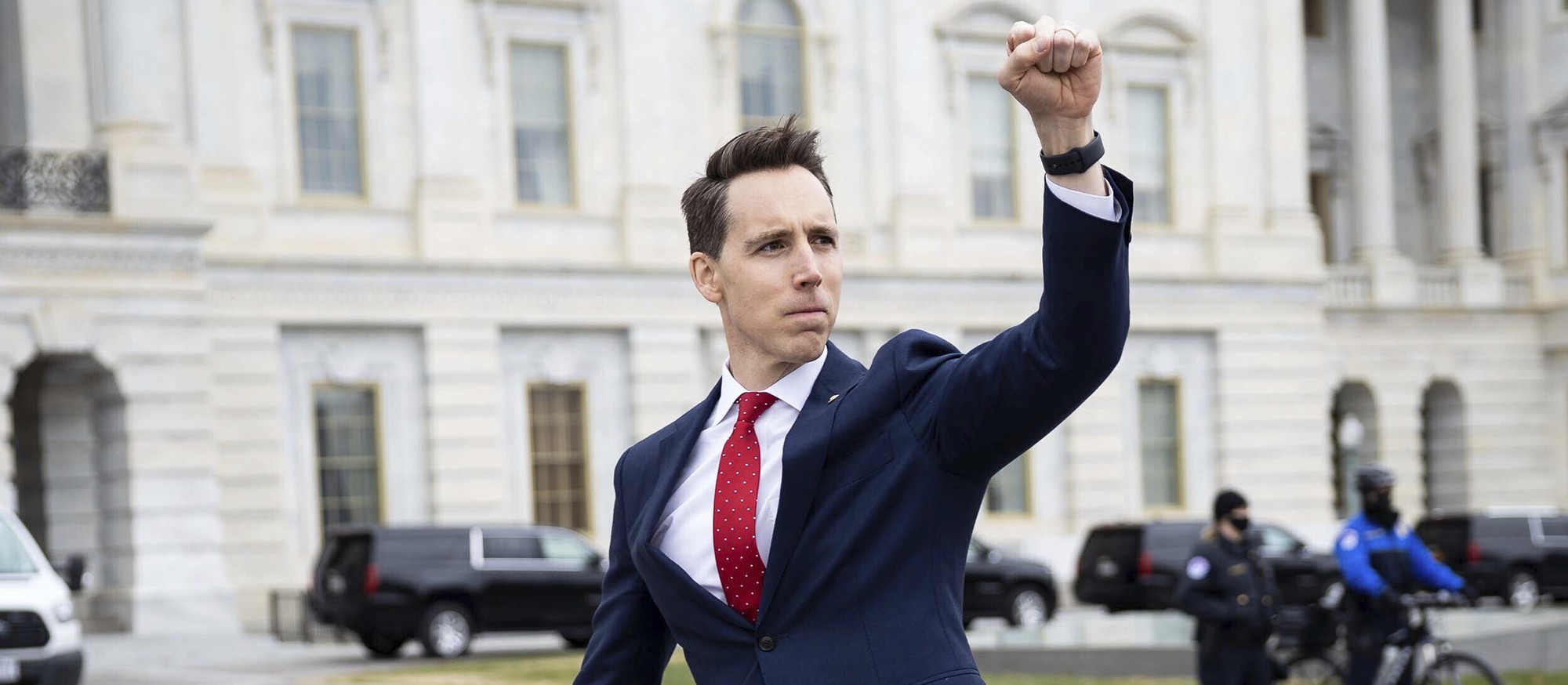
Missouri Sen. Josh Hawley’s recent First Things essay, “Our Christian Nation,” may warm the hearts of Christian nationalists and confound historians and theologians who worry about continuing threats to the separation of church and state.
Missouri Sen. Josh Hawley’s recent First Things essay, “Our Christian Nation,” may warm the hearts of Christian nationalists and confound historians and theologians who worry about continuing threats to the separation of church and state.
Yeah, the people that came to build european colonies on this land were christian extremists, but that doesnt make America a christian nation… Especially since the very foundation of the nation, a staunch separation of church and state with no law establishing one religion over another, was one of the very beginning principles.
Its right there in the first amendment.
America is a land where religion should have no more presence but between a person and their god, as far as Jefferson was concerned at least, and I’m sure many other founders shared that sentiment.
Not anymore. But that’s a product of the current generation divesting (or simply losing touch with) the religious communities of their elders. Go back 40 years and you could very credibly claim that America was a Christian Nation in every way that mattered. Billy Graham was a fixture in every White House. Religious fundamentalism was driving foreign and domestic policy. Individual elected delegates were de facto required to be members of large religious communities in order to take and hold office or mobilize large bodies of political activism.
The First Amendment has no teeth. Religious minorities in the US are routinely persecuted, by the state, both explicitly and implicitly for their membership and their beliefs. This hit the ceiling in the wake of 9/11, when any kind of Muslim religious affiliation was borderline criminal. Police wiretapping and surveillance and extrajudicial punishment of Muslim individuals and groups (very obvious breaches of the 4th and 5th and 8th amendments) was routine. People were deported entirely on the grounds of their religious affiliation. States passed laws outright banning the practice of Sharia custom and culture. And that’s just in the last few decades.
You can find all sorts of crazy prohibitions, sanctions, and outright persecution of religious minorities, from the hounding of Mormons across the American Midwest to the denial of legal asylum to Jewish refugees fleeing Nazi persecution.
Okay, sure, that’s a beautiful ideal. But it isn’t the reality on the ground. Certainly not in a country where clery post the names and addresses of abortion providers, encourage their congregants to kill them, and then suffer no meaningful legal culpability.
The separation between church and state, in practice, is a fig leaf that serves more to protect religious institution from taxation and regulation than to keep religious beliefs from affecting public policy or election results. If anything, it has created a kind of paradox in which religious leaders have more influence over politics than lay congregants.