deleted by creator
Part of the excellent case why you shouldn’t roll for the routine. Take “town downtime activities”.
If a character is a lifetime street urchin, they should be able to find a few “safe marks” versus rolling to snag some risky but lucrative pickpockets. A talented musician doesn’t flub every 20th note, but you can certainly reward bigger rolls with bigger tips.
I feel like this doesn’t take two things into account.
First is what the group wants. While that work for a bunch, and does for my Tuesday game, it wouldn’t for the games that I’ve run in the past and personally doesn’t work for me either. A lot of people actually like rolling for stuff like that. It adds some element of flavor on how good or bad it can go. While you succeeding might be all but guaranteed, the numbers can impact a lot. That and some of us just like using the clicky math rocks we’ve spent a disgusting amount of money on.
The other thing is that it still ignores the core problem of a 5% chance of failure of something that you are proficient or an expert in. An expert having a 5% chance of not just failure but critical failure isn’t something that I really jive with. Can you imagine if those margins were acceptable in our reality? Can you imagine if there was a 5% chance that during a lecture on something that they’ve been studying all their life, a medical doctor gives genuinely dangerous advice to his students? Sure. Accidents happen. That has happened in the past but if that happened 5% of the time with every expert on the planet… well things would look very different. The entire term expert would probably have a different definition as that perpetual 5% chance would really change your opinion on how much you trust someone when they have the same chance of catastrophic failure as Joe from the market.
Critical failure doesn’t have to mean the worst outcome imaginable, though.
Rolling a 1 on a routine skill check that you’ve done a thousand times as an expert should reflect the circumstances.
Landing a familiar model plane at your home airport on a sunny day with no wind? Rolling a 1 means it’s as bad as it can be under those circumstances. Let’s say, a bird flies into the windshield and obscures your view. New problem to solve! New roleplaying opportunity! Doesn’t mean the plane insta-crashes. You might just deal with the failure creatively and carry on like nothing happened. Scary moment, but fun to play out.
Now let’s say you’re the same experienced pilot, but you’re landing an unfamiliar, stolen plane that your rogue hot wired, and you’re trying to land on a beach littered with tourists and rocks.
Rolling a 1 for a critical failure is a much different scenario this time.
Every 20th dish from Gordon Ramsay is just dogshit smeared on a plate.
That’s why I do crit fail confirms. That way an experienced pilot only crashes every 400th landing.
That’s still far more than reality though.
D&D isn’t meant to be an accurate simulator of reality. It’s meant to be fun. If you find 1 in 400 auto failures to be unfun then don’t use it.
Indeed.
Also you can take 10 if you’re not stressed.
And that’s why you as the DM can do passive skill checks (neé “taking a 10”) for non-stressful situations. A routine landing is just 10 + ability mod (probably INT on a big plane with full FBW) + PB. It’s only with 3 of the 4 engines down, the 4th on fire, the computers are fucked, you’re trying to land the 747 on a dirt strip, and oh, there’s a hurricane when you need to actually roll for it.
Though I’m also down with Esper’s idea of every class having a limited reliable talent. So every character could pick one class skill at level 7 and one at level 14 in which they couldn’t roll under a 10. The “expert” classes (rangers, rogues, bards, and artificers) would have additional picks at levels 3, 10, and 17 with full reliable talent being their capstone feature.
Yes, but nobody plays Tarmac and Turnstiles, the game of Uneventful Travel.
deleted by creator
I like how Pathfinder 2E does it. A 20 brings your result one tier higher. A 1 brings your result one tier lower. With a high enough base expertise, you can still succeed when rolling a 1, just not as awesome as you normally are. And a 20 isn’t a guarantee against really strong foes.
This. Plus, if you beat the DC by 10 or more, you get a Critical Success or if you fail by 10 or more you get a Critical Failure, regardless of the dice roll.
And for opposed skill checks only the player/NPC taking the action rolls a d20, and that’s compared against the opposing skill DC (10 + Skill Bonus). This streamlines play and reduces random variability.
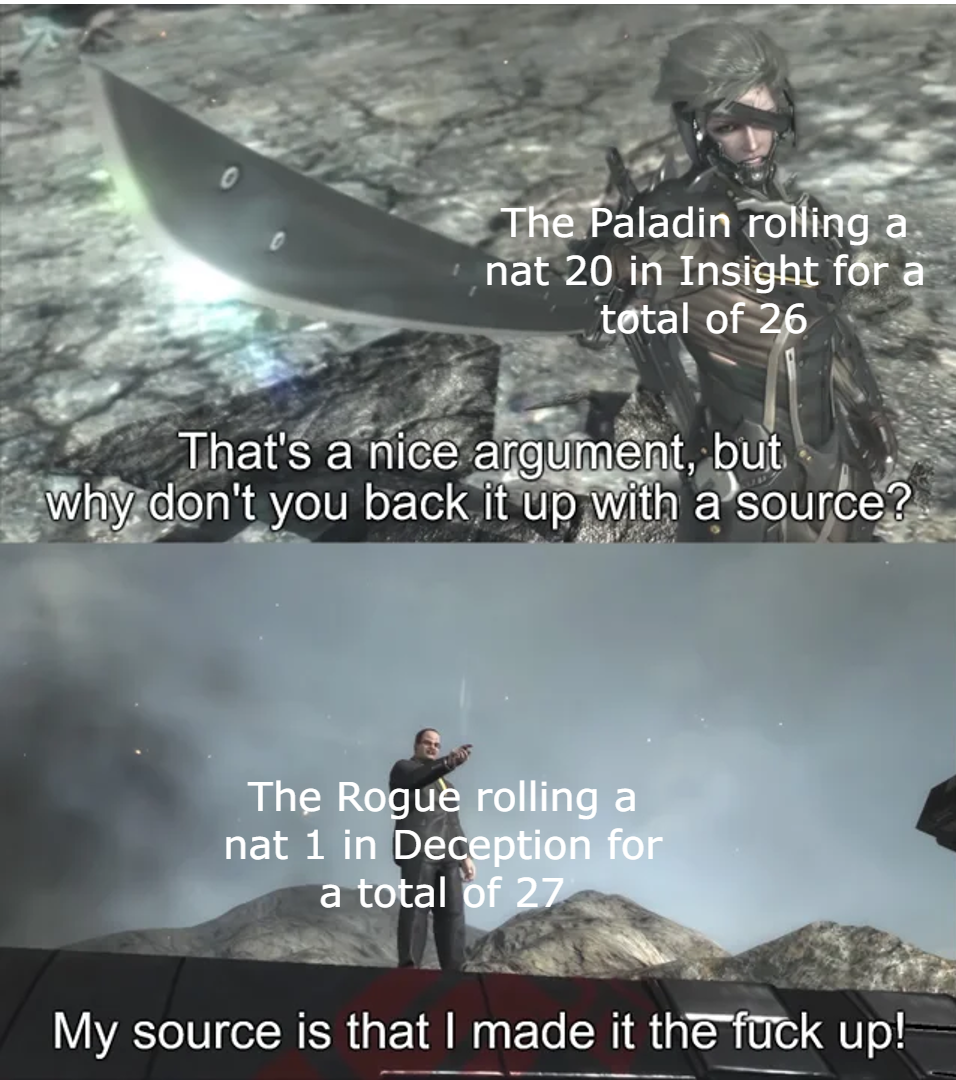
So in the example here, only the rogue would have rolled the natural 1 and added 26 for a 27. The paladin’s Perception DC would be 16, so the Rogue beat it by 11 and it’d normally be a Critical Success. But since it was a natural 1, the Critical Success is reduced to a Success. They still succeeded at deception, but not quite as well as they could have.
I’ve had players have this exchange, and then the Paladin decided to ignore the rogue’s critical miss, and just roll with it.
Paladin to the rest of the party “I forget what they said exactly, but it was a very convincing argument!”
Critical success and failure has never applied to skills. It was only ever in the rules for attack rolls and (in 5e) death saving throws. Critical success and failure in skill checks is probably an example of the Mandela Effect. Anyway, for the above reasons I don’t use them as such. However, on nat 20s I might provide a “path for success” where one may not otherwise have been possible. But it’s never a given. More of an opportunity for roleplay.
It’s not the mandela effect, it’s a common house rule that people express their opinions on.
Yeah, everyone is very aware it’s not in the official rulebook, other than in the section of the official rulebook where it says not to treat it as an official rulebook and only something to fall back on if you can’t think of something better.
And for anyone that for any small moment of time may not have temporarily been aware that skill crits isn’t in the official rulebook, that problem is solved very quickly the second they meet any other player online.
I like the idea of a critical role needing another roll to see just how critical it was. That way something crazy can always happen, but it doesn’t need to be a certain doom either.