If you check my comment, I will show you my current Dying condition that I have been able to test on the field.
It’s 80 % the one from XP to level 3, with a few things changed and actually used in a DND game :)
Enjoy
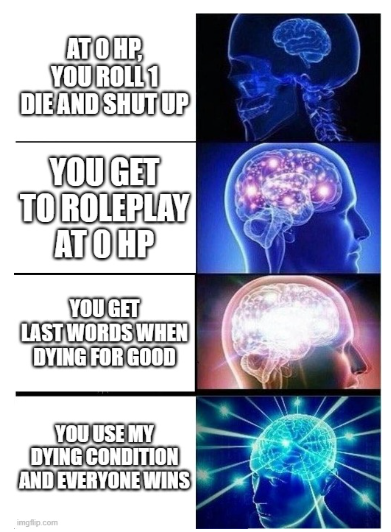
I take a system inspired by the video game Wildermyth, where the player gets to decide what happens at 0 HP.
Option 1: You fall unconscious. Your fate is out of your hands.
Option 2: You die, but… You might go out in a blaze of glory, or inspire an ally, but you’re dead for good. At least it’s a good death, which is better than some get.
Option 3: You live, but… You might lose an eye, or a magic item gets destroyed, but you manage to escape. You’re still out of the fight, but you live to see another.This is a really overview.
I play a lot of WFRP. The fate point system is similar to option 1 and the critical system is effectively option 3.
And as a GM I’ll never get in the way of option 2!
3 sided dice roll? interesting
Dice roll? No, you get to choose which one you’d prefer. Nothing random about it.
but without the mathrocks how can the deities of random chance smite my players? and what goes clickly clack?
NO MATH ROCKS!??
Uh… Okay, optional revised version. Roll a d3 (use a d6 and half it) and use whichever option comes up. If you don’t like the result, or you want more click clack throwing fun, roll again until you get the result you want.
this is satisfaction. clacky sounds of probability creating doom for the players, er, FATE, for the players. Yes. yesssss…
Since I’m enjoying the different rules shared here, here’s a (from memory) rendition of the Fate RPG rules on encountering lethal amounts of damage.
DM and player discuss and assign an appropriate and interesting condition that moves the game along. That condition may be “dying” or could be something more interesting.
Players and the GM can invoke the new player condition to gain benefits and make other rolls easier or harder. (The core FATE rule.)
Weirdly, this covers a lot of interesting cases really well:
- the GM can invoke “dying” to keep the dying character from monopolizing the remaining combat in un-fun ways, and make it (taking lethal amounts of damage) have an in-game cost.
- the GM can invoke the “dying” condition in other ways to nudge players to find a way to lend aid ( like granting a character “encumbered” while they carry the “dying” character around)
- the “dying” player may be able to invoke “dying” as an “I’m very motivated” bonus if they’re doing something very in-character that matters to their character
- “unconscious”, “prone”, “mostly paralyzed”, can be a useful on-and-off conditions to represent recovery rolls that go badly
For GMs running a game of FATE, I recommend watching the “The Princess Bride”, which milks the “dying” condition for interesting moments, in many delightful ways.
I have recently encountered ICON and come to really like its dying mechanic. Each time a character is reduced to 0HP they become incapacitated, but stable, and gain a wound. Each wound reduces max hp by 25% and only goes away after an adventure (quest). A character can help an incapacitated character (rescuing) bringing them up and healing them to their new max HP, which after one wound would be 75% of max. Second time dropping to 0hp, a second would and new max hp of 50% of original.
It gives good longevity in individual encounters and forces caution in the longer run.
If it takes a half hour for a single round of combat then I will assert that you actually are doing D&D wrong. Players should know the rules for anything their character can do and be paying attention so they’re ready when their turn comes up. Combat and magic rules take up maybe a dozen pages in the PHB, spend an hour and read over them a few times to make those weekly games you invest two to six hours into go much smoother.
The DM should know all the rules. Like most homebrew I see, this is an overly complex “solution” that functions nothing like anything else in the game and wouldn’t be necessary if everyone involved actually learned the real rules. 5e already has an exhaustion mechanic and it works nothing like what is described. Making up new and convoluted rules to be used by people that take six minutes to move and make an attack or cast a spell is not going to accomplish anything but making your combat turns forty minutes long instead of thirty. I play in a game that includes seven PCs including two “lightly experienced” players and one complete noob. Combat rounds take maybe ten minutes, tops, because people pay attention and the DM actually learned all the real rules.
You are entitled to your opinion, but I disagree with most of it.
You must be a treat at the game table. 🫥
Yes, I am. When my turn comes up in combat I’m done in thirty seconds because I pay attention and know how to play my character.
Do you bitch to the other players then ? Or have you kicked then out of the table before that ?
That’s the Pathfinder death system, if I recall correctly.
deleted by creator
Condition Dying
Not for NPCs, the goal is to keep players alive.
When hit points reach 0, the character drops Prone and becomes Dying
At the beginning of the round, we start with the Death saving throws.
Then, the character can either:
Move (prone = half movement). Cost: Free
Talking while dying. Cost = Free
Action. Cost = 3 levels of Exhaustion
Bonus Action. Cost = 1 level of Exhaustion
Reaction. Cost = 1 level of Exhaustion
It is not possible to get up.
Exhaustion: On the d20
1 = -1 on every d20
2 = -2 on every d20
…
9 = -9 on every d20
10 = death
Recovery **First ** shorts rest = - 1 Exhaustion Long rest = - 2 Exhaustion
Edits following comments :
so, the -1 exhaustion on short rests is only on the FIRST short rest that they use it on. They can’t do it twice in a day. Also clarified the scaling. Love to you all
I used to run 5e for years and also use to make all kinds of house rules and systems just like this to get it to run how I wanted it to because it doesn’t do much outside of combat out of the box. I read through the PF2e rulebook and kicked myself for not switching sooner because they have a rule for damn near everything I would want to run and super balanced at the same time.
If I had more time, PF2 is on my list for a game. I do know a DM, I just don’t have the time yet in my scheduling. But yeah, I’m trying PF2 one day if I live long enough.
That’s addressing a totally different issue to what the above piece, which is about maintaining action and agency when a PC is knocked unconscious.
The up-down yo-yo of 5e is a problem but the frustration here is when combat rounds are taking a while, it’s so boring to just make one roll every 40 minutes.
Interesting concept, but I just need to ask for some clarification before I can consider using it for my players. Are the Exhaustion points you use disconnected from the condition Exhaustion, where you get various negative effects until death at the 6th point? If I read the last line correctly, you get 10 points and you die? If they’re not regular points of exhaustion, a player can just use an action to heal themselves with a potion or spell, remove themselves from combat. Then they just need a short and long rest and they’re good to go. I think this might make them too powerful in the long run. If you use regular points of Exhaustion, you suddenly raise the stakes, while still keeping the player’s ability to move half movement and talk. Otherwise you’re indtroducing another value to keep track of that might raise more questions than solve problems. Can they be removed with a powerful enough healing spell/potion?
Keep the system, but use regular points of Exhaustion instead. You get one action that’ll really mess you up, where you are able to heal yourself, but you suffer the consequences of it after. Now that seems exciting. Just my two cents.
Its my new Exhaustion system borrowed from one dnd. I always hated the 5th version of exhaustion, as its hard to remember every single point. So my system here replaces the old one. Where instead every d20 roll has a minus.
Thank you for elaborating. How’d the playtesting go? Also, you referred to a specific XP To Lvl 3 video, would you be ok with sharing the link, pretty please?
How to refuse such politeness ? Here it is my good sir :
https://m.youtube.com/watch?v=w_6fHrOUoXM
It went really well. The hardest part was putting my 10+ leveled players to 0 HP. After that its a straight buff to them. They can talk and move for free, the rest is optional. You could even have the rule for half the table and still working. Except for changing the exhaustion, but fuck I do not like the complexity of every stage of 5th exhaustion. It lacks simplicity.
In your penultimate point you lost me, can you explain more about why 9 = -9, etc?
At level 9 of exhaustion it means -9 to every d20 roll.
Thanks, I’m with you now