

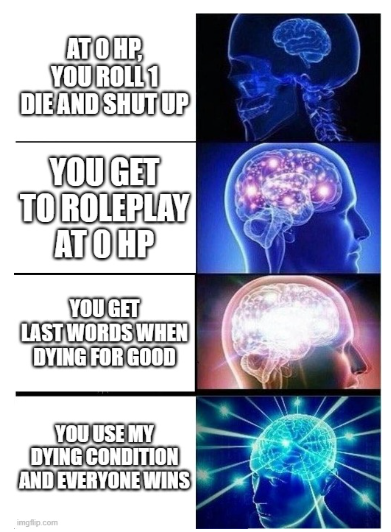
If you check my comment, I will show you my current Dying condition that I have been able to test on the field.
It’s 80 % the one from XP to level 3, with a few things changed and actually used in a DND game :)
Enjoy
If you check my comment, I will show you my current Dying condition that I have been able to test on the field.
It’s 80 % the one from XP to level 3, with a few things changed and actually used in a DND game :)
Enjoy
Condition Dying
Not for NPCs, the goal is to keep players alive.
When hit points reach 0, the character drops Prone and becomes Dying
At the beginning of the round, we start with the Death saving throws.
Then, the character can either:
Move (prone = half movement). Cost: Free
Talking while dying. Cost = Free
Action. Cost = 3 levels of Exhaustion
Bonus Action. Cost = 1 level of Exhaustion
Reaction. Cost = 1 level of Exhaustion
It is not possible to get up.
Exhaustion: On the d20
1 = -1 on every d20
2 = -2 on every d20
…
9 = -9 on every d20
10 = death
Recovery **First ** shorts rest = - 1 Exhaustion Long rest = - 2 Exhaustion
Edits following comments :
so, the -1 exhaustion on short rests is only on the FIRST short rest that they use it on. They can’t do it twice in a day. Also clarified the scaling. Love to you all
I’m telling you, just play Pathfinder 2e already. They have great dying rules that prevents up/down abuse with the wounded condition building on the dying condition to stop the up/down cheese seen in 5e.
I used to run 5e for years and also use to make all kinds of house rules and systems just like this to get it to run how I wanted it to because it doesn’t do much outside of combat out of the box. I read through the PF2e rulebook and kicked myself for not switching sooner because they have a rule for damn near everything I would want to run and super balanced at the same time.
If I had more time, PF2 is on my list for a game. I do know a DM, I just don’t have the time yet in my scheduling. But yeah, I’m trying PF2 one day if I live long enough.
That’s addressing a totally different issue to what the above piece, which is about maintaining action and agency when a PC is knocked unconscious.
The up-down yo-yo of 5e is a problem but the frustration here is when combat rounds are taking a while, it’s so boring to just make one roll every 40 minutes.
Interesting concept, but I just need to ask for some clarification before I can consider using it for my players. Are the Exhaustion points you use disconnected from the condition Exhaustion, where you get various negative effects until death at the 6th point? If I read the last line correctly, you get 10 points and you die? If they’re not regular points of exhaustion, a player can just use an action to heal themselves with a potion or spell, remove themselves from combat. Then they just need a short and long rest and they’re good to go. I think this might make them too powerful in the long run. If you use regular points of Exhaustion, you suddenly raise the stakes, while still keeping the player’s ability to move half movement and talk. Otherwise you’re indtroducing another value to keep track of that might raise more questions than solve problems. Can they be removed with a powerful enough healing spell/potion?
Keep the system, but use regular points of Exhaustion instead. You get one action that’ll really mess you up, where you are able to heal yourself, but you suffer the consequences of it after. Now that seems exciting. Just my two cents.
Its my new Exhaustion system borrowed from one dnd. I always hated the 5th version of exhaustion, as its hard to remember every single point. So my system here replaces the old one. Where instead every d20 roll has a minus.
Thank you for elaborating. How’d the playtesting go? Also, you referred to a specific XP To Lvl 3 video, would you be ok with sharing the link, pretty please?
How to refuse such politeness ? Here it is my good sir :
https://m.youtube.com/watch?v=w_6fHrOUoXM
It went really well. The hardest part was putting my 10+ leveled players to 0 HP. After that its a straight buff to them. They can talk and move for free, the rest is optional. You could even have the rule for half the table and still working. Except for changing the exhaustion, but fuck I do not like the complexity of every stage of 5th exhaustion. It lacks simplicity.
In your penultimate point you lost me, can you explain more about why 9 = -9, etc?
At level 9 of exhaustion it means -9 to every d20 roll.
Thanks, I’m with you now