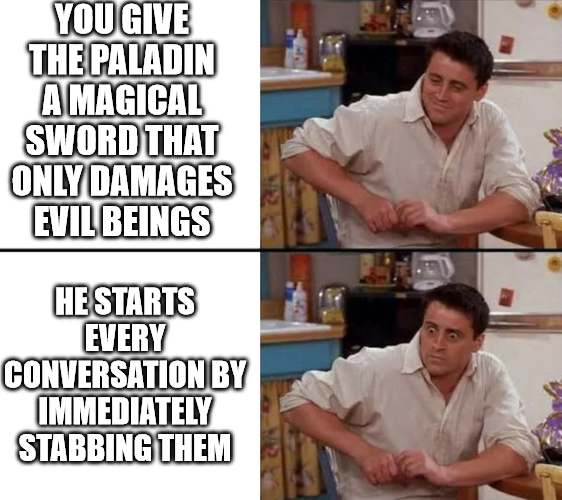

The sword’s power changes with time, and as it racks up more kills. Soon, it gains a +1 to attack and damage. Then, it can become wreathed in flame as a bonus action. Then, it grants advantage to checks made to locate creatures. Then, its base power inverts and it can only kill non-evil creatures.
Do not tell the player about that last one. Insist to the player that it works exactly as you first described. The Paladin can kill innocent shopkeepers and little old ladies, but cannot kill this assassin working for the BBEG.
Will he question his own stab-first ask-later methods? Or will he turn evil without even noticing?
I also hate this kind of twist. There better be a great lore reason for this because it’s a huge fuck your playstyle meta reason to do this.
The playstyle is stabbing random townsfolk on the off chance you kill a bad guy. Fuck that playstyle.
And for a lore reason, just have the sword be influenced by the morality of the wielder’s actions. Stabbing random townsfolk is evil. The sword turns evil.
If you know that the sword can’t hurt people that aren’t evil, then stabbing randoms is by definition not evil because you can’t hurt them.
I mean, yeah it’s meta gaming hard and lots of folks wouldn’t want this at their table, so chalk it up as a learning moment as a DM and figure out a good way to take it from them. The obvious one in this case is that the sword damages evil creatures, not destroys. Have our little meta-gaming pally stab a guy twice his level and get wrecked so he rethinks the practice. “Welp you’ve stabbed the bbeg, they’ve stripped you and the party of their possessions and locked you in a dungeon, boy you’re lucky he had somewhere to be or you’d be dead.” Like this is only a clever meta-game if you’re in a video game where you know the level of the zone you’re in and you know the full meta.
And even then, a simple “hey we’re a RP table and we try to keep meta to a minimum, so please reconsider this practice” or “hey before you go stabbing everyone, do you know what the level of each of the characters are? something to think about…” is the polite thing to do before you ruin their game based on the DM’s mistake.
First off, a sword that only destroys evil doesn’t mean insta-kill. It just means you only deal a fatal blow if they’re evil. You can just rule that it still damages good characters, so you lose basically all of your allies due to constant wounding.
Second, this is consequentialism vs deontologism. Is the morality of an act decided by the outcome or the act itself? You have the consequentialism view that the action is okay because you know it can only kill an evil person. I argue that the sword’s properties can change without you knowing, so this knowledge is just belief. As the consequences cannot be truly known before the action takes place, the morality is decided by the action itself (deontology). Stabbing people at the start of every conversation is evil.
I personally hate this kind of twist. If you need to actively lie to your player, not just mislead with some clever wordplay, it always feels like you’re breaking trust.
deleted by creator
To be fair, the sword kept nagging him.
“You should draw me, i bet that guy’s really evil” OKAY FINE SWORD-NIMI YOU CAN EAT THAT OLD MAN
Now throw him a good character with some magic immunity that negates the effect of the weapon.
I mean, that sounds very much like a paladin in unapologetic violation of one or more of their oaths.
I mean… theyre not harming anything good so not really?
But would it kill neutral innocent people?
Are neutral innocent people evil?
I could see a Vengeance Paladin justifying through divine will or whatever
It does sound like Frank Castle living out that one scene in Westworld.
Yea, blatant murder and assault isn’t justifiable to most good deities or codes of ethics, even if the target pings as evil. “Oh this shopkeeper is evil? Guess he dies.”
At the least, it’s highly illegal most places, so even if there aren’t divine consequences there’d certainly be social ones.
Make an evil dude who’s just immune to stab wounds. Problem solved.
Have him stab the mayor who’s evil because he’s greedy and selfish and borderline abusive in trade-deals with neighboring regions but is otherwise beloved (and has rewards heaped on him) because he’s so good at actually keeping order in the town and keeping their goodwill (although probably at least a little bit through some passive-aggressive blackmail). That’s always fun.
Link: The Faces of Evil
I wanna play that game
Can’t find out without fucking around 😉
Certified Faces of Evil moment. “This is my Smart Sword!”
deleted by creator