
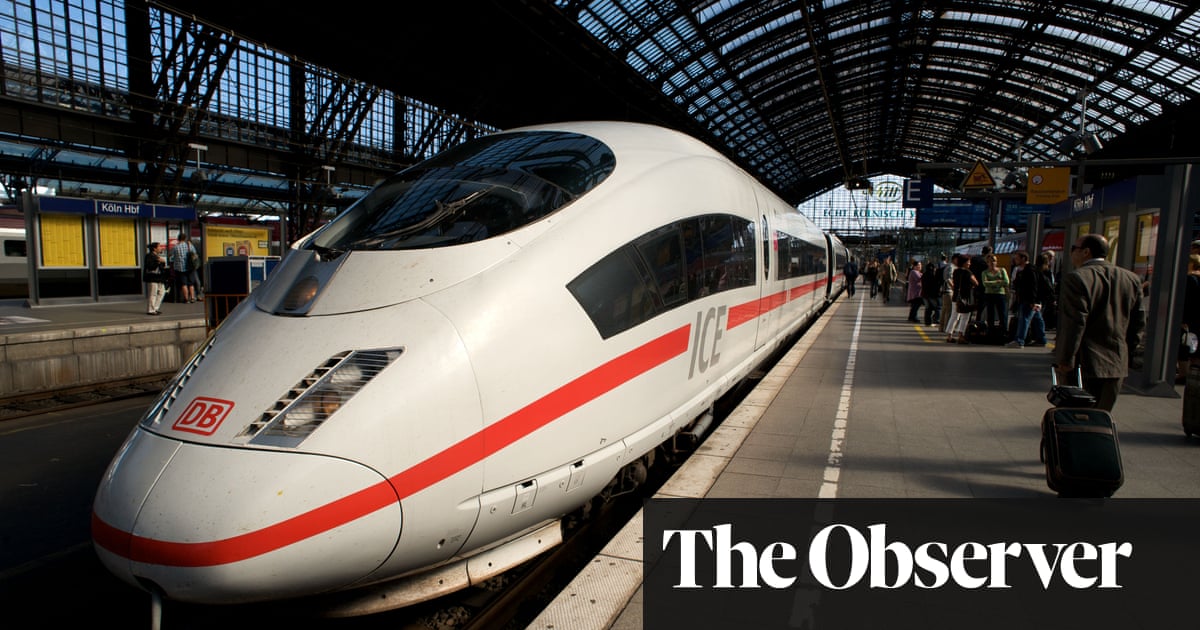
15 years ago I thought the Germans were the smartest people in the world because they understood the importance of investing in public services and had a central european style of capitalism that focused on fundamentals over financialization. since then they’ve slowly been adopting more neoliberal policies and making really stupid foreign policy decisions. I’ve lost a lot of respect for them as a world leader.
It is straight from the neoliberal privatisation playbook. Defund public infrastructure until the public complains, then “fix it” by privatising it
I’m German and have been in France quite often in recent years. It’s fascinating to hear their opinions on Germany. Outside our country is still imaged as having great engineering, efficiency - that Trains run on time. It’s quite puzzling to me.
I came to the conclusion that the only real innovation in the last 30 years has been accounting. largely driven by neoliberalism. So every neo liberal country has kind of become more similar. Germany is not special, but has the advantage of having a lot of old successful companies that only slowly get sold of to international conglomerates. (Like Kuka etc). We behave as shitty as the rest, but our downward trajectory started higher up.
Modern computers and software made it possible to account for basically every item in a company with little cost. Before you’d have needed so many people and hours of work to judge profitability of small things that it wouldn’t have been sensible to do so. CAD-Software also enables a special kind of accounting - simulating hardware components enables engineers to judge which parts are necessary and how much thickness is really needed. This is a huge and complicated process of optimization.
Accounting made it possible to turn a mostly opaque company structure that ran inefficient (but mostly on par with the competition) and judge every employee, every item. That’s why supermarkets have outsourced the job of restuffing the shelves to a different company (that has to somehow make it work with the shitty pay that get). But it’s also the reason why appliances seem to hold just slightly over the warranty period. CAD-simulations made it possible for the accountants to change the products (make them shittier) so that people would need to buy new ones often.
The Deutsche Bahn is the same. Has made it possible to invest the smallest amount possible, because they realized they can just work with the deterioration infrastructure as well - most people don’t have a choice and have to take the late train anyways.
It’s the same with telecommunications here btw. With only few companys owning most Internet services they realized they don’t have to invest a lot into fiber. People need Internet and will have to pay anyways. It’s more profit to just raise prices.
Optimization feels a lot less optimal when it leads to enshittification. I have worked on the tech side of accounting systems in the US for the last 10 years and can say that American companies have largely embraced this category of innovation as well.
When you turn the logo of Deutsche Bahn upside down, you’ll see their customer.

Omg, I never noticed. Thanks 😂
How do I hide these images?
They are getting pretty annoying.
Fork of one of the Lemmy frontends and add code to specifically hide the embedded images and then deploy it to your choice of hosting providers.
Or sent a PR to the main project that adds a config option instead
The web app Voyager hides them by default, as far as I can tell. You can sign into this with whatever instance account you’re using.
Infrastructure delivers more economic impact with less grifting when it’s not designed and run to make a profit on its own.
Right? When did we start becoming concerned with a public service being “profitable”? I’ve heard this applied to the US Postal Service a lot recently.
“The postal service is losing money!”
No, the postal service costs money. It’s a service. It doesn’t aim to make a profit. It costs money, and we are in turn rendered a service that is useful.
I swear people are delusional.
Conservatives want to kill the postal service because it competes with for profit services they own and invest in. See: DeJoy
Which of course is stupid, because USPS is actually great and provides a much better and more reliable service than any private competitor even in its current underfunded state.
You want to put pressure on these things to make them more cost effecient. You’re in a capitalist system which does that job very well. But since this is not really a replaceable company, the government has to own these companies until they go public.
Depends how you calculate profit.
Exactly it’s not accumulating debt. It’s a service being provided to citizens.
Germans. Come to Melbourne Australia, and as you get off at the airport realise there is no connecting train to the city. Cabs only.
Brought to you by the cab industry/lobby.
Cab industry is the scum of the world.
Cars can do one.
There is a bus, but yeah, it’s a joke.
Yeah but the bus uses the same road as cars so other than being cheaper, you’re getting stuck with traffic
deleted by creator
Yeah the strikes and union action hasn’t helped either. Just give them what they want so we can go back to regular ish trains lol
The myth of Germany efficiency is slowly becoming unwound.
Come to Slovakia, where 30+ minute delays are the norm. Or to Greece, where railways are still operated by humans.
It’s all good though because SNCF is an order of magnitude worse.
In my experience and that of most of my friends both French and German, that is wrong. The French rail system may have its flaws (it does), but the German one is so much worse
In my experiences the SNCF Infra, rolling stock, station experience is…pretty good! Customer service on the other hand
Lol?
I’m German and travel regularily in France as well. Travelling in France by train is a JOY compared to Germany. Please ask around as many French living in Germany as you can find. Hear their opinions.
Lol! Come to hungary! Here the 30 min or even more delay is usual. While branchlines are closed due to the state railways dont have enough working diesels, as most of them are 40+ years old (or just soviet quality), and no money for new, as the EU stopped sending support, due to the corruption of the stateparty-government.
I’ve only been to Budapest and never used any intercity trains but the tram/streetcars have been way better, more on time and generally more available then anything in any German city
yes, IF you’re in the inner city. Else, if you live the outer parts of the city, or if you have to go there, you’re mostly doomed to ride on 30+ years old junk (or even see tram line 2 next to the parlaiment with those 60 years old not nice trams), with many transfers and long walks. But the transport in budapest handled by the (oppositional) city, not by the stateparty. However the stateparty takes as many money as they can from the city, just because the people in the city not voted them, so it’s hard to improve the city transfport without money.
Perhaps the Germans could start investing in coal powered trains?
100% German solution.
Edit: For everybody downvoting me, see Germany begins dismantling wind farm for coal.