

Sea of Tranquility
I like talking about sci-fi, space, robotics, linux, anti-fascism and democratic socialism. 🇩🇪☮️
(SeaOfTranquility on libera.chat)
- 3 Posts
- 21 Comments
Joined 3 years ago
Cake day: June 14th, 2023
You are not logged in. If you use a Fediverse account that is able to follow users, you can follow this user.

 2·2 years ago
Another thing you might want to consider is the repairability. If you want to swap the battery years down the line, this can become a really important metric as well. iFixit is your friend here: you can just look up a device and check what the repairability score is.
Thanks for the info, I changed it.
is the GCam app noticeably better than a stock camera app? What sorts of things would it do better?
As I mentioned in my first comment: “Sometimes, the picture quality is decent, but often times it’s lacking” when it comes to the ROM camera app. How well a camera does, depends on the app (which is supplied by the ROM) and the driver (usually supplied by the manufacturer). The quality can, therefore, vary from device to device. A few years ago I would’ve definitely said that GCam is a step above ROM camera apps, but in more and more cases, those have become almost comparable in quality. One aspect where GCam still actually makes a difference is long exposure modes (low light and night photography) as well as offering special modes like panorama or photo-sphere.
The last I checked, the Pixels had excellent sensors but had some camera software issues that I believe were eventually resolved. I’m hoping that isn’t an issue if I’m just using a basic OS.
From my experience, older oneplus devices (e.g. oneplus 7/oneplus 7 pro) and pixel devices (pixel 5 and upwards) have excellent community support, so you should be golden.
For me, the key aspects for selecting the right hardware are the camera and the comunity support. All the other capabillities you listed are available on any phone that has a relatively recent ROM available.
Let’s start with the camera quality: If you want to use your phone without GSF or microG, you could use the camera app that comes with the ROM you flashed. Sometimes, the picture quallity is decent, but often times its lacking. Instead, I would recommend using a modded GCam App together with fake GSF. This way, you can use googles powerful camera app without sacrificing your privacy. So when I’m looking for hardware, I always check, if there is a modded GCam version available.
Aside from that, I would check if there are recent stable versions of the ROM I want, available for the hardware. The last thing I would check is, how active and how big the modding community for that device is. If you can’t find a lot of support on XDA, it’s probably not the best hardware choice to begin with.
When it comes to software, there are a lot of privacy-friendly replacements to choose from, but here is my setup:
- Syncing Contacts and Todos: selfhosted baikal + DavX5 + Simple Contacts + Tasks
- Syncing Photos: selfhosted NextCloud AIO + nextcloud app
- Syncing Notes: selfhosted webdav + Joplin
- Find My Phone functionality: FindMyDevice
- Maps: OrganicMaps
- Speach to text: FUTO Voice
- Synced Music: Selfhosted JellyFin + FinAmp
- browser bookmark sync: selfhosted webdav + floccus
EDIT: GCam and FUTO are not Open Source, but they are free and don’t collect or require any user data
As a lemmy client, I would add Eternity (APGL-3.0).
For latex documents I would highly recommend Overleaf (APGL-3.0). You can selfhost it on an old PC or raspberry pi and have crossplatform access on all your devices
A better alternative to F-Droid would be Neo Store (GPL-3.0) which has a more modern design and is less broken in general.
For apps that are only available as github releases (e.g. hypeBard) I would recommend obtainium (GPL-3.0) which automates the update process.
My personal preference for calculator apps is NCalcLibre (GPL-3.0) which has a slightly different set of features than your suggestion but has a more structured UI imo.
Text Tools Pro (Apache-2.0) is another awesome tool that can improve your typing experience dramatically.
If you have a degoogled device you might want to install FMD (GPL-3.0) in case you lose it.
For rooted devices, I would also add BCR (GPL-3.0) + BCR-GUI (GPL-3.0) to keep a record of important calls.
Another app that is especially useful on rooted devices is AdAway (GPL-3.0) which is a system-wide ad blocker that doesn’t require any resources.
Maybe not exactly what you are looking for, but you could use a website archiving solution to store one of those online man-page collections. I know it sounds like overkill, but it’s actually easy to setup and can be used for all kinds of other things as well. For instance, I have a local docker container running SOSSE for C++ and Python references and for all kind of libraries and APIs I use for software development. This way I have everything I need on my laptop and can work anywhere, even if there is no network connection.
Anki is absolutely awesome. Since there is a large amount of community made decks, I found one that was specifically made for the book I used for learning Japanese. In addition to that, I also found a free Japanese-English dictionary app that had the option to add words as flashcards to a specified Anki deck. Even though it doesn’t have the most modern looking or intuitive UI, Anki is my main tool for learning Japanese because there are so many useful integrations and a large community behind it, and it is completely free.
 3·2 years ago
Very exciting to see! I wonder why the throttling is so imprecise in this test-hop. I would’ve assumed that having small nozzles and a compact design like this would make it easier to control. This is all just speculation, ofc. but maybe the engines are made to perform better with heavier loads than this proof of concept design. Hopefully, Everyday astronaut will visit them again one day to ask more questions about all the progress they’ve made.
 2·2 years ago
I’m glad you liked the idea of the world building twist, and I think I agree with everything else you said as well. Thanks for the feedback!
This sounds a bit like hamster simulator, which we used in high school in our “programming” class, the site is in German, but you might the idea. But I can absolutely see how you can make this more compelling.
Deutsch wäre jetzt kein Problem für mich und ich glaube, ich erinnere mich sogar daran, das auch mal im IT Unterricht gehabt zu haben. Leider war die Lehrerin damals 'ne Katastrophe und ich hab’ das meiste von damals wohl schon ausgeblendet 😅
Building something in-game and extending the world with coding is an interesting perspective. I haven’t thought about it this way before. Instead, I always thought about solving programming tasks and, therefore, solving some issue in-game. I’d have to think about this more and see if I could incorporate that idea. Thanks for the suggestion!
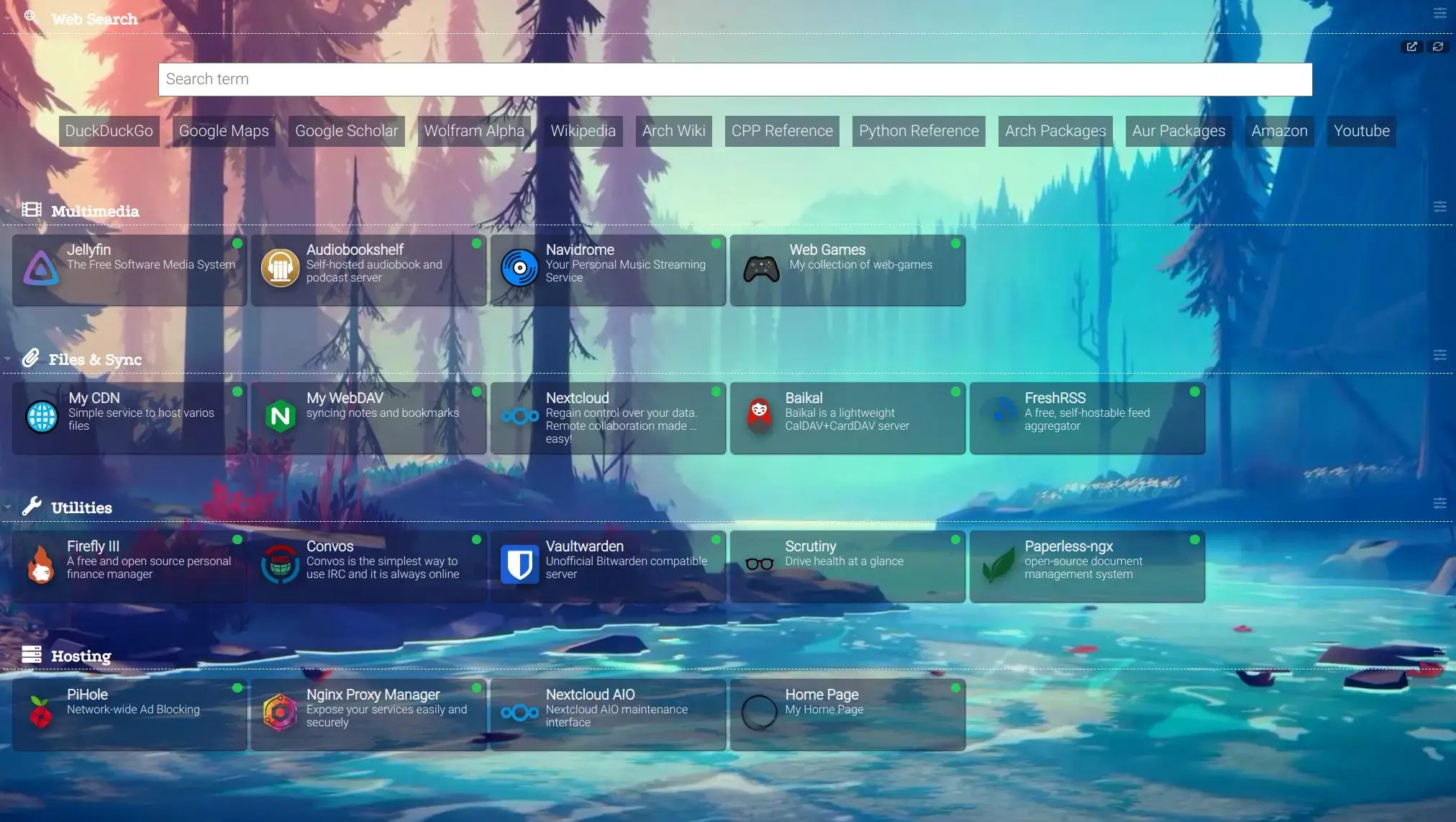
Nextcloud AIO is just a link (just the local IP+port) to the maintenance interface of my NC installation. The officially supported docker image of Nextcloud (link here) has a built-in maintenance interface which allows you to update the installation and all dependencies.
Because Nextcloud is more complicated to maintain (especially when you have a lot of apps installed), I have split all that functionality across multiple smaller services. Baikal, WebDAV, Vaultwarden and Freshrss are technically not needed if I use Nextcloud apps, but all of those services are easily configurable as docker containers and if one of them fails, none of the others are affected. If I use Nextcloud for everything and treat it as a monolithic service, I would lose all functionality if the service fails. Because of that, I only use Nextcloud’s core functionality, which is syncing files across devices and automatically uploading all the pictures I take with my phone. For everything else, I have a dedicated service that is easier to set up and maintain.
He used an interesting way to describe the interstage I think. For hot-staging I’ve only seen the completely open structure with rods, arraged in triangular patterns, connecting the stages. I wouldn’t have used the word “vent” to describe something like that, so I wonder if spacex is implementing it differently.
 5·3 years ago
I can’t wait to learn more about the GPU. I really hope it’ll be able to run CUDA.
One thing that is never mentioned when it comes to “price tag” articles for NASA projects, is how good of an investment it is. Most of NASA’s research projects (especially the ones of the JPL) are done in America by American workers and companies and, therefore, boost the economy. Investments like this also strengthen the scientific community which has a ripple effect on education and future innovations. It is also absolutely necessary if the US wants to continue being the leader in the aerospace industry.
Outsourcing r&d work to private companies means, that innovations will be kept proprietary and patented behind growing price tags that will always be just a little cheaper than doing it from scratch. It also means that shareholders of those contractors get significant margins that won’t be injected back into the system. In that sense, privatization doesn’t reduce the “price tag” on research projects, it just makes some of the costs less visible for shortsighted financial planners.
Ultimately, research will always be expensive and the real reason for the bad budget estimations is the political pressure that forces NASA to operate at such a low budget (compared to other industries with less or equal economical return). A pressure that is created by politicians who are funded by these private companies and not acting in the interest of the public.
Hopefully, they fix their camera API so that GCam works properly this time. Being stuck with the stock photo app was the only downside of version 4 imo.
I’m going to sound cynical here so if you don’t want to be confronted with negative content, please skip this one…
spoiler
Did I just read an ad for “Mike’s Hard Lemonade co.” and Brand Studio Inc.? The “experiment” they made is not scientific and it doesn’t have to exist to begin with. The point about happiness and media consumption was already researched seriously (which is also mentioned in this article).
So why does this article have to have a bright yellow background and spinning lemonades on the side and mentions a specific brand multiple times? Is it relevant to the “Good News Effect” or media consumption patterns? No… it’s an ad that uses scientific work and the topic of happiness to boost a brand’s public perception. Again… maybe it’s just me… but having a discussion about happiness and media consumption should not be based on a Mike’s Hard ad campaign imo.

 8·3 years ago
I mean… everybody involved knew that the original budget wasn’t even close to the required amount. Large government-backed projects like this one (especially ones that include so many countries) will always be late over budget because that’s how politics works. I’m astonished that people still write articles making a sensation out of this fact.
He literally got blue-pilled… The greatest fear of these guys😂
This is the key point of my question because the mass m of the “bunch of mass” that is close to Venus will be less when you consider the density p with m = p * V, where V is just the volume of mass that is close enough to Venus. Assuming the Suns density is uniform (which it isn’t, most of the mass is far away from Venus), p and by extension m and by extension F (the gravitational force) are proportional to 1/r³.
Unfortunately, the actual calculations are far too hard for me, but my intuition would suggest that the 1/r³ relationship of density and volume would outdo any other factors here.