

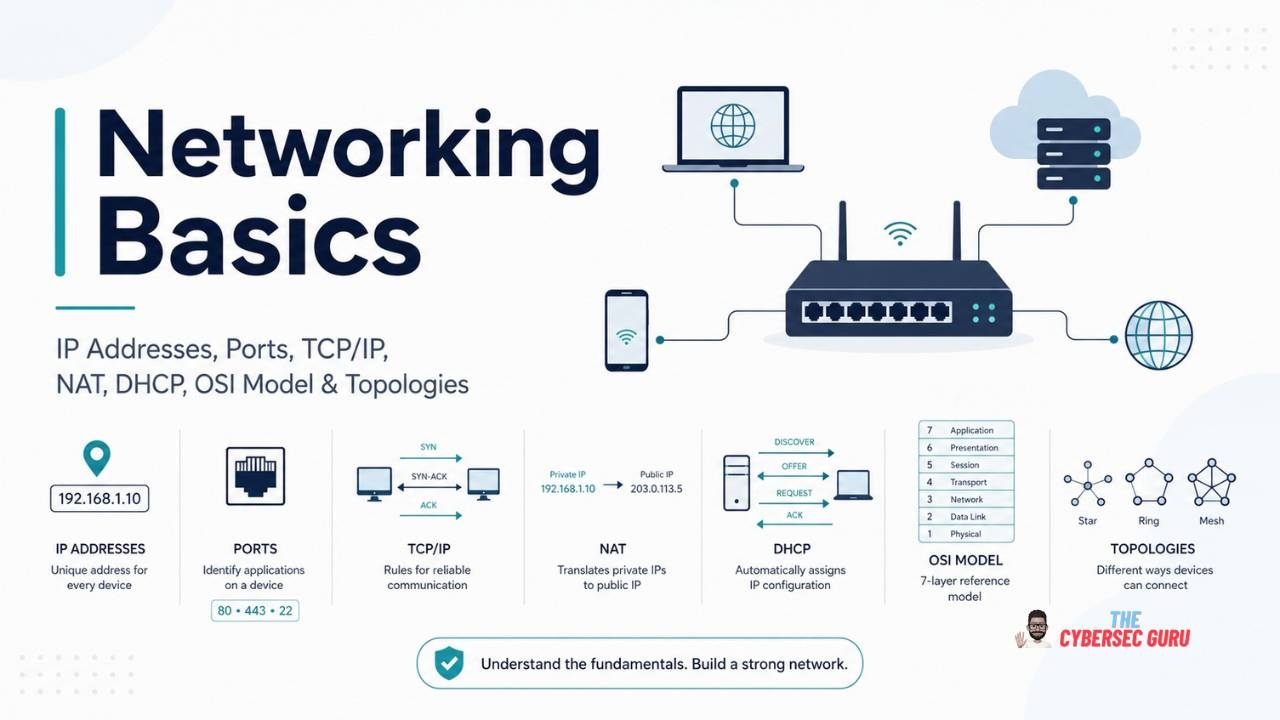
Networking is one of those topics that feels complicated until someone explains the fundamentals clearly. This guide covers the core concepts behind modern computer networks, including IP addressing, MAC addresses, TCP/IP, the OSI model, DNS, DHCP, NAT, routing, switching, ports, and common protocols
Yeah, IPv6 needs to be taught in the basics. Too many people believe it to be arcane magic and don’t get how simple it is.
Yeah. Also, many skip over IPv6 due to it being a bit more complex compared to IPv4…also it has translation IPv4 to v6 etc etc. Also, many senior sysadmins simply refuse to transition to IPv6 wherever viable and instead they opt for NAT or CGNAT depending on the installation
Subnetting is so much simpler. Sure, it does seem more complex at first because we’ve been using IPv4 all our lives so that’s our baseline for “what makes sense” but it’s actually so much more elegant of a solution than IPv4 and I would suspect that once IPv6 firmly passes over 50% adoption (now stands at ~47%) it will be reasonable to start pushing to teach IPv6 first and IPv4 viewed as supplemented but deprecated.
Actually, that 47% was just overall, but if you look at it, many major countries are well past 50% adoption, including Vietnam, Malaysia, Japan, Russia, India, Saudi Arabia, Greece, UK, Estonia, Germany, France, Norway, Brazil, Uruguay, Mexico, Guatemala, and the USA (and Puerto Rico specifically).
I think it’s beginning to be arguable that in many major countries IPv6 should be taught primary and IPv4 supplementary.
In India, every mobile ISP has transitioned to IPv6 dualstack except Jio. Jio is IPv6 only with 4 to 6 translation