It’s like my own little Fediverse
Thank god for NixOS. (My daily on my laptop, seriously flakes +
nix-direnvis godsend for productivity. Reliable development environments and I don’t have to lift a finger!)And the vscode direnv extension just makes it all work together.
I personally use Neovim (it’s not nearly as much work as people make it out to be), so it’s all integrated within my terminal.
I agree. I use a Mac but use nix to manage all this mess.
Do you have any troubles running it as your daily OS? Do you use it as your hobby or also for your work?
I know Nix and use it as my package manager, but I’m not sure about the experience with NixOS. So I’m still reluctant to make the switch.
I just jumped in headfirst. I love it. It’s really just Nix, but with options to configure your whole system to your liking.
Stability’s been rock-solid and I haven’t yet encountered anything truly headache-inducing.
Here’s some starter advice:
- Try to start with flakes. Nix channels are known for being…unreliable at times.
- Start small, slowly extend. Many people’s Nix configs are often insanely abstracted and modularized. Personally, I started my flake config by installing KDE + Nix, and then linking the
configuration.nixto the flake. (Remember, flakes just package the config, they’re not responsible for configuring the system).
My Nix config is relatively basic (check it out here, so feel free to look around trying to understand it. I’d also suggest using Home Manger if you aren’t already.
The NixOS forums are great for getting help. I’ll also point you towards the Catppuccin Discord server, the NixOS thread there is filled with many helpful people who helped me get started. (If you decide to swallow the Nix pill, feel free to join and ping me(my username’s Dukk); I’ll add you to the Nix thread).
I’ve recently discovered pipenv, and it has been a massive QoL improvement. No need to figure out bazillion of commands just to create or start an environment, or deal with what params should you use for it like you do with venv. You just pipenv install -r requirements.txt, and everything is handled for you. And when you need to run it, just pipenv run python script.py and you are good to go.
The best thing however are the .pipfiles, that can be distributed instead of requirements.txt, and I don’t get why it’s not more common. It’s basically requirements, but directly for pipenv, so you don’t need to install anything and just pipenv run from the same folder.
Yessssss
I actually wrote a script to make a folder an instant pipenv environment for me. Add it to your ./.zshrc. Has saved me a ton of time, I just removed some spaghetti lines that would reinstall pip and shit because it’s when I was still early days into Py dev, now I work more with Py than I do C# and I’m a senior C# engineer, I just enjoy the masochism of py.
Also added a check for Arch/Ubu.
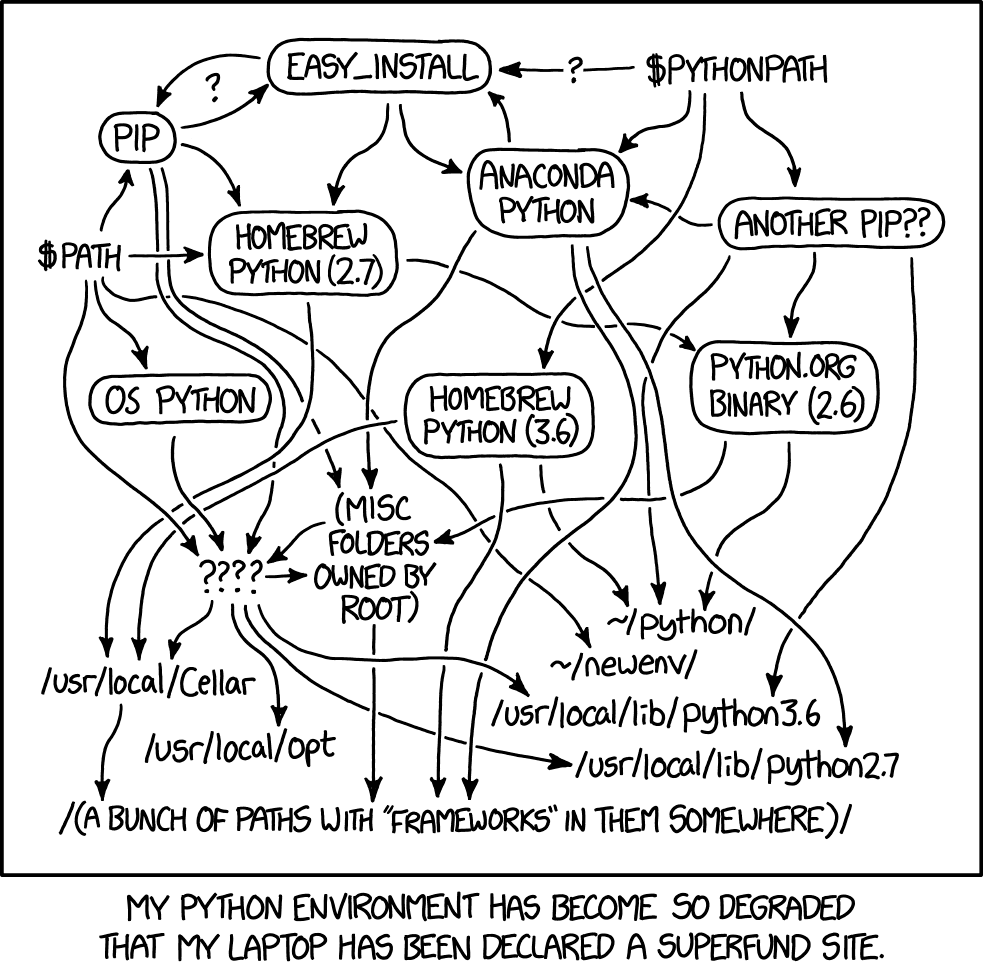
# Automated python virtual environment. ####################################### VENV(){ if ! [ -x "$(command -v pipenv)" ]; then echo "pipenv not installed... installing it now!" sudo pip install pipenv OS="$( ( lsb_release -ds || cat /etc/*release || uname -om ) 2>/dev/null | head -n1 )" if [[ "$OS" == *"buntu"* ]]; then sudo apt install pipenv -y elif [[ "$OS" == *"rch"* ]]; then sudo pacman -S pipenv fi pip install pipenv --upgrade echo "Installation complete!" fi if [ -n "$1" ]; then echo -e "Args detected, specifically using version $1 of python in this project!" version="$1" else version=$(python -V) version=$(echo "$version" | sed -e 's/Python //') if [ -z "$version" ]; then version=$(python3 -V) if [ -z "$version" ]; then echo "No python version installed... exiting." return fi fi fi echo -e "\n===========\nCreate a Python $version virtual environment in $PWD/.venv [y/n]?\n===========" read -r answer case $answer in [yY][eE][sS]|[yY]) export PIPENV_VENV_IN_PROJECT=1 pipenv --python "$version" pipenv install -r ./requirements.txt echo -e "\n\n\nVirtual python environment successfully created @ $PWD/.venv!\n" echo -e "To run commands from this dir use 'pipenv run python ./main.py'" echo -e "To enter a shell in this venv use 'pipenv shell'." echo -e "To install from a requirements text file use 'pipenv install -r requirements.txt'" echo -e "To update pip + all pip modules use 'pipenv update'!\n" echo -e "Additional information can be found @ https://pipenv-fork.readthedocs.io/en/latest/basics.html" ;; [nN][oO]|[nN]) echo "Fine then weirdo why did you run the command then, jeez.Exiting" ;; *) echo "Invalid input..." ;; esac }I could redraw this whole chart using only references to pipenv based on my experiences with managing it alongside other tools (especially homebrew). It’s good at many things but is no magic bullet.
Yeah but is it really worse than python3-venv like some people act like it is? I just don’t see it.
I’ve been burned by
pipenvbefore on a large project where it was taking upwards of 20 minutes to lock dependencies. I think these days they usepoetryinstead, but I’ve heard the performance is still not very scalableWith that said, I think it can be a nice addition, but I think it comes down to Python packages not really taking dependency management as a top priority instead of favoring flexibility. This forces a package manager to download and execute the packages to get all the dependency information. Naturally, this is a time-consuming process if the number of packages is large.
On multiple instances I’ve seen projects abandon it for
pipand arequirements.txtbecause it became unmanageable. It’s left a bad taste in my mouth. I don’t like solutions that claim to solve problems but introduce new ones.
Now take all of this and find something that needs an old out of date Python… Like 2.6.
… cry later
Oh, so that is where all of my modules are? That makes total sense, thanks!
As a mac user I feel this
This Helen’s on my laptop from following AI install scripts. I high key hate Python, it’s my hated language and I wish another language was the default for ML.
Original: https://xkcd.com/1987/
Hopefully Mojo will sort it all out. Maybe even inspiring a new, positive streak of xkcd strips in the future?