Applying updates is considered good practice. Auto-applying is the best you can do with the money provided. My critique here is the amount of money provided.
Also, you cannot pull a Boeing and let people die just because you cannot 100% avoid accidents. There are steps in between these two states.
I work at a different company in the same security space as cloudstrike, and we spend a lot of time considering stuff like “if this goes sideways, we need to make sure the hospitals can still get patient information”.
I’m a little more generous giving the downstream entities slack for trusting that their expensive upstream security vendor isn’t shipping them something entirely fucking broken.
Like, I can’t even imagine the procedureal fuck up that results in a bsod getting shipped like that. Even if you have auto updates enabled for our stuff, we’re still slow rolling it and making sure we see things being normal before we make it available to more customers. That’s after our testing and internal deployments.
I can’t put too much blame on our customers for trusting us when we spend a huge amount of energy convincing them we can be trusted to literally protect all their infrastructure and data.
I can put the blame to your customers. If I make a contract with a bank they are responsible for my money. I don’t care about their choice of infrastructure. They are responsible for this. They have to be sued for this. Same for hospitals. Same for everyone else. Why should they be exempt from punishment for not providing the one service they were trusted to provide? Am I expected to feel for them because they made the “sensible choice” of employing the cheapest tools?
This was a business decision to trust someone external. It should not be tolerated that they point their fingers elsewhere.
Can’t fault you for feeling that way. I definitely don’t think anyone should be exempt from responsibility, I meant blame in the more emotional “ugh, you jerk” sense.
If someone can’t fulfill their responsibilities because someone they depended on failed them, they’re still responsible for that failure to me, but I’m not blaming them if that makes any sense.
Power outage or not, the store owes me an ice cream cake and they need to make things even between us, but I’m not upset with them for the power outage.
You can be reasonable in your choice of words, but there are heads that need to roll. In this case it is not the one pushing the final button, but all those that created this system. Developers, Project Managers, Team Leaders, all the way up to the CEO. If the space to work in is so limited that the possibility of such pushes seems like a tolerable idea, then everything leading to this is broken. And people need to invest to make this right. Therefore there needs to be incentives, good and bad. To steer out of the current course there need to be very unfavorable incentives.
You can mock my argument by giving a ridiculous example. Once people die it will be too late. It’s why there was a time where people thought it to be a good idea to employ giant generators to keep the power in a hospital running even in case of a power outage. Or to have redundant systems in an airplane.
There is a need for adequate standards in the software world. Trusting businesses to create them will evidently kill people. Creating something like certificates for personal skills and products is severely lacking.


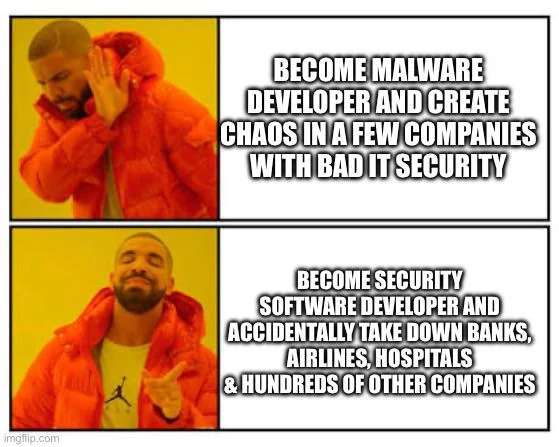
I’m volunteering to hold their beer.
Everyone remember to sue the services not able to provide their respective service. Teach them to take better care of their IT landscape.
Typically auto-applying updates to your security software is considered a good IT practice.
Ideally you’d like, stagger the updates and cancel the rollout when things stopped coming back online, but who actually does it completely correctly?
Applying updates is considered good practice. Auto-applying is the best you can do with the money provided. My critique here is the amount of money provided.
Also, you cannot pull a Boeing and let people die just because you cannot 100% avoid accidents. There are steps in between these two states.
You say that, but have you considered the savings?
People are temporary. Money is forever.
I have. They are not mine. The dead people could be.
Edit: I understand you were being sarcastic. This is a topic where I chose to ignore that.
That’s totally fair. :)
I work at a different company in the same security space as cloudstrike, and we spend a lot of time considering stuff like “if this goes sideways, we need to make sure the hospitals can still get patient information”.
I’m a little more generous giving the downstream entities slack for trusting that their expensive upstream security vendor isn’t shipping them something entirely fucking broken.
Like, I can’t even imagine the procedureal fuck up that results in a bsod getting shipped like that. Even if you have auto updates enabled for our stuff, we’re still slow rolling it and making sure we see things being normal before we make it available to more customers. That’s after our testing and internal deployments.
I can’t put too much blame on our customers for trusting us when we spend a huge amount of energy convincing them we can be trusted to literally protect all their infrastructure and data.
I can put the blame to your customers. If I make a contract with a bank they are responsible for my money. I don’t care about their choice of infrastructure. They are responsible for this. They have to be sued for this. Same for hospitals. Same for everyone else. Why should they be exempt from punishment for not providing the one service they were trusted to provide? Am I expected to feel for them because they made the “sensible choice” of employing the cheapest tools?
This was a business decision to trust someone external. It should not be tolerated that they point their fingers elsewhere.
Can’t fault you for feeling that way. I definitely don’t think anyone should be exempt from responsibility, I meant blame in the more emotional “ugh, you jerk” sense.
If someone can’t fulfill their responsibilities because someone they depended on failed them, they’re still responsible for that failure to me, but I’m not blaming them if that makes any sense.
Power outage or not, the store owes me an ice cream cake and they need to make things even between us, but I’m not upset with them for the power outage.
You can be reasonable in your choice of words, but there are heads that need to roll. In this case it is not the one pushing the final button, but all those that created this system. Developers, Project Managers, Team Leaders, all the way up to the CEO. If the space to work in is so limited that the possibility of such pushes seems like a tolerable idea, then everything leading to this is broken. And people need to invest to make this right. Therefore there needs to be incentives, good and bad. To steer out of the current course there need to be very unfavorable incentives.
You can mock my argument by giving a ridiculous example. Once people die it will be too late. It’s why there was a time where people thought it to be a good idea to employ giant generators to keep the power in a hospital running even in case of a power outage. Or to have redundant systems in an airplane.
There is a need for adequate standards in the software world. Trusting businesses to create them will evidently kill people. Creating something like certificates for personal skills and products is severely lacking.