

Basic fucking decency would be a start
Another language. It changes the way you see the world
ASL has made a shocking difference in my life, both opening me up as a more accessible person, but also finding a lot of use for it in my own file!!
To use the bins/trash cans and stop littering. Especially on beaches, parks, reserves and on the motorway.
By extension also, cigarettes, plastic, and aluminium/cardboard. Hate that.
It’s one thing if it’s compostable fruit, but cigs… do those smokers seriously think it’ll just go away?
Maybe it’s not just “one thing”, but ethics. How to make decisions in a systematic way; how to do it in advance; how to weight morality, practicality, and aesthetics to reach a decision that you’ll be satisfied with twenty years later, a decision you could explain and defend to another ethical person before or after the fact.
Is there something I can read to learn how to do this? A book or course? Or is this something gained only through experience and thought?
Start here: https://nesslabs.com/how-to-think-better This isn’t an endorsement (though I do like ness labs). That article offers practical evidence-based starting points and additional resources at the end.
There are many people/systems/schools that will offer strategies and solutions. Some are practical and effective. None of them are a replacement for learning what it means to think well, learning how to think well, or actually thinking well.
The next step is learning the jargon of philosophy so you can ask meaningful questions and parse the answers (this is true for any new discipline). I recommend reading anything on the topics of epistemology, ethics, and aesthetics, which resonate with you. Then find others to discuss what you’ve read. You do not have to be right or knowledgeable to earn a voice in the conversation: only an interest in discovering how you might be wrong and helping others discern the same for themselves.
If you haven’t read any classical philosophy but are interested I recommend Euthyphro. It’s brief, poignant, and entertaining.
I hope this helps! Happy to discuss further as well.
Definitely easier and you’ll get farther reading the works of ethical philosophers as seeing what makes sense to you than starting from scratch. For me, Kant, Adam Smith, Plato, and the Stoics were the most influential, but I also read a lot of Christian and Buddhist religious philosophers.
I myself tend to think of ethics as having three components, as I alluded to above: What is moral, what is practical, and what is beautiful. And while beauty is mostly subjective and practicality mostly objective, morality is a lot trickier.
A lot of us seem to agree, because we were taught it or otherwise, that some actions (or results, or thoughts, or attitudes) are morally good and should be pursued and some are morally evil and should be rejected, repudiated, or opposed. And we even agree most of the time about a lot of what is “good” and what is “evil”. Some say that this is because it’s subjective, others think that there are objective moral truths and we have discovered them, as yet, only imperfectly. Which if either of these camps you fall into isn’t really all that important for learning to think ethically, though; what’s important is to have moral precepts that you understand and can strive towards. If you can’t understand your own moral code, how can you seriously attempt to follow it?
Once you have the ability to do moral reasoning, you learn to balance it against practical reasoning, eg. “How much can I afford to donate to charity each month and still pay rent? Are there more effective ways to use that sun for good in the world that donating it to this charity?” and weigh in your aesthetic preferences as well. After some practice, you’ll know why you did whatever you’ve done, and hopefully, be able to explain your reasons to others, even if they don’t share your practical concerns or moral code.
The fact that psychedelic drugs like mushrooms and LSD aren’t as dangerous as media and politics make them out to be.
They are actually among the physically safest drugs out there, even when including caffeine and sugar. They can be used in so many ways for self-improvement and treating depressions, anxiety, PTSD and many other conditions.
The book ‘How to change your Mind’ by Michael Pollan is a wonderful read on the topic.
Oh yeah? Well I wish people could learn kindness.
Highroaded.
true kindness would be to not demonise and ban entheogentic medicines with thousands of years of contemporary peer review in the sickening pursuit of corporate greed
Mushrooms maybe, but doesn’t LSD have the power to affect someone for life? If I were to use any recreationals, I’m sticking to dreamfish, that doesn’t even have any documented cases of overdosing yet.
LSD and psylocibin work very similarly, they even have cross-tolerance. Schizophrenia and psychosis are some of the few risks you need to watch out for when handling psychedelics. If there is a predisposition present like mental illlnesses running in the family, psychedelics may act as a trigger for those and should be avoided or handled very carefully.
Also there is no documented overdose with LSD and psylocybe mushrooms either, even with doses as high as hundreds or thousands of recreational doses.
How to not be evil. You’d think it’s simple, but evidently not.
Because it’s subjective?
EDIT: example - abortion is evil for conservatives, but it is practically good for others
“Evil” does not mean “something I don’t like.” Conservatives are evil by their own standards too.
Basic computer literacy.
I agree. It is insane that they don’t make sure people understand computer basics, now that our life is defined by computers. I hate that people are divided to the “tech savvy” and “tech ignorant” camps at work. It makes me question what sci-fi had me believe about “technologically advanced societies”.
Critical Thinking skills. Imagine a world where everyone is able to sus out the lies, separate fact from fiction, and not fall into pitfalls of illogical thinking.
Empathy. People criticizing each other often make the same “mistakes” that are nothing but normal human behaviour. Once you understand that we are all pretty much equal, you start realizing that most bad things are sistematic. There are few bad people, most people are quite nice and forced (or taught) to behave badly
Add on top of this “maybe you don’t need to worry about criticizing others in the first place” and you’re well on your way to a happier existence.
Disclaimer: of course thinking critically is important, and there are areas where you’d be irresponsible not to be critical of others. I’m talking about the IV drip of negativity of constantly getting annoyed at things that don’t affect you.
Adding to this, the criticism is more valid if you understand more
Understanding is the only way to solve any kind of problem
It could be a better way but not the “only way”
It should be Jesus who is the only way, boom !!!
Similar answer from a bot
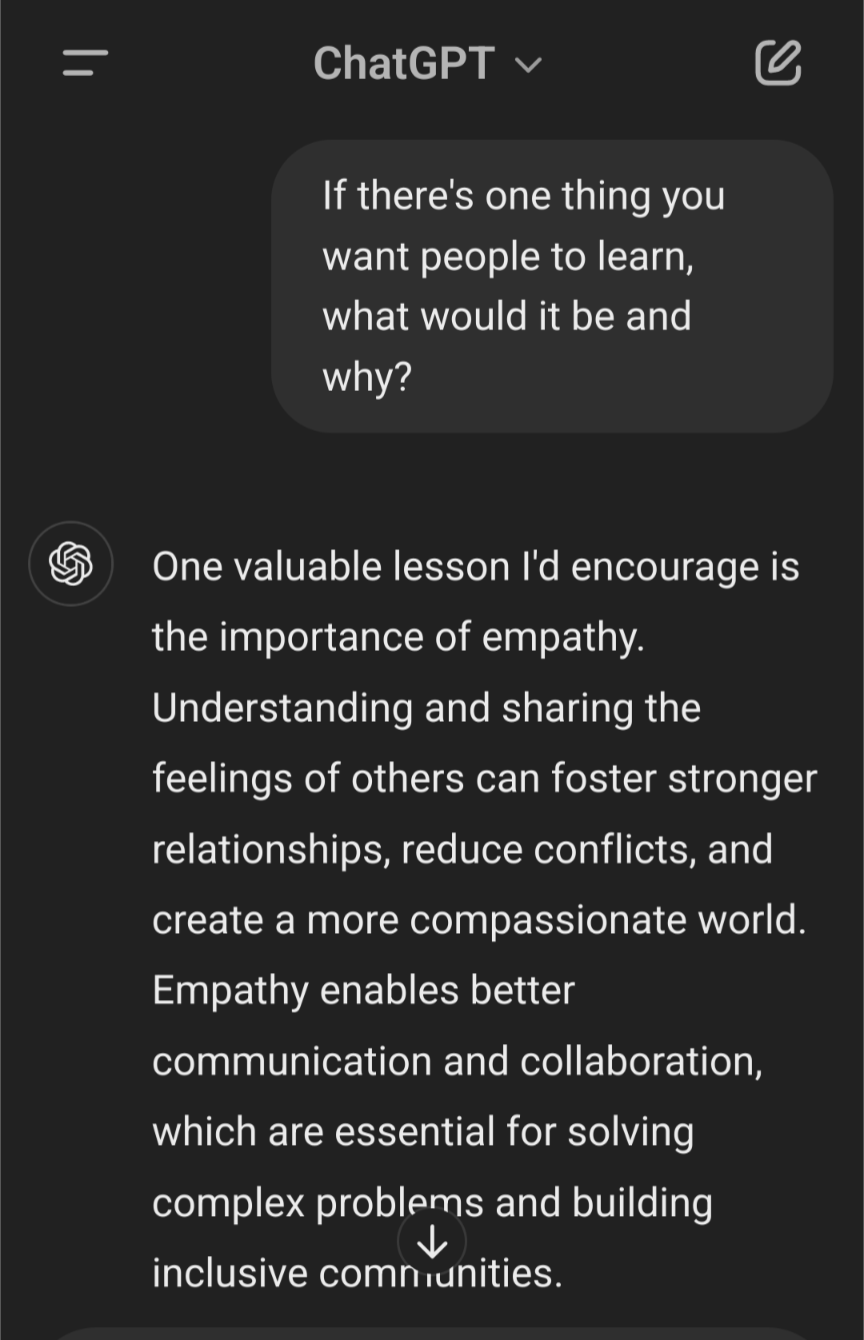
Very well said, thank you.
Gender alone doesn’t need to block you from doing things.
Situational awareness.
I’m genuinely not sure whether this is a teachable skill or something more like a character trait.
If you got really bad scores your DM may allow you a re-roll
I wish we could learn from our mistakes.
Probabilities and basic stats. People do not think in “what are the chances” but in black and white. I think one reason is we don’t teach probabilities in American schools. It drastically impacts a citizens ability to understand the news, and especially science.
What if the purpose of school isn’t inherently to teach people stuff?
Then my point still stands?
Layman statistics is not the hill I would die on. Otherwise (being guilty of the fallacy myself) I now think that making a subject mandatory school lesson will only make people more confidently incorrect about it, so this is another hill I won’t die on for probability and statistics. See for instance the widespread erroneous layman use of “statistical significance” (like “your sample of partners is not statistical significant”) you see it is a lost cause. They misinterpret it because they were taught it. Also professionals have been taught it and mess it up more than regularly to the point we can’t trust studies or sth any more. So the solution you suggest is teach more of it? Sounds a bit like the war on drugs.
What’s your solution?
Responsibility, way too many people do things without any thinking and making everything into shitshow because of not thinking
How to properly go through a four-way stop.
Or use a roundabout
Can you teach me this? I have roundabout anxiety.
Assuming right-hand side of road driving and right-hand (anti-clockwise) directionality of travel.
- Look left. Clear? Proceed. Not clear? Yield.
- When safe to do so, enter the roundabout. Locate your exit.
- Exit the roundabout.
Corollary: never stop in a roundabout. Go around more than once if you have to, but don’t stop.
I assume roundabouts in Australia and England and UK colonies that drive on the left, all instructions are direction-opposite.
Assuming left-hand side of road driving and left-hand (clockwise) directionality of travel.
- Look right. Clear? Proceed. Not clear? Yield.
- When safe to do so, enter the roundabout. Locate your exit.
- Exit the roundabout.
Corollary: never stop in a roundabout. Go around more than once if you have to, but don’t stop.
In step 1 it’s feels like it’s never clear and i don’t know how long to wait.
It’s like a stop sign entering a busy road. You stay stopped until it’s clear. Never mind the impatient people behind you that probably don’t know how to use a roundabout as well. People seem to think that you just enter the roundabout without stopping and people in the roundabout have to yield to them. The people in the roundabout have the right of way so they can get out of it and make room for more.
I did one yesterday!! There were only 3 other cars, but still, i did it!
Good job. Like anything, practice makes you better.
I always go and stop at the wrong time, i feel stuck, and then I’m like, “Look kids- Big Ben, Parliament…”