That’s where my problem comes from. I’m not experienced enough to know immediately where failure is acceptable or not; rather, I don’t always have backup plans or ideas for when things that should be able to fail, fail. So I roll, and it fails, and it should fail, but I’ve got no idea what happens when it does. So it doesn’t fail.
I think I’m getting better at improv-ing events and making backup plans. It’s still difficult for me to find the balance between the story I want to tell/ have prepared vs the story that my players wind up creating, but checking in with my party here and there tells me everyone’s having fun and only rarely does anyone feel gipped or abused by dice rolls.
Prior to rolling, think about what will happen if the roll fails or succeeds. If you are worried about failure at all, that is a good sign that failing is probably not an option. Basically, if you are able to make the decision to fudge it when it happens you had the same time frame to decide notnto risk that need to fudge in the first place.
Over time with more experience you will find ways to make failure a bump in the road to fun tims.
Thanks for spelling it out like this. I think I’ve been too focused on “doing something” and keeping the game going, that I don’t stop to think before doing some things. Ie rolling before I know what will happen with a failure. I’ll try to take more quick pauses to think things through, and worry about smoothness of play later.
It might be a little bumpy at first, but should speed up with a bit of practice and the practice of thinking about failure will happen more often!. Plus the more you think about it the better you will get at coming uo with ideas for failure and that will let you being back the random rolls!


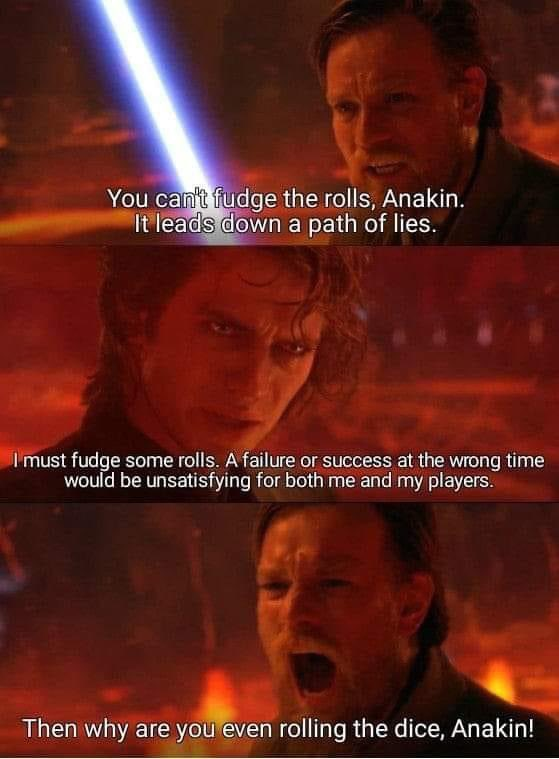
You could just skip the roll, because if failure is unacceptable then it isn’t appropriate.
That’s where my problem comes from. I’m not experienced enough to know immediately where failure is acceptable or not; rather, I don’t always have backup plans or ideas for when things that should be able to fail, fail. So I roll, and it fails, and it should fail, but I’ve got no idea what happens when it does. So it doesn’t fail.
I think I’m getting better at improv-ing events and making backup plans. It’s still difficult for me to find the balance between the story I want to tell/ have prepared vs the story that my players wind up creating, but checking in with my party here and there tells me everyone’s having fun and only rarely does anyone feel gipped or abused by dice rolls.
Prior to rolling, think about what will happen if the roll fails or succeeds. If you are worried about failure at all, that is a good sign that failing is probably not an option. Basically, if you are able to make the decision to fudge it when it happens you had the same time frame to decide notnto risk that need to fudge in the first place.
Over time with more experience you will find ways to make failure a bump in the road to fun tims.
Thanks for spelling it out like this. I think I’ve been too focused on “doing something” and keeping the game going, that I don’t stop to think before doing some things. Ie rolling before I know what will happen with a failure. I’ll try to take more quick pauses to think things through, and worry about smoothness of play later.
It might be a little bumpy at first, but should speed up with a bit of practice and the practice of thinking about failure will happen more often!. Plus the more you think about it the better you will get at coming uo with ideas for failure and that will let you being back the random rolls!