Ubuntu or Mint
Mint is just green Ubuntu.
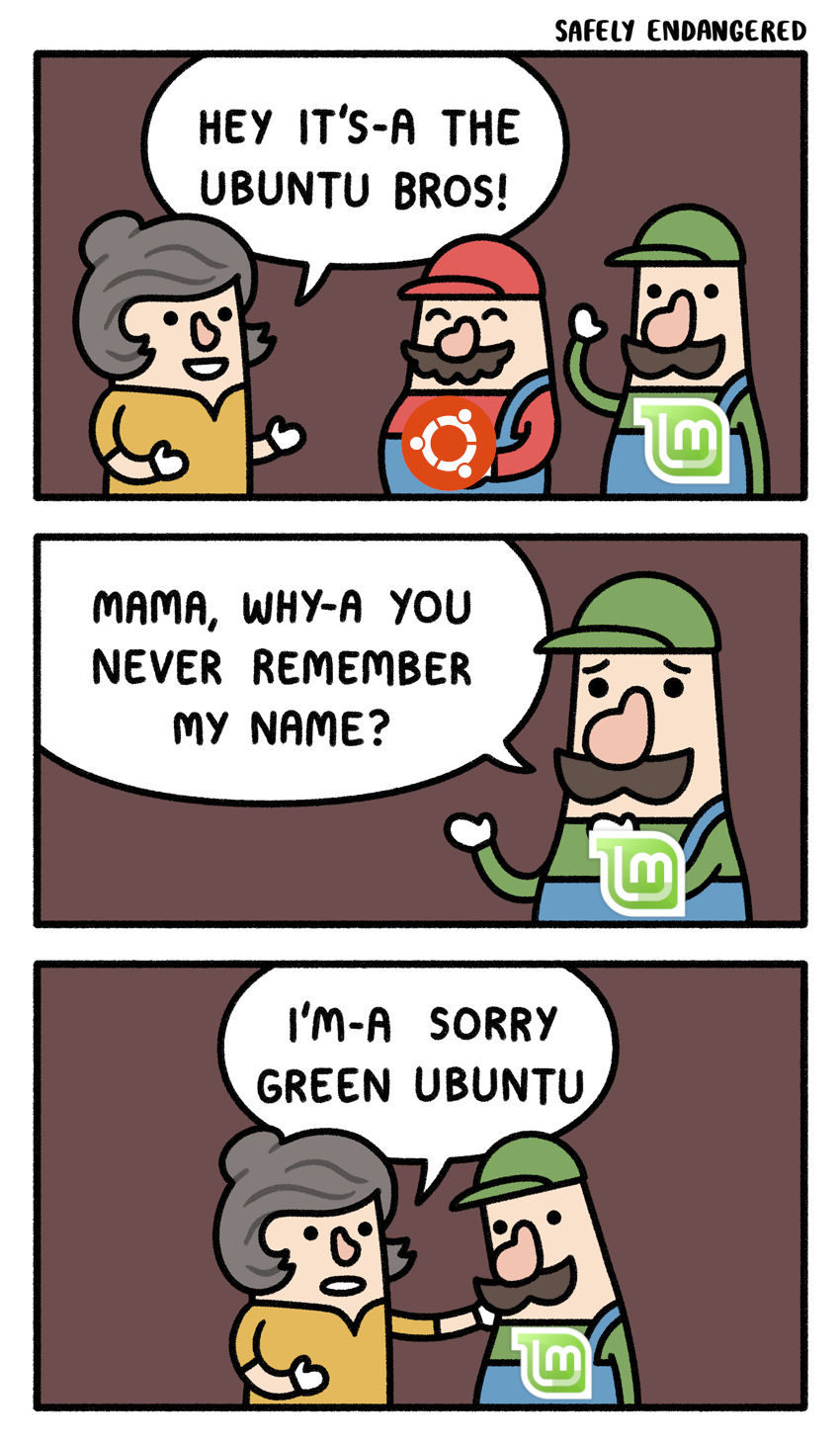
deleted by creator
Could be worse. She calls Debian “Old Ubuntu”.
Mint is better Ubuntu
better Ubuntu
And its a good pick too! Tho my favorite is pop!_OS
I liked the feel of Pop_OS!, the setup and configuration are great, but damned it was unappealing looks wise for me.
I mean, you can just install another DE on it if the looks is the problem. There’s also System76’s new COSMIC DE coming out somewhere in summer. It should be blazingly responsive as it’s written in Rust and has a GNOME-like UI.
Yeah I feel like that just defeats the purpose of it though, in that case just install Debian.
Yeah I am interested in Cosmic DE.
Probably depends how you define things. Like, is Xubuntu Xubuntu or Ubuntu with Xfce included by default? How much change is necessary before it’s not “debian with added bits”?
Ubuntu 100%, if you count how many distros are ubuntu based (and collaterally debian based), but I believe it is the most used one even if you only count official ubuntu releases
Maybe arch would be quite high, if you count the steamdeck as desktop (maybe), and the big increase on arch users in the past couple of years (wen’t from being rare to 1 in 3 users saying “I use arch btw”)
In professional work space, ubuntu will probably be highest. Second place I would guess Fedora
As personal workstation I would guess arch (even without steam deck) followed by mint or some flavour of Ubuntu
I don’t think Arch is more used than Ubuntu, unless maybe if you count all the Ubuntu flavors separately
There is not a reliable way to determine that, by design.
Ubuntu for sure, about every companies I worked at were using Ubuntu as main dev. And now in the new company I work for, it’s WSL2 in Windows, using Ubuntu too.
Only non-Ubuntu I used in companies was CentOS.
So pretty sure Ubuntu is the most popular/used.
If we are talking about desktop PCs, maybe Ubuntu, but based these reports it’s Arch.
Worth keeping in mind that the steam deck uses a distro based on arch, so it might be inflating the arch numbers in that steam survey.
With Steam having a gaming audience I’d argue that this has at least a slight bias towards Arch, as the latest kernel versions and other software are often advantageous for gaming in particular.
But even with the Steam numbers note that Arch is just listed as one single variant, while Ubuntu has separate entries for different versions. Ubuntu LTS 22.04 alone is so close to Arch that it’s probably ahead once you include all versions.
Chrome OS.
If you count Ubuntu and all disto’s base on it as one, then it would top the list.
Thst depends in a lot of things.
What do you mean with “PC”? Is a smartphone a PC? Is a steamdeck a PC? The Laptop of a government employee? A Raspberry Pi? What about a TV-box or an e-reader?
Because if you mean in general on non-server hardware it’s probably some weird Chinese/indian fork for their government PCs.
Otherwise it could be Arch due to the steam decks, but then again it depends on how tightly you define “distribution”. As others have mentioned, is Xubuntu their own distribution or does it count as Ubuntu? What is Mint/Pop!_OS?
But no matter what, it’s not MX Linux.
PC is a computer based on IBM PC compatible standard, so usually x86 processor architecture with compatible with it components.
The term is so common that in practical language people started to use it as a replacement of the “desktop PC” or overall anything that is not pocketable or Apple.
But I guess with such question from OP it does not matter, as computers at the edge of the definition (like x86 Android tablets) are in a fraction of percent and won’t matter in “what’s the most popular”.
I would say we’re beyond the era of PC referencing the classic “x86 IBM Personal Computer compatible” definition. PC could reasonably be considered to include many ARM systems, considering there are now Windows laptops shipping with ARM processors that can run “PC” software. Besides, most new x86 PCs aren’t IBM PC compatible anyways as legacy BIOS support has been dropped by a lot of UEFI implementations. I would consider any device that runs a desktop style OS (be it Windows, Linux, or even MacOS) a PC. The distinction in my mind is specifically mobile vs. desktop. Android and iOS are not PC. They’re primarily touch driven and apps are restricted to a certain format with a centralized app store where you are expected to get all of your apps. Windows/Linux/MacOS are primarily keyboard and mouse driven and you have a lot more flexibility on acquiring new apps, with their forms of “sideloading” and “rooting/jailbreaking” being things that are just normal and accepted rather than workarounds/hacks to break out of the walled garden. I would also go as far as saying a smartphone can be a PC if you have a PC like OS on it, such as mobile Linux OSes that let you run desktop applications.
Amongst Steam users, the most popular desktop distros are:
- Arch Linux 64 bit 7.66% -0.49%
- Ubuntu 22.04.4 LTS 64 bit 5.54% +5.54%
- Linux Mint 21.3 64 bit 3.77% +0.21%
- Manjaro Linux 64 bit 3.42% +0.07%
- Other 29.41% -1.37%
According to a recent survey.
define “most popular” please
for instance https://distrowatch.com/dwres.php?resource=popularity, does that metric fit your definition?
Anyway whatever the answer it doesn’t really matters, at the end of the day it is always Linux anyway, regardless of package manager, desktop environment or init.
I’d just warn you against Ubuntu, because its company Canonical is behaving a lot like a young Microsoft these days.
PC deez nuts
Removed by mod