I write the code: $400 an hour
I write the code and you help me: $800 an hour
You write the code and I help you: $1600 an hour
You write the code: $3200 an hour
deleted by creator
Unironically, yes.
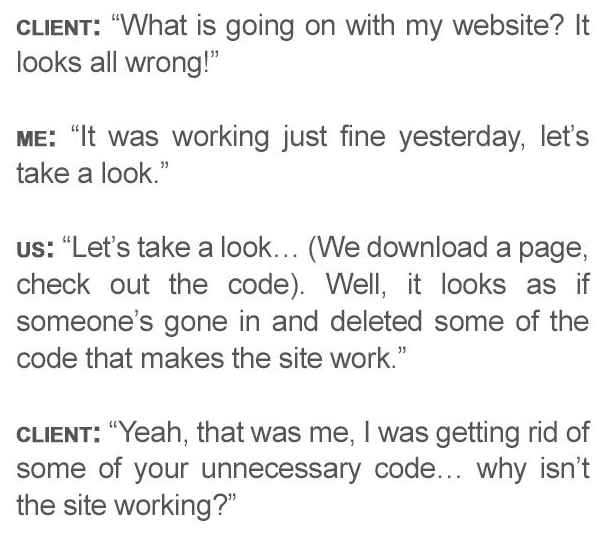
I worked for a client where we had successfully delivered a working FOH site and booking/order system. A new head of marketing joined, and from the first meeting this guy proclaimed himself as a “tech lead” and evangelist. He wanted “full FTP access” within the first 5 minutes of our meeting. We told him we didn’t use FTP as everything was deployed via our CI pipeline, and he kicked off.
After some crisis meetings, he said he wanted to change the entire CMS to be HTML boxes, threatening to ditch us if we didn’t give him what we wanted. They were paying lots for this change, so in the end we obliged. He proceeded to delete basically everything we’d built, and tried to replicate all functionality using a A/B injection tool and a HTML field. Clients were pissed, because none of it worked, and they lost some serious money from it.
In the end, we rolled back and said “fuck it, full git access, you’re a dev now”, and at midnight he brought the site down because he decided to rewrite some db transaction logic to write data to another store. To him, transactions were “outdated tech”, and he tried to clean it up by just performing destructive changes on their own…
In the end, they ditched us, and we were glad to be gone (they bought out their own contract). Sadly, he got his way, changed his title to “lead tech director”, hired a team, and their site went from fairly slick to looking like something from Geocities. That company no longer exists, and sadly, I can’t remember his name so I can’t see where he failed upwards to.
stuff like this makes me so pissed that it’s so difficult to get into leadership positions for most people, those with connections and money are free to fail upwards and ruin things, but the average joe can be the genius of our age and be stuck working at starbucks for minimum wage their entire life…
It’s also frustrating that a lot of baffling corporate decisions aren’t even excusable as being for profit, it’s just some executive being a moron and no one stops them! If it was for profit i could at least feel nihilistic about it, but this is just corporations actively choosing to continue letting things happen that benefit no-one.
I always think about stuff like this whenever libertarians talk about how much more efficient corporations are than government. I’m like, “Have you ever worked for a corporation?” Organizations are just huge dumpster fires in general, because they’re all run by humans.
Reality is a team sport, to some people. All they know is loyalty to hierarchy. If you’re below them and disagree, not only are you wrong, you are personally threatening them. Reasons do not exist.
deleted by creator
What’s funny is that this wasn’t a small company either. I won’t name it because it’ll be very easy to find this person, but they landed a leadership position with very little experience - think a few years working as a dev, and maybe one as a manager.
In my eight years working in consultancy, I’ve seen plenty of examples of this. I could write a book on some of the mental shit I’ve seen, from workplace wellness app owners trying to bully me online for having a single bug in their app, to finding several GB of fake Katy Perry nudes stored in a production database for a major company. Tech is totally fucked.
My hourly rate for tutoring is actually about 50% higher than my hourly rate for on call support which is about 100% higher than my hourly rate for work.
I’m trying to afford groceries here, It’s not 90 days payable It’s pay-per-play. I’m tired of trying to finance an inhaler while the boss’s favorite child can’t decide on a font color and thinks that 5 minute phone calls at 7:30 on a friday are free.
Those prices sound 30% too low at the minimum. You definitely deserve more.
in fact proper market economy dictates that you should charge precisely as much as you can possibly get away with, OP is effectively doing charity for rich people.
I have a friend who is graphic designer for a small shop. Customers drop off work at the front desk, and depending on how much effort it works out to be, it can land on his desk.
Some customers insist on explaining to “the designer directly”. They get told/warned that it’s more expensive (hourly) and that the clock starts as soon as he walks up to the counter. And some customers agree to these terms.
It’s always entertaining to hear his stories.
Not quite this, but I did have a validation team that didn’t know when to quit.
The project was a Windows service, and they would be constantly opening bugs saying “program crashes when we deleted xxxxx.dll”
Like… Yeah. If you delete necessary libraries from the installation directory, the program won’t run correctly.
That should be elementary computer literacy: if you don’t know what the file does, then don’t delete it.
But that’s how you learn!
Nowadays it’s less of an issue with docker and whatnot.
Just set the image to refresh every night at midnight and if they tried to make manual changes it’ll just revert back to its original state at midnight.
Customers don’t really get direct access to deployed code now, it’s buried under like 4 layers of abstraction on most CDNs now.
Simply deploying to azure already smears multiple layers of access control and RBAC overtop that it’s hard enough for me, the dev, to answer the question if “what is actually deployed atm?”, let alone for the customer to get in their and meddle.
My dumb arse used to do this to win 98/me when I was a student. “Optimising” everything and deleting anything I would never use, trying to squeeze every mb out of my limited 2gb disk space but the damn thing was so unreliable I was constantly reinstalling windows.
After one reload, I finished late at night and just left it alone, forgetting to perform all my “power user customisation” until I remembered a week later when it suddenly dawned on me that it was running fast AND stable - I hadn’t had a single crash that week. As a final test, I applied all my “optimisations” again and “oh, look! It’s crashing constantly again”. I was a slow learner and turns out I don’t know better than the people that built the system!
I always think of this when I see threads about win7 - 11 being unstable, because it just isn’t. As you dig through the thread, the op reveals more - they’ve chopped out all sorts of system components with registry hacks and third party tools or blocked updates and then bitch about windows being garbage - don’t get me wrong, they simultaneously make it better and worse with every release so I sympathize why people try chopping out edge, copilot etc - but just don’t.
Disabling services and uninstalling functions the non-hacky way ‘should’ be fine (and likely reversable) but if someone wants to bare-bone their OS or be data gathering-free, they’d be better off learning Linux.
the biggest causes of bsods and other crashes on windows up to xp were drivers. after xp, Microsoft required drivers for windows to go through their signing and verification program, which was controversial but it did solve the problem
modern windows rarely crashes outright but in my experience it does break in small ways over time, without the user doing anything
in terms of disabling windows components, it’s true that this can break your system, but I would argue this is still Microsoft’s problem. there are many windows competents that are deeply coupled together when they have no reason to be
That’s right! I remember those signed drivers where also why early XP (pre SP2) had a bad rep. Not as bad as ME but users were swearing on the graves of dead relatives they would never give up W98 or W2k. Without new or signed drivers, a lot of hardware struggled but by the time SP2 rolled out, hardware vendors had mostly caught up and the OS had matured.
Vista had similar issues (so, so many issues with Vista) with it’s security changes which made life difficult for badly written/insecure software (wanting admin rights to run or write access to system folders/reg keys). Those changes in Vista paved the way for Win7 to be so much better at launch since most software had caught up by then.
I think the issue with disabling components is 90% how users remove them. Pulling them out via “official” methods hasn’t ever caused me issues - DISM is really handy - particularly for permanently removing the default apps. Those deeply connected functions can be a pain!
If you want barebones Windows I’d suggest you cough cough obtain Windows 10 LTSC.
It’s got most the bloatware cut out, you just have to reenable the old style picture viewer.
Though when I eventually make a new PC, I’m probably just gonna use Linux Mint because I hear running Windows games/software isn’t nearly as bad nowadays, thanks Steam.
Windows 11 is pretty unreliable on my 3 machines. I don’t see many blue screens but the Start menu, Explorer, Task Manager, search and other basic bits frequently become unresponsive. I haven’t changed or removed anything. My Linux machines don’t do this. I think Windows 11 just isn’t that stable.
deleted by creator
I’m not sure about this one - it’s definately not my experience but yours could be very different.
The system definitely reports data back to MS but I’ve never seen a box have issues because we denied it the ability to dial home or update. Unless the PC is online and the user is actively trying to prevent the updates installing? I’ve seen users pull the plug on a PC that started/midway though updates hoping to stop them and it would often make a mess of things.
We had a small handful of XP then Win7 boxes that were completely off the grid/standalone as SCADA access points/controllers? for several years without issues.
Likewise, we had one box where the vendor did not allow any updates despite it being networked and online. They had disabled win updates completely without our input. It ran just fine for a few years until it was picked up in a security audit. We didn’t understand why updates were disabled at that time so we switched them back on and updated. The PC ran just fine until it’s eventual retirement.
deleted by creator
I don’t know why I thought about that but for younger people, Windows ME was Windows Millenium Edition.
“Oh I fixed your code because you did it wrong”
Later:
“Hey the application no longer compiles, I re-wrote a huge chunk of your code and now I don’t know whats wrong”
“Here are my emergency ‘I broke production’ rates, the bill will be in the mail.”
Code? No.
Physical equipment? YesCustomer wasn’t happy when we billed them list price for a Cisco switch their MSP tossed out.
We looked after a cafe who had a couple of PC’s to use that gave internet access. Yes this was a while ago, way before smartphones and wifi. The PC’s had some software that allowed internet access for a set duration based on how long they had purchased. This software was managed by an NT4 Server backend.
The owner called one day to say nothing works. When I got there, NT4 has been wiped and replaced with Windows 98. Apparently one of the university student baristas was asked to help when they had an issue. The owner was trying to save money from calling us out. Fixing this mess was way pricier than whatever was wrong previously!This is why we do nightly automatic backups on all sites. Whatever happens we can just restore to the previous night and you never lose more than a day of work. Backup plans and redundancy is a waste of money to management, accounting, and customers until they need it.
To my marketing industry colleagues, I’m so sorry you have to live like this. Join us in product development and rid yourself of the scourge that is clients.
deleted by creator
deleted by creator
KISS and YAGNI in a nutshell.