If while acting in your own self-interest you knowingly, through action or inaction, allow others to come to harm, even indirectly, that is evil. In the same way that a character knowingly doing something that benefits others would arguably make them good. A chaotic neutral person may act on a whim or in self-interest the majority of the time, but I doubt they’d let their actions cause actual harm to others.
But trying to pigeonhole human behavior into a rigid matrix of alignments is inherently flawed, people are much more complex than that. Fortunately, DND allows the DM free reign to define that or allow it to be a grey area - in reality, “alignment” will always be fluid.
No, it still requires something the person does or doesn’t do (within reason) to influence or allow the evil act. If you see someone being mugged and you ignore it and keep walking when you have the power to help, even if just calling the police and walking away, then yes, that inaction makes you a bad person, IMO. But if a bad guy starts a war on the other side of the planet, you’re not evil if you don’t enlist and go fight the evil regime.
But like I said, it’s all a grey area, there is no black and white good and evil in reality. It’s rarely as simple as just “this is good, and this is evil” in real life.
By that description, the vast majority of people are evil. Well, both evil and good, since most people at least occasionally do things that aren’t in their self-interest to help others. But primarily evil, thanks to the inaction clause on the evil side and nothing comparable on the good side.
They’re also more evil the more educated they are, since they’re more aware of ways that people are suffering harm that they could potentially abate.
For example, if you are not homeless and you are aware that some people are homeless and a storm is coming, if you don’t help them all find shelter - to the extent of bringing them into your own home even if it means you end up not having a place to sleep - by your definition, you’re evil.
I’m not a fan of that definition, either for D&D or anything else, but if it works for your table, great!
An “evil” act does not make a person evil necessarily. We all do bad shit sometimes. My point was it’s a grey area that can’t be defined with 9 alignments outside of the structure of a game, but knowingly allowing your actions to cause harm to others is an evil act.
That being said, the idea of good and evil is entirely the result of fiction. I don’t believe there’s a black and white “good and evil” in reality. Human actions and motivations can’t be defined so broadly IMO.
No. Neutral only cares about the cosmic or universal good. The welfare of others or ones self doesn’t factor into it. Many druids are Neutral because the balance of nature (the natural order) is the motivation behind their actions.
I prefer to think of good vs evil as altrusim vs egoism. LG is “the laws should protect everyone” and LE is “the laws should protect me”. CG is “everyone should be free to live as they please” and CE is “I should be free to live as I please”. Acting in pure self-interest with no regard for ideals would be CE, or maybe NE depending on how it’s done.
I disagree. Lawful or Chaotic describes ones adherence to rules; either those of society or their own moral code. Chaotic would describe one who does not adhere to any rules or guidelines; nothing is off limits except that which would violate their alignment on the Good-Evil axis. Neutral would mean that one would bend those rules to achieve a particular outcome. Lawful is going to stick to the book; they’re very conservative.
Nope. Neutral would be a tendency to act in the interests of the cosmic or universal order. Neither ones self nor the general welfare of others is given priority.

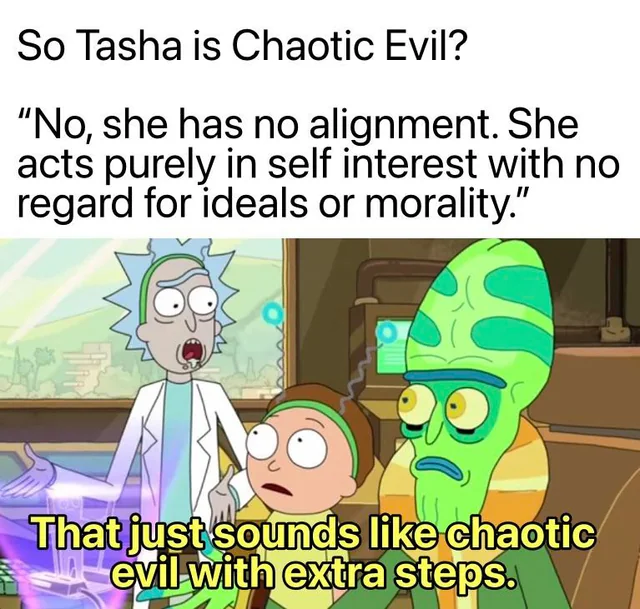
Isn’t acting purely in self interest the general definition of chaotic neutral?
If while acting in your own self-interest you knowingly, through action or inaction, allow others to come to harm, even indirectly, that is evil. In the same way that a character knowingly doing something that benefits others would arguably make them good. A chaotic neutral person may act on a whim or in self-interest the majority of the time, but I doubt they’d let their actions cause actual harm to others.
But trying to pigeonhole human behavior into a rigid matrix of alignments is inherently flawed, people are much more complex than that. Fortunately, DND allows the DM free reign to define that or allow it to be a grey area - in reality, “alignment” will always be fluid.
I think this is a little over-broad. As written, the only way to be good is to stop all evil everywhere. Or am I missing something?
No, it still requires something the person does or doesn’t do (within reason) to influence or allow the evil act. If you see someone being mugged and you ignore it and keep walking when you have the power to help, even if just calling the police and walking away, then yes, that inaction makes you a bad person, IMO. But if a bad guy starts a war on the other side of the planet, you’re not evil if you don’t enlist and go fight the evil regime.
But like I said, it’s all a grey area, there is no black and white good and evil in reality. It’s rarely as simple as just “this is good, and this is evil” in real life.
I think most Americans buy products made via unethical labor practices, and which damage the environment, harming everyone.
Are you really making the argument that the vast majority of Americans are evil?
As an American, I’m not not making that argument.
Why not? It’s not a moral argument.
With regards to the D&D alignment chart? Sure. I don’t know what kind of weird moral gotcha you’re attempting here but there’s not one to be found.
By that description, the vast majority of people are evil. Well, both evil and good, since most people at least occasionally do things that aren’t in their self-interest to help others. But primarily evil, thanks to the inaction clause on the evil side and nothing comparable on the good side.
They’re also more evil the more educated they are, since they’re more aware of ways that people are suffering harm that they could potentially abate.
For example, if you are not homeless and you are aware that some people are homeless and a storm is coming, if you don’t help them all find shelter - to the extent of bringing them into your own home even if it means you end up not having a place to sleep - by your definition, you’re evil.
I’m not a fan of that definition, either for D&D or anything else, but if it works for your table, great!
An “evil” act does not make a person evil necessarily. We all do bad shit sometimes. My point was it’s a grey area that can’t be defined with 9 alignments outside of the structure of a game, but knowingly allowing your actions to cause harm to others is an evil act.
That being said, the idea of good and evil is entirely the result of fiction. I don’t believe there’s a black and white “good and evil” in reality. Human actions and motivations can’t be defined so broadly IMO.
No. Neutral only cares about the cosmic or universal good. The welfare of others or ones self doesn’t factor into it. Many druids are Neutral because the balance of nature (the natural order) is the motivation behind their actions.
Neutral druids don’t care about the welfare of others? Not even the other druids in their circle?
If given a choice between upsetting the balance and saving a druid they’ll maintain the balance. Healing a wound or something isn’t moral decision.
I prefer to think of good vs evil as altrusim vs egoism. LG is “the laws should protect everyone” and LE is “the laws should protect me”. CG is “everyone should be free to live as they please” and CE is “I should be free to live as I please”. Acting in pure self-interest with no regard for ideals would be CE, or maybe NE depending on how it’s done.
I like your take, you said it better than I did.
I disagree. Lawful or Chaotic describes ones adherence to rules; either those of society or their own moral code. Chaotic would describe one who does not adhere to any rules or guidelines; nothing is off limits except that which would violate their alignment on the Good-Evil axis. Neutral would mean that one would bend those rules to achieve a particular outcome. Lawful is going to stick to the book; they’re very conservative.
Nope. Neutral would be a tendency to act in the interests of the cosmic or universal order. Neither ones self nor the general welfare of others is given priority.