
Ok. This covers every ipv6 and ipv4 address.
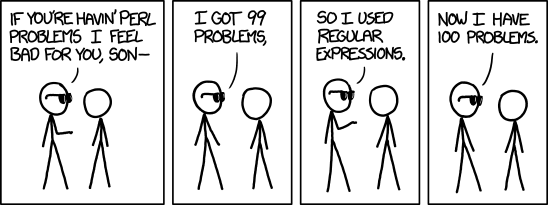
“^\s*((([0-9A-Fa-f]1,4}:){7}([0-9A-Fa-f]{1,4}:)6}(:[0-9A-Fa-f]{1,4})|:))|(([0-9A-Fa-f]1,4}:){5}(((:[0-9A-Fa-f]{1,4}){1,2}))|:))|(([0-9A-Fa-f]1,4}:){4}(((:[0-9A-Fa-f]{1,4}){1,3}))?:((25[0-5]|2[0-4][0-9]|1[0-9][0-9]|[1-9]?[0-9])(.(25[0-5]|2[0-4][0-9]|1[0-9][0-9]|[1-9]?[0-9]))3})):)3}(((:[0-9A-Fa-f]{1,4}){1,4}))0,2}:((25[0-5]))|:))|(([0-9A-Fa-f]1,4}:){2}(((:[0-9A-Fa-f]{1,4}){1,5}))0,3}:((25[0-5]))|:))|(([0-9A-Fa-f]1,4}:){1}(((:[0-9A-Fa-f]{1,4}){1,6}))0,4}:((25[0-5]))|:))|(:(((:[0-9A-Fa-f]1,4}){1,7}))0,5}:((25[0-5]))|:)))(%.+)?\s*$”
deleted by creator
IPv6 was a mistake. We should have just added an addition octet
Oh yeah, great, let’s change the fundamental protocol on which all the networks in the world are based. Now two third of the devices in the world crashed because you tried to ping 192.168.0.0.1
that WOULD be quite funny for the first second or 2…
They played us for absolute fools!
IPv
heared of ipv5?
Plus the MAC address
deleted by creator
Holy hell yeah you did. How would you go about doing that in a single expression? A bunch of back references to figure out the country? What if that’s not included? Oy.
deleted by creator
The only valid regex is
(.+). Maybe add a separate country field (especially because some Americans wholeheartedly believe that the entire world should understand that “foobar, TX” means “foobar, Texas, United States”) (don’t get me started on states whose abbreviations are also ISO country codes).Unfortunately I guess business people only care about getting fewer support calls for missing shipping details, not correctness or a couple of calls from customers who live in the boonies. Then the proper answer is a form with a bunch of fields… which Americans will inevitably fuck up by making the “State” field mandatory despite most countries not having an equivalent.
What I’d really do is use one of those services that automatically fill on the address using google maps or whatever. Not perfect, probably not free, but a whole lot less work for presumably way fewer PEBCAKs from customers.
It’s always a treat to debug a regex of that size.
I knew there would be someone with the regex.
You’re more of a perl programmer than network engineer :P
.*
Technically, this one also matches everything:
*exits the room*
0.0.0.0/0 0::0/0
You didn’t specify it couldn’t be in CIDR block notation…
::/0
Remember, when we abbreviate an ipv6 address all leading zeros are reduced to a single 0.
E.g
0003 would just become 03
When there are geoups of 4 zeros these can be represented as a single 0 or as a double colon ::
But we can only use the :: once so when summarizing an address containing multiple groups of 4 0s one after the other they can all be abbreviated to a single ::
Eg
fe80:0000:0000:0000:0210:5aff:feaa:20a2 would become fe80::210:5aff:feaa:20a2
Therefore it is perfectly valid to abbreviate an address of 0000:0000:0000:0000:0000:0000:0000:0000 /0 to just ::/0
Eh, I’ve seen some software internally prefer 0::0 instead of just ::0 or :: . Notation wise though you are correct, it is unnecessary.
0.0.0.0 /0 ::/0
SUCK MY DICK, GRU!
Haha spot on
deleted by creator
Its CIDR notation. So /0 means the subnet mask has no on bits and would read as 0.0.0 0 if you had a /1 that turns 1 bit on in the subnet mask, so it would be 128.0.0.0.
If i had a /24 which is the subnet mask used for most small networks like your home router. There would be 255 minus 2 addresses available for clients (phones, pcs etc) so the subnet mask would have 24 on bits and read 255.255.255.0, which you may be familiar with.
(Assuming you dont know much, not to insult you, you might know plenty), but when writing any kind of instructions or guides, i was always told to assume the reader knows absolutely nothing and miss nothing out.
This is the way.
:00-:ffEdit: Just learnt this can be also noted as:
::-::fWhat about IPv4
0.0.0.0/0
Better hope the goon hasn’t heard of IPv6 either, or you’re toast
::/0
Undefined
0.0.0.0/0
::/0
Winrar
Chicken dinrar?
0.0.0.0/0
one of them has a 7 I’m pretty sure
/32
That’s only 1 ip (single host)
1 and 0. Some assembly required.
32 or 128 of them, depending on protocol.
0.0.0.0/0I’ll start.
0.0.0.1: Sophie
Your turn.
0.0.0.2 is Bob
0.0.0.3 is Clarence
0.0.0.4 is Darryl
127.0.0.1 is you
127.0.0.1
Heh, you just doxxed yourself
Name every protocol