
Yet another win for Systemd.
Soon we’ll be debating whether we call it systemd/linux or gnu/systemd.
Red Hat: “we put the D in your System”
I’m happy that this is coming to linux (I believe Nutanix has a great method to expose storage over IPs), but I would have liked if this was a bit more project/dependence agnostic.
Yay, yet another storage protocol over the network.
Not a storage protocol over the network, but yes :P
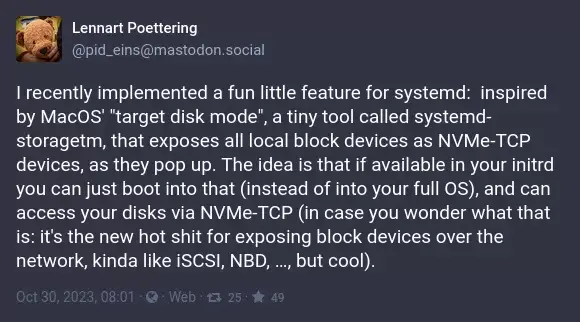
“ via NVMe-TCP (in case you wonder what that is: it’s the new hot shit for exposing block devices over the network, kinda like iSCSI…”
So….?
The protocol already existed. This made it convenient to boot from it
So NVMe-TCP is yet another storage over network standard…. Regardless of making it work like this.
I guess if you had your way we’d still be doing token ring over twin-ax. Whatever
I see no flaw in this logic
Link to the post (for accessibility and follow-up in the thread): https://mastodon.social/@pid_eins/111324093735348164
Pull request: https://github.com/systemd/systemd/pull/29748
This seems like a win for almost all distros
Can someone eli5 pls?
How do you think file systems would be handled? Apple’s SCSI/FireWire/USB/Thunderbolt Target Disk Mode just made all disks available over the interface in a filesystem-agnostic manner. Would I be able to see my ext4 boot partition, ZFS arrays, and any attached volumes?
As with Apple’s implementation, filesystems aren’t handled - whatever device you connected with would see block devices, essentially no different from a physical disk in your system.
Is this like booting over pxe? Is nvme tcp widely supported on motherboards?
No, this has nothing to do with your motherboard. Once you reach the boot menu you’ll be able to pick your OS and alternatively
systemd-storagetm. If you chose the the latter then your disks will be available to other machines over NVME-TCP. Just like Apple.The problem of keeping comparing and doing analogies with apple shit stuff is that many of us have no idea what tech of magic apple does, so saying things like “just like apple” is a completely useless phrase that gives zero info whatsoever about anything.
So I could mount and chroot over TCP to fix problems? Looks a little more complicated at this point than fstabbing an iscsi target, but I imagine that’ll improve. https://access.redhat.com/documentation/en-us/red_hat_enterprise_linux/9/html/managing_storage_devices/configuring-nvme-over-fabrics-using-nvme-tcp_managing-storage-devices
Sweet.
The PR aims to make it easy and simple.
So like, grubd boot menu? And from there I can boot over a location on my nas for example? I set up ipxe a couple weeks ago but it couldn’t load over my thunderbolt to 10g nic. Would this help?
So this is a service aimed at exposing disks as nvme-tcp boot targets on boot of the system? I mean I love it, I wonder if this could be used to help with a chicken and egg problem I’ve had with building clustered systems easier. So far I either need a running service to host a network file system (like NFS or CEPH), or I need local disks that bootstrap the clustered storage environment.
Not compelling to me. Gonna stick with runit and/or s6 on my Artix Linux systems at home. But you do you Lennart.
Same for me, but dinit