Hey everyone!
I was just wondering why one would use any of the programs I mentioned above instead of VS Code to write Code.
Can someone give me a brief overview of the advantages?
Thanks in advance!
If you frequently work on remote systems you frequently only get command line access, where you can still use vim/nano/emacs but not a full IDE like VS Code. In that case you might find it more convenient to learn one text editor well and forgo the IDE.
From the perspective of someone who uses Visual Studio Code, but also knows how to exit
vim, there are a couple reasons that most developers who prefer one of the three, at least those I’ve spoken to.- VS Code is a Microsoft product, and while “open source” it isn’t really open source. The core utility is but Microsoft ships the final application with some proprietary features. If this is your main gripe, then you can try VSCodium instead, which is a “fork” that doesn’t have the Microsoft additions.
- VS Code uses Electron, which is essentially browser emulation and isn’t exactly optimized. CLI editors like the above take up far fewer resources than a Visual Studio Code instance would. Unlike point (1), I don’t think there’s really a way around this in all practicality. It’s just an unavoidable fact. You can chose to still use VS Code of course, most personal computers can easily handle the load. But many see that as unnecessary when they get the same amount of “power” from a CLI editor.
- Plugins for the CLI applications are very powerful, and the ability to navigate using only the keyboard is by design. Many swear by keyboard-only operation of a computer because it’s faster and promotes more optimal methods of doing tasks. It forces discovery of new features and hotkeys by making things annoying to do otherwise. VS Code (and most editors) include a “
vimkeybindings” specifically for this reason. You’ll find that it’s a very popular method of working.
Really it comes down to personal preferences and what you “grew up” using. It’s really hard to transition into something like
vimand it takes a concerted effort to switch by most users. You have to want to switch, otherwise you’ll find it too difficult a learning curve or find yourself wandering back to more “featured” applications.There are likely more reasons out there, but these are, in my experience, the primary reasons.
I like VS Code, but it regularly takes up 3-5 gb of ram on my systems to edit 2-3 text files.
I use Textadept over any of the named ones, including VS Code. (I use the vi subset of Vim for remote access to machines I haven’t yet installed Textadept on.)
Why?
I have a moral objection to … Well let me show you:
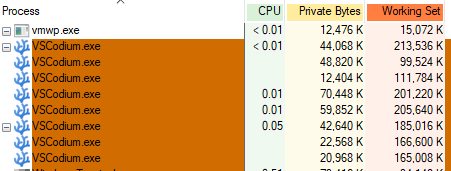

One of those is VSCode (well, VSCodium, which is VSCode without Microsoft’s spyware installed), and the other is Textadept. One of those is occupying almost 30MB of memory to do nothing. The other is occupying about 1.5-2GB of memory … to do nothing. In both cases there are no files open and no compilers being run, etc. I find this kind of intense wastefulness a sign of garbage software and I try not to use garbage software. (Unfortunately I’m required to use garbage Windows 10 at work. 😒)
Oh, and Textadapt has both a GUI version (and not the shit GUI that Emacs provides in its GUI version!) and a console version, allowing me to quickly get it running even on remote machines I have to use. VSCode/Codium … not so much. I’d have to run it with remote X and … that is painful when doing long-distance stuff.
I mean it’s not doing nothing. It’s an entire js engine running right?
Personally not a fan but being portable to the browser is certainly an advantage in some cases.
Doing nothing from the problem domain. I mean I could make a “hello world” program that occupies 16TB of RAM because it does weird crap before printing the message.
The problem domain is text editing. An idle text editor (not even displaying text!) is “doing nothing”. The fact it was programmed by someone to occupy multiple GB of space to do that nothing is bad programming.
I guess you could argue it doesn’t really matter nowadays tbh.
Sloppiness is rarely contained in one narrow area. If programmers are so sloppy they’re using up 1.5-2GB to do literally nothing, then they’re sloppy in how they do pretty much everything.
My very first computer had all my friends exceedingly jealous. I had 208KB of RAM see. (No, that’s not a typo. KB.) I could run four simultaneous users, each user having 48KB of RAM with a staggering 16KB available for the operating system. I had available spreadsheet and word processing applications, as well as, naturally, development applications. (I also had a secret weapon that drove my friends crazy: while they were swapping around their floppy disks holding 160KB of data each, I had two of those … and I had a 5MB hard disk!
I compare those days to now and I have to laugh. My current computer (which is considered pretty weak by modern standards since I don’t game so I don’t give a fuck about GPUs and ten billion cores and clock rates in the Petahertz range) is almost four orders of magnitude faster than that first computer at the CPU level. I have six orders of magnitude more disk space and the disks are at least 3 orders of magnitude faster (possibly more: I don’t have the stats for the old drive on hand.) I have five orders of magnitude more memory and it, again, is probably 3 orders of magnitude or more faster.
Yet …
I don’t feel anywhere from 3 to 6 orders of magnitude more productive. Indeed I’d be surprised if I went about an order of magnitude better in terms of productivity with this (barely) modern machine than I had with my first machine. Things look prettier (by far!) I’ll admit that, but in terms of actually getting anything done, these thousands, to millions of times more resources are basically 100% wasted. And they’re wasted precisely because every time we increase our ability to do something in a computer by a factor of 10, sloppy- and lazy-assed programmers increase the resources they use to get things done by a factor of 11.
And it shows.
That old computer? Slow as it was, it booted from nothing to full, multi-user functionality in 10 seconds. 10 seconds after turning the power on, I could have up to four users running their software (or in my case one user with four screens) without a care in the world. Loading the word processor or spreadsheet was practically instantaneous. One, maybe two seconds. It didn’t register as a wait. I just timed loading LibreOffice Writer on this modern system that runs four orders of magnitude faster. Six seconds, give or take. Which not even a slow-loading program! (Web browsers take significantly longer….)
And you know what problem I never once faced on that old computer running under a ten-thousandth (!) the speed? Typing faster than the system could keep up while displaying text. Yet as I type this I’m consistently typing one or two characters faster than the web browser can update plain text in a box. More than a ten thousand times faster!
So yes, yes it matters. When a system made likely before you were even born is running circles around a modern system in key pieces of functionality (albeit looking far, far, far prettier while doing it!), there’s something that’s going horribly wrong in software. And shit like VS Code is almost the Platonic Form of what’s wrong with software today: bloated, slow, and so overpacked with features it has no elegance in functionality or implementation.
But hey, if you want to waste 2GB of RAM to load a 12KB text file, more power to you! I’ll stick with a system that only wastes 30MB of RAM to do the same, and runs faster, and looks cleaner, and is easier to extend. (And since its total code, including the C code and the Lua extensions, is something you can peruse and understand out of the box in a weekend, it’s also less buggy than VS Code: that’s the other cost of bloat, after all. Bugs.)
Back in my day we had 17 bytes and were damn happy about it!!
For me NVIM has several really cool advantages: NVIM is really fast. With a good terminal emulator I can open enormous log files and be able to navigate around/search immediately. I have recently pivoted to DevOps, and using VSCode to interact with large log files made me realize how slow and sluggish it actually is.
Motions and modal editing. Plenty of people have already said how fast it is, I will just add that it is also very fun and, if you dig around a bit, not that hard to learn.
Configuration using Lua - I like it because my configs are simple git repos, so the file structure and the logic of configuration is easy for me to work with. I always thought VSCode to be quite awkward to configure. Also, using Lua instead of JSON makes it incredibly flexible, and as a tinkerer I find a lot of joy in customizing things.
NVIM (or VIM) is ubiquitous. You can expect it everywhere, and every other IDE has VIM-like bindings. Learn VIM = be comfortable anywhere.
A personal perk for me personally is that NVIM is designed to be used without a mouse. Mice give me wrist pain, and switching to NVIM made my work a lot more bearable.
If you’re thinking about trying it out, I would recommend going for a community-maintained distributions like AstroNvim or ChadNvim. It’s also quite cool to go back to your preferred editor, knowing your preferences are now more refined after trying alternatives.
Anyway, good luck
Editing in Vim is so much faster. If you know emacs I’m sure it’s similar. Mice are good. Keyboards are good. Constantly switching between the two is terrible.
If you actually understand the programming language, libraries, problem, and think about your solution first, you can code just fine in ed, the standard text editor. Sometimes I do, I’m the third real programmer
In practice, I mostly code in Vim, which launches instantly, is completely customizable, and I can type and edit faster than in anything else. IDEs are excruciatingly slow, with all the highlighting and analysis stuff on, waiting for code completion instead of just typing it out because you know things.
You don’t need any of that.
There’s also the issue that VSCode is spyware created by Microsoft, and both things should send you running away.
There is always VSCodium for the second issue.
I’m not a pro, or especially familiar myself, but I know that because Vim is command-based, people like that they can accomplish significant edits with it using only a couple keep strokes. It’s like learning another language but if you take the time, I’m told, to do so, then you reap substantial efficiency rewards which make other text editors feel limited by comparison.
One thing I haven’t heard others mention is fun. The better I get with vim, the more fun I have applying my skills to work efficiently.
I also love that I can use it with a phone keyboard and still remain highly efficient. Being able to SSH into my server on the go and not be terribly hampered in my admin and editing is pretty amazing.
Ubiquitous, powerful, flexible, lightweight, fun: it’s a pretty good mix of positives in the tradeoff for vim.
I was a hardcore emacs user for 9 or so years, then moved on to Jetbrains’ editors, even paying for them, now I’m trying to move into neovim and loving it (only for non-work stuff for now).
Jetbrains editors have been great for me, stable and feature rich, specially in terms of debugging. The only problem I have is that they are quite the consumers of resources and power.
I used vscode for a while and what I found is that even though it consumes fewer resources than Jetbrains it also has way fewer features and fails more often. You can’t do much customization or error handling besides setting some obscure json variable and good luck.
Now with neovim (and emacs) you can customize it endlessly (which is something I want) and have almost no resources used. The “drawback” is that you need more plugins working in conjunction to get the same features you’d get in the previous editors. Now, beware that things will fail sometimes for sure but you’re in a position that can fully try to fix them, but will take time.
I learned Vim something around 25 years ago. I love Vim, but if I have VSCode available, I’m gonna use it (with Vim emulation, of course).
The emulation is missing stuff but is nice for getting your toes wet. You can run fully-fledged neovim in vscode too!
Lapce is an interesting alternative to vs code too: https://lapce.dev/
For me, vim is nice to use because it’s ubiquitous across any system I log into. Any server will have vi at the least. It’s also light and can load a file instantly on any hardware, reducing dependency to zero. Once you have a comfortable config, you’re done for the rest of your life. Although, in reality vim config is a lifestyle and not a choice ;)
I don’t configure Vim :)
For me personally it’s probably mostly just momentum or habit at this point. I got into Linux on the late 90s or early 00s. Vim was the best option at the time so I figured it out mostly out of necessity. Now I’m just so comfortable with it and I’ve tweaked it to high hell it’s like a perfectly broken in pair of shoes… Everything fits me just right. I don’t see any real benefit to switching to vs code. I’ve tried it but didn’t like it. Things like filesystem navigation were so clunky and slow compared to what I was used to.
Whatever… No judgement. There are obviously great developers out there using vs code. This just works for me.
Because I know how to use vim, and haven’t really tried vscode. I doubt there are any real advantages of vim other than inertia, and as I understand vscode plugins / extensions could give me vim keybindings if I wanted them. I’ll try it some day.
JetBrains also has a VIM mode as well AFAIK
Even today, it’s often the smallest common denominator in large scale hardened enterprise environments. Absolutely zero chance of getting vscode or anything outside of the bare RHEL/SUSE packages running for mere convenience reasons on the servers. So we are forced to learn vim and bash scripting on the fly whenever the higher level tools ( config management, CI/CD) fail that - in theory - make direct access completely unnecessary. But that’s not a good reason, it’s more an indication for a badly managed project/environment.
And no, I’m not an oldie, so I grew up with IDEs being ubiquitous and versatile.
Advantages of being forced on bare vim/emacs are slim. It’s cumbersome, it’s hard to teach newcomers, syntax highlighting rarely works, etc. Overall efficiency and productivity is very low in environments where people are forced to use them. But yes, as is true with any other tool, the wizards of old can cast amazing shortcut spells and be highly productive. But it’s very tedious and time consuming to learn, and there’s little point in wasting time on it when modern tools are much more accessible and equally flexible.
People have a weird obsession with typing speed it seems haha
When I’m coding I tend to do more thinking than typing so I don’t see the benefit. Being able to reason about code is much easier with syntax highlighting and go to definition etc.
Vi is the default for Linux and you’re essentially forced to learn it as it may be the only editor on a server you’re working on. Then it feels like Stockholm syndrome.