I love such formatters and wish they were even more widespread. In many cases, I really want consistency above all and it’s so dang hard to achieve that without an opinionated formatter. If the formatters isn’t opinionated enough, it just leads to countless human enforced rules that waste time (and lead to an understandable chorus of “why can’t the formatter just do that for meeeee”).
Not any standard (and actually not at all something to do for real), but try it, it works
def magic(a, b, c):
if a > 0:
if b > 0:
if c > 0:
return 'All positive'
return 'Not all positive'print(magic(1,2,3))
print(magic(-1,1,2))
print(magic(1,-1,0))
print(magic(-1,-1,-2))
(you should be able to verify I used both tab and spaces f*cking bad way in this example, like I described)
Output:
All positive
Not all positive
Not all positive
Not all positive
** Process exited - Return Code: 0 **
Press Enter to exit terminal
That’s really interesting. So does that mean the interpreter just checks whether the current line is more indented, less indented, or equal vs. the preceding, without caring by how much?


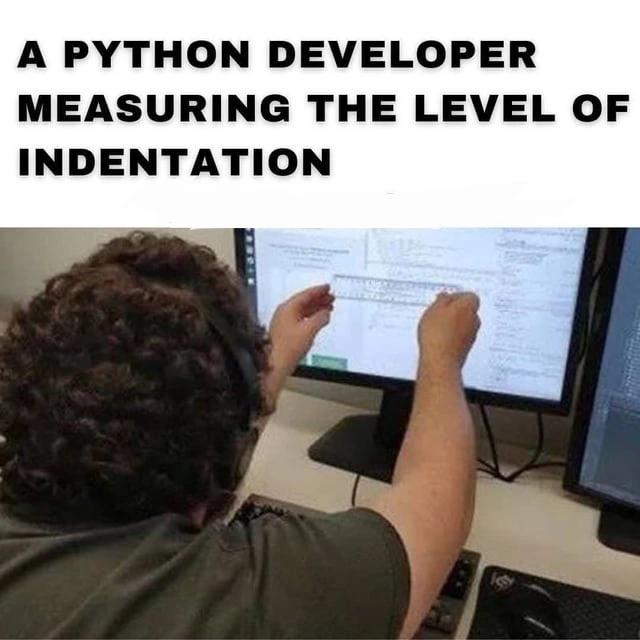
spaces or tabs
Tada, your indentation level is nicely visible.
Tabs. But really with modern IDE it’s irrelevant. Whatever the tech lead says I guess.
With things like black, flake 8 and Isort I can code however I want, list/format however I want, and commit team compliant content. The dream is real
I love such formatters and wish they were even more widespread. In many cases, I really want consistency above all and it’s so dang hard to achieve that without an opinionated formatter. If the formatters isn’t opinionated enough, it just leads to countless human enforced rules that waste time (and lead to an understandable chorus of “why can’t the formatter just do that for meeeee”).
semicolons
Full colons
4 Spaces, then one tab, then 3 spaces, then 2 tabs, then 2 spaces, then 3 tabs…
Python supports that (and I hate this)
Please elaborate (eg which standard is this defined in?)
Not any standard (and actually not at all something to do for real), but try it, it works
def magic(a, b, c):
    if a > 0:
    	if b > 0:
    	   		if c > 0:
    	   		  return 'All positive'

    return 'Not all positive'

print(magic(1,2,3))
print(magic(-1,1,2))
print(magic(1,-1,0))
print(magic(-1,-1,-2))
(you should be able to verify I used both tab and spaces f*cking bad way in this example, like I described)
Output:
All positive Not all positive Not all positive Not all positive ** Process exited - Return Code: 0 ** Press Enter to exit terminalThat’s really interesting. So does that mean the interpreter just checks whether the current line is more indented, less indented, or equal vs. the preceding, without caring by how much?
“indentation is indentation!” (mr_incredible_cereal.jpg)
it may look messy, but would you actually rather Python didn’t support some inconsistency when the intent is clear?
being exact just for the sake of being pedantic isn’t useful.